## Fluid Level Diagram: Rotated Containers
### Overview
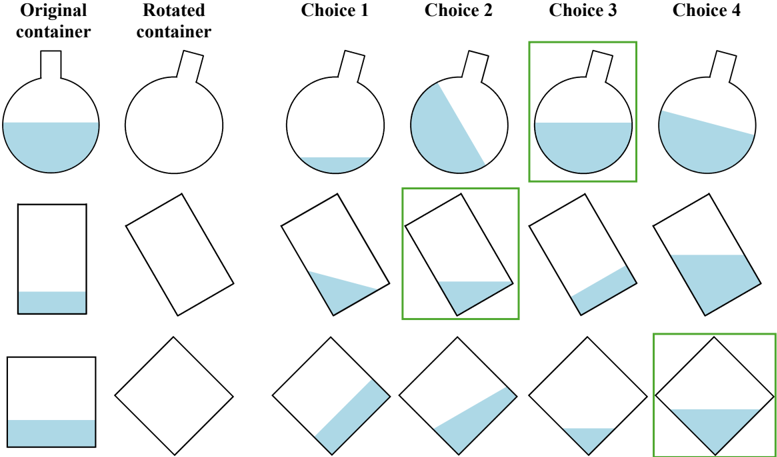
The image presents a diagram illustrating the behavior of fluid levels in containers of different shapes (flask, rectangle, square) when rotated. The diagram compares the original container orientation with a rotated version and four possible choices for the fluid level after rotation. The correct choices are highlighted with green boxes.
### Components/Axes
* **Columns:**
* Original container
* Rotated container
* Choice 1
* Choice 2
* Choice 3
* Choice 4
* **Rows:**
* Flask-shaped container
* Rectangular container
* Square container
* **Containers:** Each cell contains a drawing of a container, either in its original orientation, rotated, or as one of the four choices.
* **Fluid:** The fluid inside the containers is represented by a light blue fill.
* **Green Boxes:** Green boxes highlight the correct choices for the fluid level in the rotated containers.
### Detailed Analysis or ### Content Details
**Row 1: Flask-shaped container**
* **Original container:** Flask with a horizontal fluid level filling approximately the bottom third of the flask.
* **Rotated container:** Empty flask rotated slightly counter-clockwise.
* **Choice 1:** Flask with no fluid.
* **Choice 2:** Flask with fluid level at an angle.
* **Choice 3:** Flask with a horizontal fluid level filling approximately the bottom third of the flask. This choice is highlighted with a green box.
* **Choice 4:** Flask with fluid level at an angle.
**Row 2: Rectangular container**
* **Original container:** Rectangle with a horizontal fluid level filling approximately the bottom fifth of the rectangle.
* **Rotated container:** Empty rectangle rotated counter-clockwise.
* **Choice 1:** Rectangle with fluid level at an angle.
* **Choice 2:** Rectangle with a horizontal fluid level filling approximately the bottom fifth of the rectangle. This choice is highlighted with a green box.
* **Choice 3:** Rectangle with fluid level at an angle.
* **Choice 4:** Rectangle with fluid level at an angle.
**Row 3: Square container**
* **Original container:** Square with a horizontal fluid level filling approximately the bottom fifth of the square.
* **Rotated container:** Empty square rotated 45 degrees.
* **Choice 1:** Square with fluid level at an angle.
* **Choice 2:** Square with fluid level at an angle.
* **Choice 3:** Square with fluid level at an angle.
* **Choice 4:** Square with a horizontal fluid level filling approximately the bottom fifth of the square. This choice is highlighted with a green box.
### Key Observations
* The fluid level remains horizontal regardless of the container's orientation due to gravity.
* The green boxes correctly identify the choices where the fluid level is horizontal in the rotated containers.
* The amount of fluid in each container remains constant across all orientations and choices.
### Interpretation
The diagram demonstrates the principle that fluid levels remain horizontal due to gravity, even when the container is rotated. The correct choices highlight this principle, showing that the fluid adjusts to maintain a horizontal surface. The diagram effectively illustrates this concept using different container shapes, reinforcing the understanding that the shape of the container does not affect the fluid's tendency to level itself horizontally.