\n
## Diagram: Liquid Volume Conservation Test
### Overview
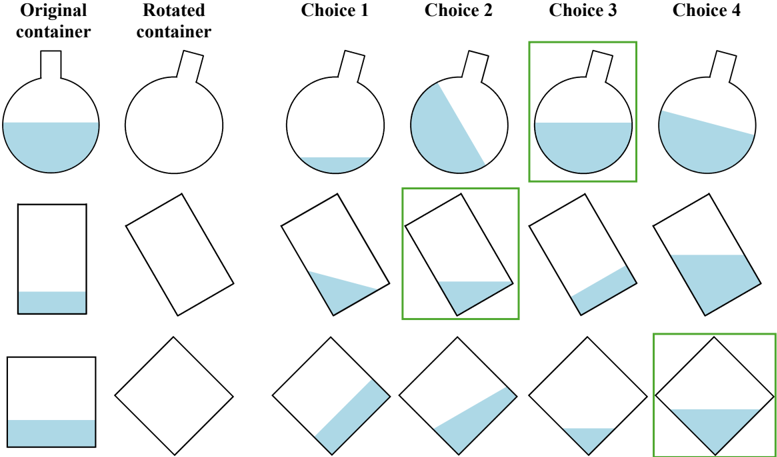
The image presents a visual test designed to assess understanding of liquid volume conservation. It displays a series of containers, initially with a liquid level in the "Original container", then rotated, and then presented with four "Choice" containers. The choices are highlighted with green boxes around the containers that match the original volume.
### Components/Axes
The diagram is organized into columns labeled: "Original container", "Rotated container", "Choice 1", "Choice 2", "Choice 3", and "Choice 4". There are three rows, each depicting a different container shape: a flask, a rectangle, and a diamond. Each container is shown with a liquid level.
### Detailed Analysis or Content Details
The diagram shows three different container shapes, each in three states: original, rotated, and four possible choices.
* **Flask:**
* Original: The flask is upright, with the liquid filling approximately the bottom quarter of the container.
* Rotated: The flask is rotated 90 degrees clockwise, with the liquid level remaining the same relative to the container.
* Choice 1: The flask is upright, with approximately half of the container filled with liquid.
* Choice 2: The flask is upright, with approximately the bottom quarter of the container filled with liquid.
* Choice 3: The flask is rotated 90 degrees clockwise, with approximately half of the container filled with liquid.
* Choice 4: The flask is rotated 90 degrees clockwise, with approximately the bottom quarter of the container filled with liquid. (Highlighted in green)
* **Rectangle:**
* Original: The rectangle is upright, with the liquid filling approximately the bottom sixth of the container.
* Rotated: The rectangle is rotated 45 degrees clockwise, with the liquid level remaining the same relative to the container.
* Choice 1: The rectangle is rotated 45 degrees clockwise, with approximately the bottom third of the container filled with liquid.
* Choice 2: The rectangle is rotated 45 degrees clockwise, with approximately the bottom sixth of the container filled with liquid. (Highlighted in green)
* Choice 3: The rectangle is rotated 45 degrees clockwise, with approximately the bottom third of the container filled with liquid.
* Choice 4: The rectangle is rotated 45 degrees clockwise, with approximately the bottom sixth of the container filled with liquid.
* **Diamond:**
* Original: The diamond is upright, with the liquid filling approximately the bottom sixth of the container.
* Rotated: The diamond is rotated 45 degrees clockwise, with the liquid level remaining the same relative to the container.
* Choice 1: The diamond is rotated 45 degrees clockwise, with approximately the bottom third of the container filled with liquid.
* Choice 2: The diamond is rotated 45 degrees clockwise, with approximately the bottom sixth of the container filled with liquid. (Highlighted in green)
* Choice 3: The diamond is rotated 45 degrees clockwise, with approximately the bottom third of the container filled with liquid.
* Choice 4: The diamond is rotated 45 degrees clockwise, with approximately the bottom sixth of the container filled with liquid.
### Key Observations
The diagram highlights the correct choices (Choice 2 for the rectangle and diamond, and Choice 4 for the flask) with green boxes. These choices represent the containers where the liquid volume remains the same despite the change in orientation. The other choices demonstrate a misunderstanding of volume conservation, where the perceived liquid level changes with the container's orientation.
### Interpretation
This diagram illustrates a classic cognitive development test related to Piaget's theory of cognitive development, specifically the concept of conservation. The test aims to determine whether an individual understands that the amount of liquid remains constant even when its appearance changes due to a change in container shape or orientation. The correct responses (highlighted in green) indicate an understanding of volume conservation, while incorrect responses suggest a focus on perceptual cues (e.g., height of the liquid) rather than the underlying quantity. The diagram demonstrates that children in the preoperational stage often struggle with this concept, as they tend to focus on the visible aspects of the liquid rather than its actual volume. The consistent highlighting of the rotated container with the same volume suggests the test is designed to assess the ability to disregard the shape and focus on the quantity.