## Diagram: Container Rotation and Liquid Distribution Assessment
### Overview
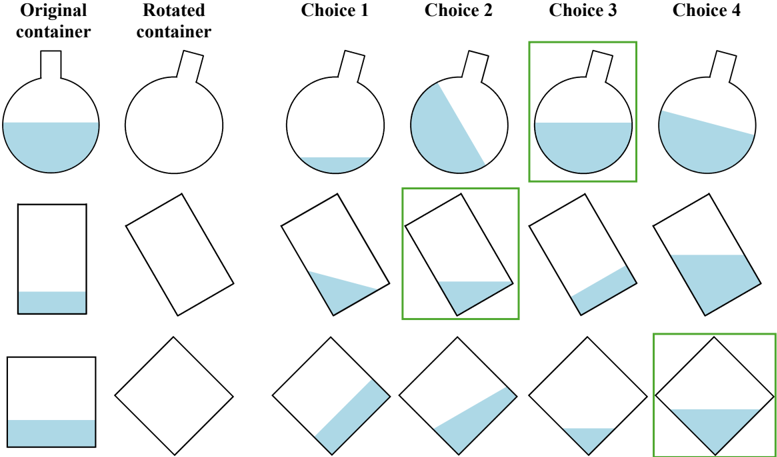
The image presents a comparative analysis of liquid distribution in containers before and after rotation, alongside geometric shape orientation variations. It consists of two primary sections:
1. **Circular containers** (beaker-like) with liquid levels
2. **Geometric shapes** (rectangles and diamonds) with liquid-filled regions
Each section includes:
- Original orientation
- Rotated orientation
- Four comparative choices (Choice 1–4)
Two choices per section are highlighted with green boxes (Choice 3 for containers, Choice 4 for shapes).
---
### Components/Axes
#### Labels and Structure
- **Top Row**:
- "Original container" (circular beaker with half-filled liquid)
- "Rotated container" (empty circular outline)
- "Choice 1"–"Choice 4" (variations in liquid distribution)
- **Middle Row**:
- Rectangular shapes with liquid levels
- Similar structure to the top row but with rectangular geometry
- **Bottom Row**:
- Diamond-shaped figures with liquid levels
- Mirroring the rectangular row’s structure
#### Visual Elements
- **Liquid Representation**:
- Light blue shading indicates liquid-filled regions
- No explicit scale or volume measurements provided
- **Rotation Indicators**:
- Arrows or implied orientation changes (not explicitly labeled)
- **Highlighted Choices**:
- Green boxes emphasize "Choice 3" (containers) and "Choice 4" (shapes)
---
### Detailed Analysis
#### Circular Containers
- **Original**: Half-filled liquid in a circular beaker with a spout.
- **Rotated**: Empty circular outline (no liquid).
- **Choices**:
- **Choice 1**: Minimal liquid at the base.
- **Choice 2**: Diagonal liquid division (50% fill).
- **Choice 3** (highlighted): Uniform half-fill matching the original.
- **Choice 4**: Diagonal liquid division (70% fill).
#### Rectangular Shapes
- **Original**: Small liquid layer at the base.
- **Rotated**: Empty rectangle.
- **Choices**:
- **Choice 1**: Minimal liquid at the base.
- **Choice 2**: Diagonal liquid division (30% fill).
- **Choice 3**: Diagonal liquid division (50% fill).
- **Choice 4** (highlighted): Diagonal liquid division (70% fill).
#### Diamond Shapes
- **Original**: Small liquid layer at the base.
- **Rotated**: Empty diamond.
- **Choices**:
- **Choice 1**: Minimal liquid at the base.
- **Choice 2**: Diagonal liquid division (30% fill).
- **Choice 3**: Diagonal liquid division (50% fill).
- **Choice 4** (highlighted): Diagonal liquid division (70% fill).
---
### Key Observations
1. **Consistency in Highlighted Choices**:
- Containers: Choice 3 replicates the original liquid distribution.
- Shapes: Choice 4 shows the highest liquid fill (70%).
2. **Rotation Impact**:
- Rotated containers/shapes are depicted as empty, suggesting liquid redistribution upon rotation.
3. **Geometric Variation**:
- Rectangles and diamonds show similar liquid distribution patterns despite differing shapes.
---
### Interpretation
The diagram likely assesses understanding of **liquid conservation principles** and **geometric orientation effects**. Key insights:
- **Containers**: The highlighted Choice 3 implies that rotation does not alter liquid volume, only its apparent distribution.
- **Shapes**: The 70% fill in Choice 4 (shapes) suggests a focus on maximizing liquid capacity post-rotation.
- **Educational Purpose**: The exercise may test spatial reasoning or fluid dynamics concepts, emphasizing how container geometry influences liquid behavior during rotation.
No numerical data or explicit legends are present; conclusions rely on visual comparisons and implied relationships.