## Chart: Proportion of Flips over Iterations for SmolLM2-1.7B
### Overview
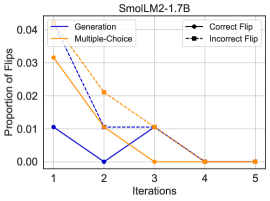
This image displays a 2D line chart titled "SmolLM2-1.7B", illustrating the "Proportion of Flips" on the y-axis against "Iterations" on the x-axis. Four distinct data series are plotted, representing different conditions: "Generation", "Multiple-Choice", "Correct Flip", and "Incorrect Flip". The chart shows how the proportion of flips changes across five iterations for each condition.
### Components/Axes
* **Chart Title**: SmolLM2-1.7B (positioned at the top-center).
* **X-axis**: Labeled "Iterations" (positioned at the bottom-center).
* Scale: Discrete values from 1 to 5, marked at each integer.
* **Y-axis**: Labeled "Proportion of Flips" (positioned on the left-middle, rotated vertically).
* Scale: Continuous numerical values from 0.00 to 0.04, with major grid lines at 0.00, 0.01, 0.02, 0.03, 0.04.
* **Legend**: Located in the top-left quadrant of the plot area.
* **Generation**: Represented by a solid blue line with circular markers.
* **Multiple-Choice**: Represented by a solid orange line with circular markers.
* **Correct Flip**: Represented by a solid black line with square markers.
* **Incorrect Flip**: Represented by a dashed black line with square markers.
### Detailed Analysis
The chart plots four data series, each showing the "Proportion of Flips" at specific "Iterations":
1. **Generation (Blue, solid line, circular markers)**:
* **Trend**: This line starts at a moderate proportion, drops to zero, rises back, and then remains at zero.
* **Data Points**:
* Iteration 1: Approximately 0.010
* Iteration 2: Approximately 0.000
* Iteration 3: Approximately 0.010
* Iteration 4: Approximately 0.000
* Iteration 5: Approximately 0.000
2. **Multiple-Choice (Orange, solid line, circular markers)**:
* **Trend**: This line starts at the highest proportion among all series, then sharply decreases to a lower value, and subsequently drops to zero where it remains.
* **Data Points**:
* Iteration 1: Approximately 0.031
* Iteration 2: Approximately 0.010
* Iteration 3: Approximately 0.000
* Iteration 4: Approximately 0.000
* Iteration 5: Approximately 0.000
3. **Correct Flip (Black, solid line, square markers)**:
* **Trend**: This line begins at Iteration 2, showing a relatively high proportion, then decreases to a lower value, and finally drops to zero where it remains. It is not plotted for Iteration 1.
* **Data Points**:
* Iteration 2: Approximately 0.021
* Iteration 3: Approximately 0.010
* Iteration 4: Approximately 0.000
* Iteration 5: Approximately 0.000
4. **Incorrect Flip (Black, dashed line, square markers)**:
* **Trend**: This line starts at a very high proportion, drops sharply, then plateaus for one iteration before dropping to zero and remaining there.
* **Data Points**:
* Iteration 1: Approximately 0.035
* Iteration 2: Approximately 0.010
* Iteration 3: Approximately 0.010
* Iteration 4: Approximately 0.000
* Iteration 5: Approximately 0.000
### Key Observations
* All four conditions show a general decreasing trend in the "Proportion of Flips" as the "Iterations" increase, eventually reaching zero by Iteration 4 or 5.
* At Iteration 1, "Incorrect Flip" has the highest proportion (~0.035), closely followed by "Multiple-Choice" (~0.031). "Generation" is significantly lower (~0.010), and "Correct Flip" is not plotted.
* By Iteration 2, "Correct Flip" (~0.021) has the highest proportion, while "Multiple-Choice", "Incorrect Flip" are equal (~0.010), and "Generation" drops to zero.
* At Iteration 3, "Generation" and "Correct Flip" both show a proportion of ~0.010, while "Multiple-Choice" drops to zero. "Incorrect Flip" maintains its ~0.010 proportion from Iteration 2.
* From Iteration 4 onwards, all conditions show a "Proportion of Flips" of approximately 0.000.
* The "Generation" line exhibits a unique pattern, dropping to zero at Iteration 2, then rising back to 0.010 at Iteration 3, before returning to zero. This is the only series that shows an increase after an initial drop.
* "Multiple-Choice" and "Incorrect Flip" show the most rapid initial decline in flip proportion.
* "Correct Flip" and "Incorrect Flip" converge at Iteration 3 with a proportion of ~0.010, and then both drop to zero.
### Interpretation
This chart likely illustrates the performance or behavior of the "SmolLM2-1.7B" model across different iterative processes or evaluation modes, specifically concerning "flips," which could refer to changes in predictions, states, or classifications.
The overall trend suggests that as iterations progress, the model or system stabilizes, leading to a reduction in "flips." This could indicate convergence, improved consistency, or a reduction in uncertainty over time.
* **Initial High Flips (Iteration 1)**: The high "Proportion of Flips" for "Incorrect Flip" and "Multiple-Choice" at Iteration 1 suggests that these conditions might represent initial stages where the model is more prone to changing its mind or making errors that are later corrected.
* **Rapid Stabilization**: The sharp decline in "Multiple-Choice" and "Incorrect Flip" proportions from Iteration 1 to Iteration 3 indicates that the system quickly reduces these types of flips. This could imply that the model learns or refines its decisions efficiently under these conditions.
* **"Generation" Anomaly**: The "Generation" condition's dip to zero at Iteration 2 and subsequent rise to 0.010 at Iteration 3 is an interesting anomaly. This might suggest a temporary phase of stability or certainty, followed by a brief period where flips re-emerge before final stabilization. This could be due to a specific learning phase or a change in the generation process that temporarily introduces more "flips."
* **Convergence to Zero**: The fact that all conditions reach a near-zero "Proportion of Flips" by Iteration 4 or 5 is a strong indicator of the system's stability and reliability in the later stages of the iterative process. It implies that after a few iterations, the model's outputs or decisions become consistent and no longer "flip."
* **Distinction between "Correct" and "Incorrect" Flips**: The separate tracking of "Correct Flip" and "Incorrect Flip" is crucial. While both decrease, understanding their individual trajectories helps in diagnosing the nature of the model's changes. The "Incorrect Flip" starting higher and decreasing suggests that initial changes are often erroneous, but these errors are resolved quickly. The "Correct Flip" also decreasing implies that even beneficial changes become less frequent as the model settles on its final state.
In summary, the data demonstrates that the SmolLM2-1.7B model, under various conditions, tends to stabilize its "flip" behavior within a few iterations, with most types of flips diminishing to zero. The "Generation" condition shows a slightly different stabilization pattern, warranting further investigation into its specific process.