## Type System Rules and Axioms
### Overview
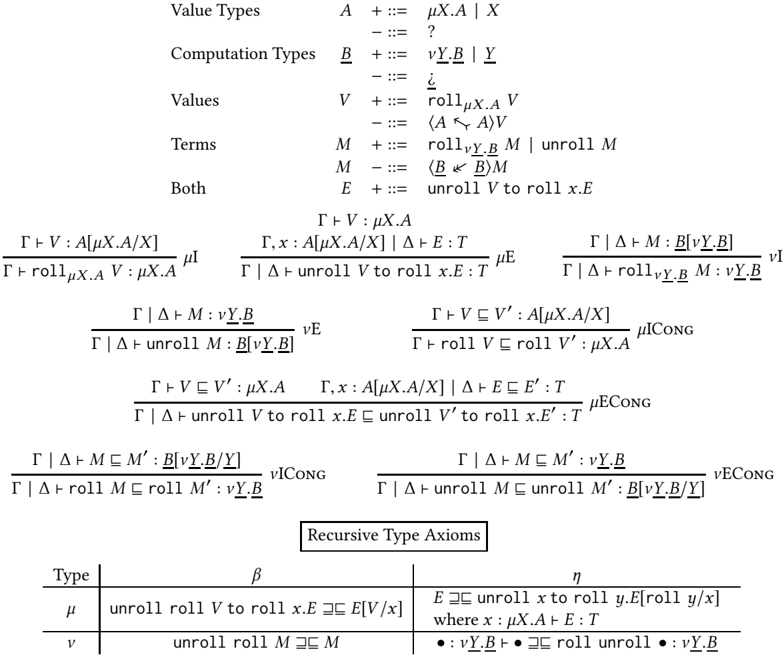
The image presents a set of type system rules and recursive type axioms, likely related to a programming language or formal system. It defines value types, computation types, values, terms, and expressions, along with inference rules for type checking and axioms for recursive types.
### Components/Axes
* **Value Types (A):** Defined recursively as either `μX.A` (a recursive type) or `X` (a type variable).
* **Computation Types (B):** Defined recursively as `vY.B` or `Y`.
* **Values (V):** Constructed using `roll_{μX.A} V` or `<A ≼ A>V`.
* **Terms (M):** Constructed using `roll_{vY.B} M` or `unroll M` or `<B ≼ B>M`.
* **Both (E):** `unroll V to roll x.E`
* **Judgments:** The rules use judgments of the form `Γ ⊢ V : μX.A`, `Γ, x: A[μX.A/X] | Δ ⊢ E : T`, and `Γ | Δ ⊢ M : vY.B`.
* `Γ` and `Δ` are likely type environments or contexts.
* `V`, `M`, and `E` represent values, terms, and expressions, respectively.
* `A`, `B`, and `T` represent types.
* **Inference Rules:** The rules are presented in the standard format:
* Premises above the line.
* Conclusion below the line.
* Rule name on the right.
* **Recursive Type Axioms:** A table defining β and η reduction rules for recursive types.
### Detailed Analysis or ### Content Details
**Type Definitions:**
* `A ::= μX.A | X`: Value types are either recursive types `μX.A` or type variables `X`.
* `B ::= vY.B | Y`: Computation types are either recursive types `vY.B` or type variables `Y`.
* `V ::= roll_{μX.A} V | <A ≼ A>V`: Values are constructed by rolling a value of type `A` into a recursive type `μX.A` or by `<A ≼ A>V`.
* `M ::= roll_{vY.B} M | unroll M | <B ≼ B>M`: Terms are constructed by rolling a term of type `B` into a recursive type `vY.B`, unrolling a term, or by `<B ≼ B>M`.
* `E ::= unroll V to roll x.E`: Expressions involve unrolling a value and rolling it back into an expression.
**Inference Rules:**
1. **μI (Mu Introduction):**
* Premise: `Γ ⊢ V : A[μX.A/X]`
* Conclusion: `Γ ⊢ roll_{μX.A} V : μX.A`
* Interpretation: If `V` has type `A` where `X` is replaced by `μX.A`, then rolling `V` gives it the recursive type `μX.A`.
2. **μE (Mu Elimination):**
* Premise: `Γ, x: A[μX.A/X] | Δ ⊢ E : T` and `Γ ⊢ V : μX.A`
* Conclusion: `Γ | Δ ⊢ unroll V to roll x.E : T`
* Interpretation: If `E` has type `T` under the assumption that `x` has type `A[μX.A/X]` and `V` has type `μX.A`, then unrolling `V` and rolling it into `E` results in an expression of type `T`.
3. **vI (Nu Introduction):**
* Premise: `Γ | Δ ⊢ M : B[vY.B]`
* Conclusion: `Γ | Δ ⊢ roll_{vY.B} M : vY.B`
* Interpretation: If `M` has type `B` where `Y` is replaced by `vY.B`, then rolling `M` gives it the recursive type `vY.B`.
4. **vE (Nu Elimination):**
* Premise: `Γ | Δ ⊢ M : vY.B`
* Conclusion: `Γ | Δ ⊢ unroll M : B[vY.B]`
* Interpretation: If `M` has type `vY.B`, then unrolling `M` results in a term of type `B[vY.B]`.
5. **μICONG (Mu Congruence):**
* Premise: `Γ ⊢ V ≼ V' : A[μX.A/X]`
* Conclusion: `Γ ⊢ roll V ≼ roll V' : μX.A`
* Interpretation: If `V` is related to `V'` at type `A[μX.A/X]`, then `roll V` is related to `roll V'` at type `μX.A`.
6. **μECON (Mu Expression Congruence):**
* Premise: `Γ ⊢ V ≼ V' : μX.A` and `Γ, x: A[μX.A/X] | Δ ⊢ E ≼ E' : T`
* Conclusion: `Γ | Δ ⊢ unroll V to roll x.E ≼ unroll V' to roll x.E' : T`
* Interpretation: If `V` is related to `V'` at type `μX.A` and `E` is related to `E'` under the assumption that `x` has type `A[μX.A/X]`, then the unrolled and rolled expressions are related at type `T`.
7. **vICONG (Nu Term Congruence):**
* Premise: `Γ | Δ ⊢ M ≼ M' : B[vY.B/Y]`
* Conclusion: `Γ | Δ ⊢ roll M ≼ roll M' : vY.B`
* Interpretation: If `M` is related to `M'` at type `B[vY.B/Y]`, then `roll M` is related to `roll M'` at type `vY.B`.
8. **vECON (Nu Expression Congruence):**
* Premise: `Γ | Δ ⊢ M ≼ M' : vY.B`
* Conclusion: `Γ | Δ ⊢ unroll M ≼ unroll M' : B[vY.B/Y]`
* Interpretation: If `M` is related to `M'` at type `vY.B`, then `unroll M` is related to `unroll M'` at type `B[vY.B/Y]`.
**Recursive Type Axioms:**
| Type | β | η |
| :--- | :---------------------------------------- | :------------------------------------------------------------------------------------------------- |
| μ | `unroll roll V to roll x.E ⊐ E[V/x]` | `E ⊐ unroll x to roll y.E[roll y/x]` where `x: μX.A ⊢ E: T` |
| v | `unroll roll M ⊐ M` | `: vY.B ⊢ ⊐ roll unroll : vY.B` |
* **β-reduction (Beta reduction):** Describes how to simplify expressions involving `unroll` and `roll`.
* **η-reduction (Eta reduction):** Describes how to simplify expressions by introducing `unroll` and `roll`.
### Key Observations
* The system uses recursive types (`μ` and `v`) to define value and computation types.
* The inference rules describe how to type-check expressions involving rolling and unrolling of recursive types.
* The axioms provide simplification rules for expressions involving recursive types.
### Interpretation
This type system appears to be designed for a language with recursive types and some form of effect or computation type (indicated by `B` and `v`). The `roll` and `unroll` operations are used to introduce and eliminate recursive types, respectively. The inference rules ensure that these operations are type-safe. The axioms provide a way to simplify expressions involving recursive types, which can be useful for program optimization or reasoning about program behavior. The presence of both value types (`A`) and computation types (`B`) suggests a system where values and computations are treated differently, possibly to manage side effects or other computational effects.