\n
## Formal System Definition: Type Theory
### Overview
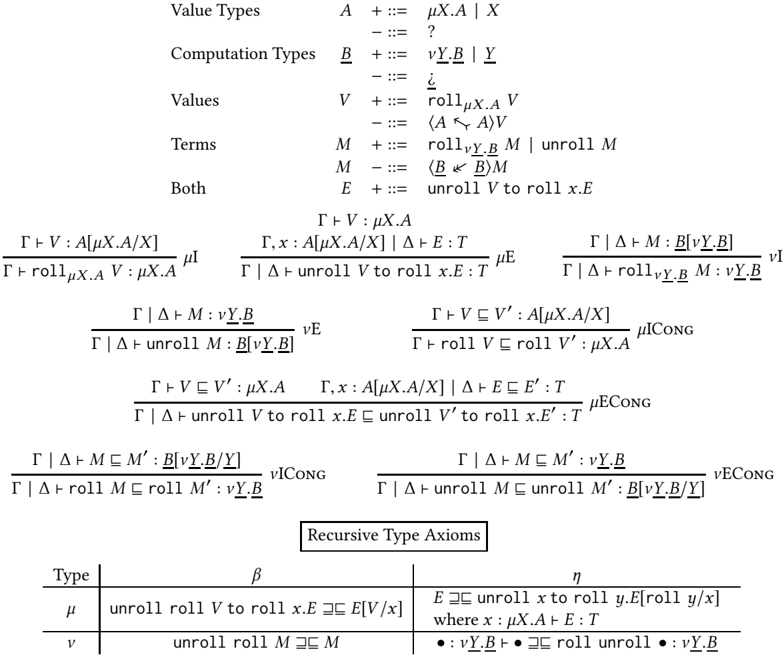
The image presents a formal definition of a type theory system, likely related to programming language semantics or mathematical logic. It defines value types, computation types, terms, and rules for type checking and evaluation. The notation uses symbols common in lambda calculus and type theory. The document appears to be a set of axioms and inference rules.
### Components/Axes
The document is structured into several sections:
* **Value Types (A):** Defines the structure of values.
* **Computation Types (B):** Defines the structure of computations.
* **Values (V):** Defines the structure of values.
* **Terms (M):** Defines the structure of terms.
* **Both (E):** Defines the structure of expressions that can be either values or terms.
* **Typing Rules:** A series of inference rules denoted by Γ ⊢ ... , where Γ represents the typing context. These rules define how to derive type judgments.
* **Recursive Type Axioms:** A table defining β and η reduction rules for μ and ν types.
The notation uses the following symbols:
* `::=` : Defines a type or structure.
* `+` : Indicates alternative definitions.
* `|` : Separates alternatives within a definition.
* `μX.A` : A recursive type definition.
* `roll` : A function or operator.
* `Δ` : Represents a set of assumptions.
* `A[μX.A/X]` : Type substitution.
* `vCong` : Value Congruence.
* `μCong` : μ Congruence.
* `η` : Eta reduction.
* `β` : Beta reduction.
### Detailed Analysis or Content Details
**Value Types (A):**
`A ::= μX.A | X`
**Computation Types (B):**
`B ::= ∀Y.B | Y`
**Values (V):**
`V ::= rollμX.A V | (A ∧ V)`
**Terms (M):**
`M ::= rollvY.B M | unroll M`
`M ::= (B ⊣ B)M`
**Both (E):**
`E ::= unroll V to roll x.E`
**Typing Rules:**
1. `Γ ⊢ V : μX.A`
2. `Γ, x : A[μX.A/X] ⊢ E : T`
3. `Γ ⊢ rollμX.A V : μX.A`
4. `Γ | Δ ⊢ unroll V to roll x.E : T` μE
5. `Γ | Δ ⊢ M : vY.B` vE
6. `Γ | Δ ⊢ M : vY.B` vCong
7. `Γ ⊢ V ⊆ V' : A[μX.A/X]` μCong
8. `Γ ⊢ roll V ⊆ roll V' : μX.A` μCong
9. `Γ ⊢ V ⊆ V' : μX.A`
10. `Γ, x : A[μX.A/X] | Δ ⊢ E ⊆ E' : T` μECong
11. `Γ | Δ ⊢ unroll V to roll x.E ⊆ unroll V' to roll x.E' : T` μECong
12. `Γ | Δ ⊢ M ⊆ M' : B[vY.B/Y]` vCong
13. `Γ | Δ ⊢ roll M ⊆ roll M' : vY.B` vCong
**Recursive Type Axioms:**
| Type | β | η |
| :--- | :-------------------------------- | :-------------------------------- |
| μ | unroll roll V to roll x.E ∃[v/x] | E ≡ unroll x to roll y.[roll y/x] |
| ν | unroll roll M ∃[M/x] | •vY.B + ∃ roll unroll |
### Key Observations
The notation is highly symbolic and requires familiarity with type theory to fully understand. The rules define how types are assigned to expressions and how computations are evaluated. The recursive type axioms define the reduction rules for μ and ν types, which are fundamental concepts in type theory. The use of congruence rules (vCong, μCong, μECong) indicates that the system is designed to handle structural equivalence of expressions.
### Interpretation
This document defines a formal system for reasoning about types and computations. It is likely a foundational component of a programming language or a formal verification system. The recursive type axioms are crucial for defining recursive data structures and functions. The typing rules ensure that programs are well-typed, which is essential for preventing runtime errors. The congruence rules allow for simplification and manipulation of expressions while preserving their meaning. The system appears to be designed to be sound and complete, meaning that it can derive all valid type judgments and that it does not derive any invalid ones. The notation is concise and precise, which is typical of formal systems. The document is a technical specification that would be used by researchers and developers working on type theory or related fields.