## Line Graph: Codebook Entropy vs. Training Steps
### Overview
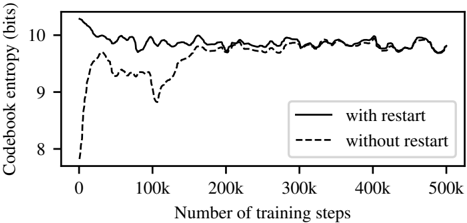
The graph compares codebook entropy (in bits) across training steps (0 to 500k) for two scenarios: "with restart" (solid line) and "without restart" (dashed line). Both lines exhibit fluctuations but converge toward similar entropy values after ~200k steps.
### Components/Axes
- **X-axis**: "Number of training steps" (0 to 500k, increments of 100k).
- **Y-axis**: "Codebook entropy (bits)" (8 to 10 bits, increments of 1 bit).
- **Legend**: Located in the bottom-right corner. Solid line = "with restart"; Dashed line = "without restart".
### Detailed Analysis
- **With restart (solid line)**:
- Starts at ~10.2 bits at 0 steps.
- Dips to ~9.5 bits at ~100k steps.
- Stabilizes between ~9.7–10.0 bits after ~200k steps.
- **Without restart (dashed line)**:
- Starts at ~8.5 bits at 0 steps.
- Sharp drop to ~8.2 bits at ~50k steps.
- Rises to ~8.8 bits at ~100k steps.
- Stabilizes between ~9.4–9.6 bits after ~200k steps.
- Both lines converge near ~9.8 bits by 500k steps.
### Key Observations
1. **Initial divergence**: "With restart" begins with higher entropy (~10.2 vs. ~8.5 bits).
2. **Early fluctuations**: Both lines show volatility in the first 100k steps, with "without restart" experiencing a sharper initial drop.
3. **Convergence**: After ~200k steps, entropy values for both scenarios overlap significantly (~9.7–10.0 bits).
4. **Stability**: Post-200k steps, entropy remains relatively flat for both lines.
### Interpretation
The data suggests that restarting training initially increases codebook entropy, potentially due to regularization effects or reduced overfitting. However, after ~200k steps, the entropy values for both scenarios stabilize, indicating that the long-term impact of restarts diminishes. This could imply that restarts are more critical in early training phases, while later stages rely more on consistent optimization. The convergence highlights that extended training mitigates the initial divergence caused by restart strategies.