## Bar Chart: Accuracy vs. Length of Paths in SPARQL
### Overview
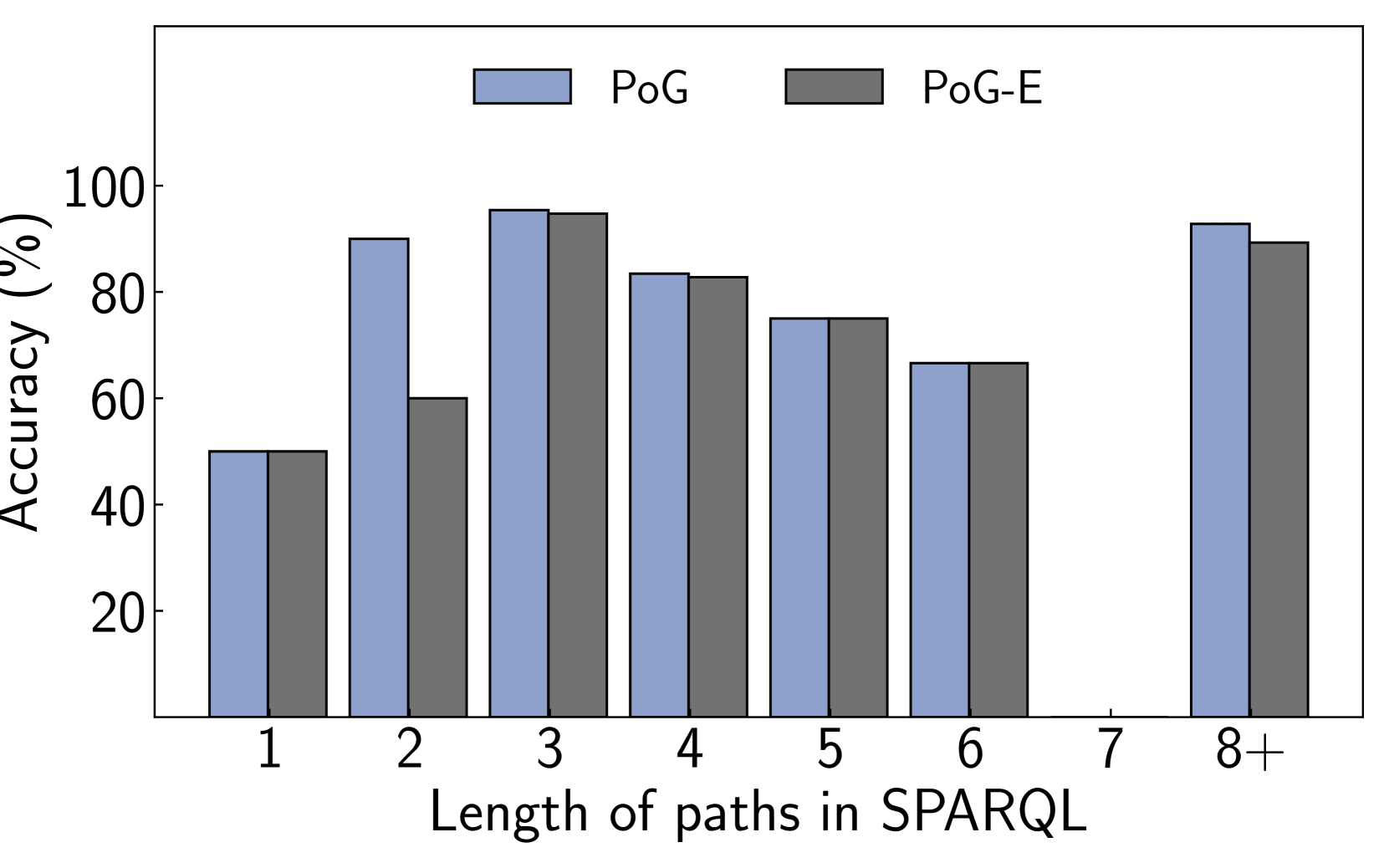
The image is a bar chart comparing the accuracy of two methods, PoG and PoG-E, based on the length of paths in SPARQL queries. The x-axis represents the length of paths, and the y-axis represents the accuracy in percentage.
### Components/Axes
* **Title:** (Inferred) Accuracy vs. Length of Paths in SPARQL
* **X-axis:**
* **Label:** Length of paths in SPARQL
* **Categories:** 1, 2, 3, 4, 5, 6, 7, 8+
* **Y-axis:**
* **Label:** Accuracy (%)
* **Scale:** 0 to 100, with tick marks at 20, 40, 60, 80, and 100.
* **Legend:** Located at the top of the chart.
* **PoG:** Represented by light blue bars.
* **PoG-E:** Represented by dark gray bars.
### Detailed Analysis
Here's a breakdown of the accuracy for each path length and method:
* **Path Length 1:**
* PoG (light blue): Approximately 50%
* PoG-E (dark gray): Approximately 50%
* **Path Length 2:**
* PoG (light blue): Approximately 90%
* PoG-E (dark gray): Approximately 60%
* **Path Length 3:**
* PoG (light blue): Approximately 96%
* PoG-E (dark gray): Approximately 95%
* **Path Length 4:**
* PoG (light blue): Approximately 83%
* PoG-E (dark gray): Approximately 82%
* **Path Length 5:**
* PoG (light blue): Approximately 75%
* PoG-E (dark gray): Approximately 74%
* **Path Length 6:**
* PoG (light blue): Approximately 67%
* PoG-E (dark gray): Approximately 66%
* **Path Length 7:**
* PoG (light blue): No data
* PoG-E (dark gray): No data
* **Path Length 8+:**
* PoG (light blue): Approximately 93%
* PoG-E (dark gray): Approximately 90%
### Key Observations
* PoG generally has higher accuracy than PoG-E, except at path length 1 and 3 where they are nearly equal.
* The accuracy of PoG peaks at path length 3, then decreases until path length 6, and increases again at path length 8+.
* The accuracy of PoG-E peaks at path length 3, then decreases until path length 6, and increases again at path length 8+.
* There is no data for path length 7.
### Interpretation
The chart suggests that the length of paths in SPARQL queries affects the accuracy of both PoG and PoG-E methods. PoG appears to be more accurate than PoG-E for most path lengths, especially at path length 2. The drop in accuracy between path lengths 3 and 6 could indicate a complexity threshold where longer paths become more difficult to process accurately. The increase in accuracy at path length 8+ is interesting and might suggest that very long paths have some properties that make them easier to process, or that the queries represented by 8+ paths are of a different nature than those with lengths between 4 and 6. The absence of data for path length 7 is a notable gap in the data.