\n
## Bar Chart: Accuracy vs. SPARQL Path Length
### Overview
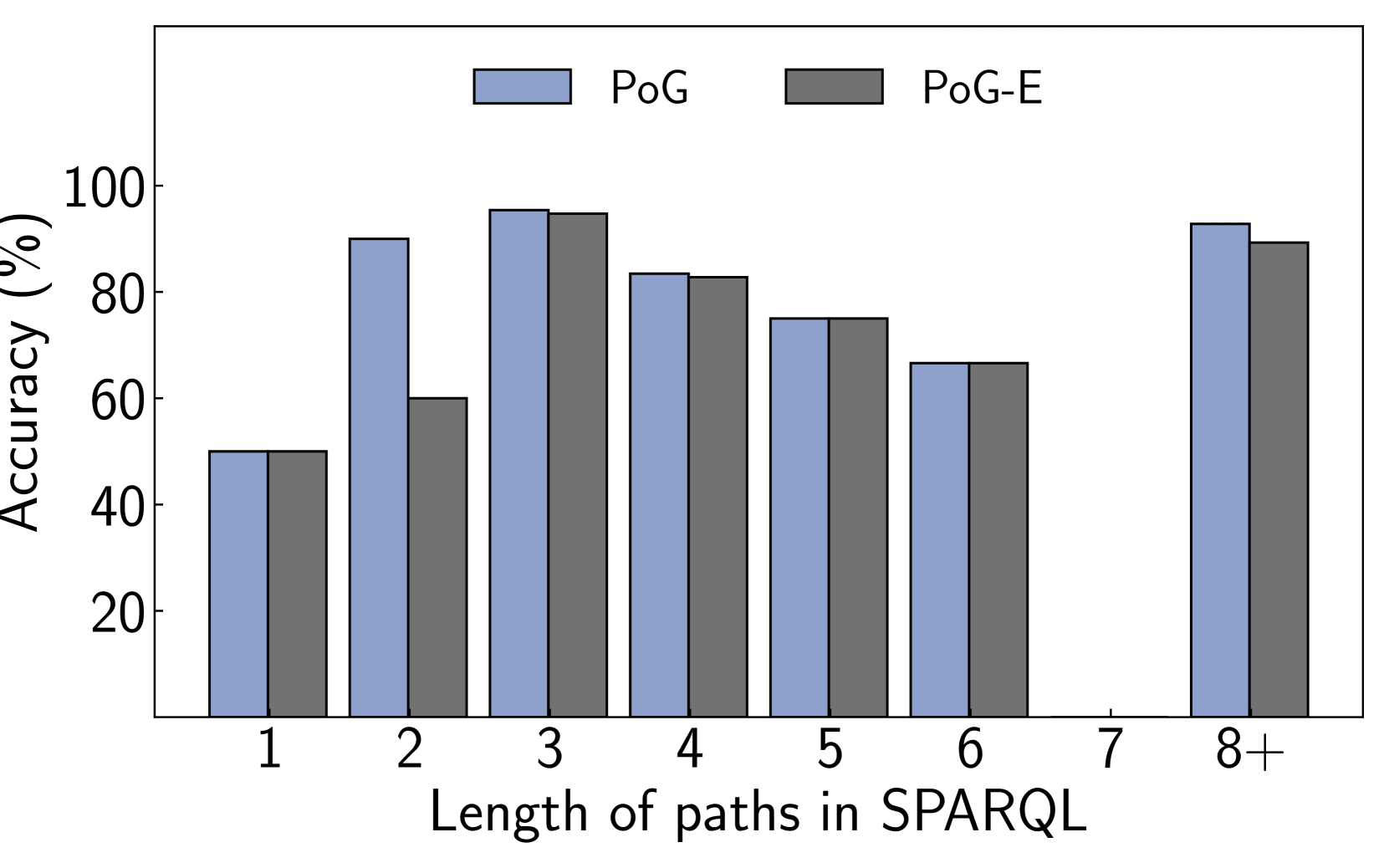
This bar chart compares the accuracy of two methods, PoG and PoG-E, across different lengths of paths in SPARQL queries. The x-axis represents the length of the paths, ranging from 1 to 8+, while the y-axis represents the accuracy in percentage (%). Each path length has two bars, one for PoG and one for PoG-E.
### Components/Axes
* **X-axis Title:** "Length of paths in SPARQL"
* **X-axis Markers:** 1, 2, 3, 4, 5, 6, 7, 8+
* **Y-axis Title:** "Accuracy (%)"
* **Y-axis Scale:** 0 to 100, with increments of 20.
* **Legend:**
* PoG (Light Blue)
* PoG-E (Dark Gray)
### Detailed Analysis
The chart consists of paired bars for each path length.
* **Path Length 1:**
* PoG: Approximately 50% accuracy.
* PoG-E: Approximately 52% accuracy.
* **Path Length 2:**
* PoG: Approximately 90% accuracy.
* PoG-E: Approximately 58% accuracy.
* **Path Length 3:**
* PoG: Approximately 97% accuracy.
* PoG-E: Approximately 93% accuracy.
* **Path Length 4:**
* PoG: Approximately 83% accuracy.
* PoG-E: Approximately 80% accuracy.
* **Path Length 5:**
* PoG: Approximately 74% accuracy.
* PoG-E: Approximately 68% accuracy.
* **Path Length 6:**
* PoG: Approximately 68% accuracy.
* PoG-E: Approximately 65% accuracy.
* **Path Length 7:**
* PoG: Approximately 70% accuracy.
* PoG-E: Approximately 68% accuracy.
* **Path Length 8+:**
* PoG: Approximately 93% accuracy.
* PoG-E: Approximately 90% accuracy.
**Trends:**
* **PoG:** The accuracy of PoG generally increases with path length up to path length 3, then decreases for path lengths 4 and 5, remains relatively stable for path lengths 6 and 7, and then increases again for path length 8+.
* **PoG-E:** The accuracy of PoG-E generally increases with path length, but remains lower than PoG for most path lengths.
### Key Observations
* PoG consistently outperforms PoG-E for path lengths 1, 2, 3, 4, 5, 6, 7, and 8+.
* The largest difference in accuracy between PoG and PoG-E occurs at path length 2, where PoG has a significantly higher accuracy.
* Both methods show a dip in accuracy around path length 4 and 5.
* Both methods achieve high accuracy for path length 8+.
### Interpretation
The data suggests that PoG is generally more accurate than PoG-E across various SPARQL path lengths. The initial increase in accuracy for both methods as path length increases could be due to the methods becoming more confident with longer, more defined query patterns. The dip in accuracy around path lengths 4 and 5 might indicate a point where the complexity of the queries starts to introduce more ambiguity or challenges for both methods. The resurgence in accuracy at path length 8+ suggests that the methods can handle even more complex queries effectively. The consistent outperformance of PoG suggests it is a more robust method for handling SPARQL queries, particularly as the path length increases. The chart highlights the importance of considering query complexity (path length) when evaluating the performance of different query methods.