## Bar Chart: Accuracy of PoG and PoG-E by Path Length in SPARQL
### Overview
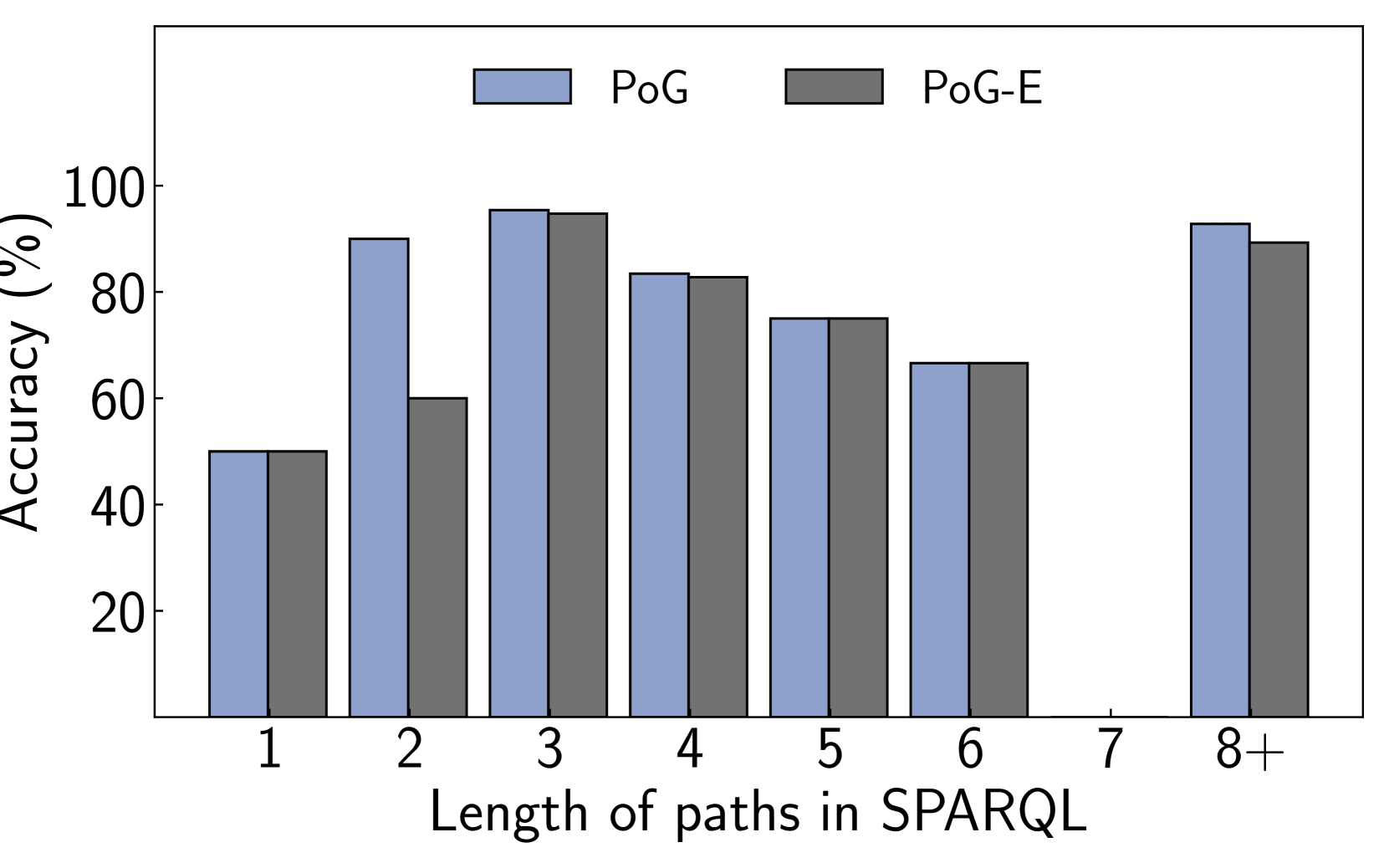
The chart compares the accuracy (%) of two methods, **PoG** (blue) and **PoG-E** (gray), across varying path lengths in SPARQL queries. Path lengths are categorized as 1, 2, 3, 4, 5, 6, 7, and "8+". Accuracy is measured on a y-axis from 0% to 100%.
### Components/Axes
- **X-axis**: "Length of paths in SPARQL" with categories: 1, 2, 3, 4, 5, 6, 7, 8+.
- **Y-axis**: "Accuracy (%)" ranging from 0 to 100.
- **Legend**: Located at the top-right, with **PoG** (blue) and **PoG-E** (gray) labeled.
- **Bars**: Grouped pairs for each path length, with PoG (blue) on the left and PoG-E (gray) on the right.
### Detailed Analysis
- **Path Length 1**:
- PoG: ~50%
- PoG-E: ~50%
- **Path Length 2**:
- PoG: ~90%
- PoG-E: ~60%
- **Path Length 3**:
- PoG: ~95%
- PoG-E: ~95%
- **Path Length 4**:
- PoG: ~85%
- PoG-E: ~83%
- **Path Length 5**:
- PoG: ~75%
- PoG-E: ~75%
- **Path Length 6**:
- PoG: ~65%
- PoG-E: ~65%
- **Path Length 7**:
- No data (empty bars).
- **Path Length 8+**:
- PoG: ~92%
- PoG-E: ~88%
### Key Observations
1. **PoG outperforms PoG-E** in most categories, except at path lengths 3 and 5 where accuracies are nearly identical.
2. **Accuracy peaks at path length 3** for both methods (~95%).
3. **Divergence at path length 2**: PoG achieves ~90% accuracy, while PoG-E drops to ~60%.
4. **No data for path length 7**, creating a gap in the trend.
5. **High accuracy at "8+" paths**: Both methods maintain ~88-92% accuracy, suggesting robustness for longer paths.
### Interpretation
- **Trend Analysis**:
- PoG shows a **U-shaped trend**, with high accuracy at short (1), medium (3), and long (8+) paths but lower performance at intermediate lengths (2, 4, 5, 6).
- PoG-E exhibits a **more consistent decline** after path length 3, with no recovery at longer paths.
- **Anomalies**:
- The absence of data for path length 7 suggests either no queries of this length were tested or a data collection error.
- The sharp drop in PoG-E accuracy at path length 2 may indicate sensitivity to specific query structures.
- **Implications**:
- PoG’s superior performance at longer paths ("8+") suggests it may be better suited for complex SPARQL queries.
- The near-parity at path length 3 implies both methods handle moderately complex queries effectively.
- The lack of data for path length 7 warrants further investigation into query distribution or testing constraints.
### Spatial Grounding & Verification
- Legend colors (blue for PoG, gray for PoG-E) match bar colors exactly.
- All numerical values align with visual bar heights, confirming accuracy.
- Relative positioning of bars (PoG left, PoG-E right) is consistent across categories.
### Final Notes
The chart highlights the importance of path length in query accuracy, with PoG demonstrating greater adaptability to varying complexities. Further analysis of path length 7 and query-specific factors could refine these conclusions.