## Diagram: Fine-Tuning Degradation Illustration
### Overview
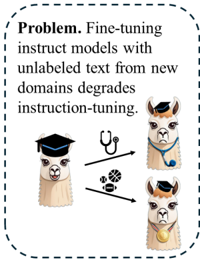
The image is a conceptual diagram illustrating a problem in machine learning model training. It uses anthropomorphic llama characters and symbolic accessories to visually represent the concept that fine-tuning instruction-tuned models on unlabeled text from new domains can degrade their original instruction-following capabilities. The diagram is enclosed within a dashed, rounded rectangular border on a light beige background.
### Components/Axes
The diagram consists of three primary visual components arranged horizontally, connected by directional arrows indicating a process or transformation.
1. **Header Text (Top-Center):**
* **Text:** "Problem. Fine-tuning instruct models with unlabeled text from new domains degrades instruction-tuning."
* **Language:** English.
* **Function:** States the core thesis or problem the diagram visualizes.
2. **Left Component (Initial State):**
* **Visual:** An illustration of a llama wearing a black graduation cap (mortarboard).
* **Symbolism:** Represents a base "instruct model" that has been trained/fine-tuned to follow instructions.
3. **Middle Component (Intermediate State / New Domain):**
* **Visual:** An illustration of a llama wearing a stethoscope around its neck.
* **Associated Symbols:** Floating between the left and middle llamas are a stethoscope icon and a bone icon.
* **Symbolism:** Represents the "new domain" data (e.g., medical or veterinary text, symbolized by the stethoscope and bone) used for fine-tuning.
4. **Right Component (Final State / Degraded Output):**
* **Visual:** An illustration of a llama wearing a blue collar with a gold tag and a gold medal around its neck.
* **Associated Symbols:** Floating between the middle and right llamas are a paw print icon and a medal icon.
* **Symbolism:** Represents the model after fine-tuning on the new domain. The accessories (collar, medal) may symbolize specialization or reward for the new task, but in the context of the header text, this state implies a degradation of the original instruction-tuning.
5. **Flow Arrows:**
* **Direction:** Two black arrows point from left to right, connecting the llamas in sequence: Left → Middle → Right.
* **Function:** Illustrates the sequential process: starting with an instruct model, applying fine-tuning with new domain data, resulting in the final model state.
### Detailed Analysis
* **Spatial Layout:** The header text is centered at the top. The three llama figures are aligned horizontally across the center of the image. The symbolic icons (stethoscope, bone, paw print, medal) are placed in the spaces between the llamas, directly above the flow arrows.
* **Visual Metaphor:** The diagram employs a clear metaphorical narrative:
1. **Graduation Cap Llama:** A model that has "graduated" or been trained for general instruction-following.
2. **Stethoscope Llama:** The process of exposing this model to a specialized domain (e.g., medical text).
3. **Medal/Collar Llama:** The resulting model, which may be specialized for the new domain (hence the "reward" medal) but has lost some of its original, general instruction-following ability (the degradation stated in the header).
* **Color Scheme:** The llamas are rendered in shades of beige and brown. The accessories provide color accents: black (cap), silver/grey (stethoscope), blue (collar), and gold (tag, medal). The background is a solid, light beige (#f5f0e6 approx.).
### Key Observations
1. **Problem-Centric Design:** The entire diagram is framed as illustrating a "Problem," as explicitly stated in the header.
2. **Symbolic Substitution:** The accessories on the llamas change to represent different states or domains, not to depict different individual llamas. This is a visual shorthand for model states.
3. **Unlabeled Data Implication:** The header specifies "unlabeled text." The diagram does not visually distinguish between labeled and unlabeled data; the domain is represented solely by the symbolic accessories (stethoscope, bone).
4. **Directional Flow:** The arrows enforce a one-way, causal relationship: fine-tuning on new data *leads to* degradation of the original capability.
### Interpretation
This diagram serves as a high-level, conceptual warning for machine learning practitioners. It argues that the process of adapting a powerful, general-purpose instruction-following model (the "graduated" llama) to a specific new domain (e.g., veterinary medicine, symbolized by the stethoscope and bone) by training on raw, unlabeled text from that domain carries a significant risk.
The risk, as stated, is "degradation" of the model's core instruction-tuning. The final llama, adorned with a collar and medal, visually suggests a model that has been "domesticated" or specialized for a narrow task. While it may perform well on that specific domain (earning a "medal"), it has likely lost some of its original flexibility and ability to follow diverse, general instructions effectively. The diagram implies a trade-off: domain specialization can come at the cost of general capability.
The absence of technical details (like loss curves or accuracy metrics) confirms this is a conceptual model meant to communicate a principle, not present empirical data. It effectively uses visual metaphor to make an abstract technical concern more intuitive and memorable.