## Diagram: Instruction-Tuning Degradation in Domain Adaptation
### Overview
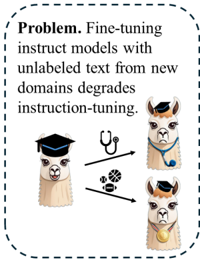
The diagram illustrates a problem statement regarding the degradation of instruction-tuning performance when fine-tuning models with unlabeled text from new domains. It uses visual metaphors (llamas with accessories) and directional arrows to represent the flow of degradation across domains.
### Components/Axes
- **Text Box**: Contains the problem statement:
*"Fine-tuning instruct models with unlabeled text from new domains degrades instruction-tuning."*
- **Visual Elements**:
- **Llama 1**: Wearing a graduation cap (symbolizing foundational instruction-tuning).
- **Llama 2**: Wearing a stethoscope (representing medical domain adaptation).
- **Llama 3**: Wearing a medal (representing sports domain adaptation).
- **Arrows**: Two black arrows connect Llama 1 to Llama 2 and Llama 3, indicating the flow of degradation.
### Detailed Analysis
- **Problem Statement**: Explicitly states the core issue: fine-tuning with unlabeled text from new domains (e.g., medical, sports) reduces the effectiveness of instruction-tuning.
- **Visual Flow**:
- Llama 1 (graduation cap) → Llama 2 (stethoscope): Degradation in medical domain adaptation.
- Llama 1 (graduation cap) → Llama 3 (medal): Degradation in sports domain adaptation.
- **No Numerical Data**: The diagram relies on symbolic representation rather than quantitative values.
### Key Observations
- The use of llamas with domain-specific accessories (stethoscope, medal) emphasizes the contrast between general instruction-tuning and specialized domains.
- Arrows suggest a unidirectional degradation effect, implying no recovery or improvement in instruction-tuning after domain adaptation.
### Interpretation
The diagram highlights a critical challenge in machine learning: domain adaptation using unlabeled text from new domains (e.g., healthcare, sports) compromises the model's ability to generalize instruction-following capabilities. The visual metaphor underscores that even foundational instruction-tuning (Llama 1) is undermined when exposed to specialized, unlabeled data. This aligns with research showing that domain shift can introduce noise or conflicting patterns, reducing model robustness. The absence of bidirectional arrows implies the degradation is irreversible without additional mitigation strategies (e.g., domain-specific fine-tuning, data augmentation).