## Code Comparison: LLM vs. LLM + APOLLO
### Overview
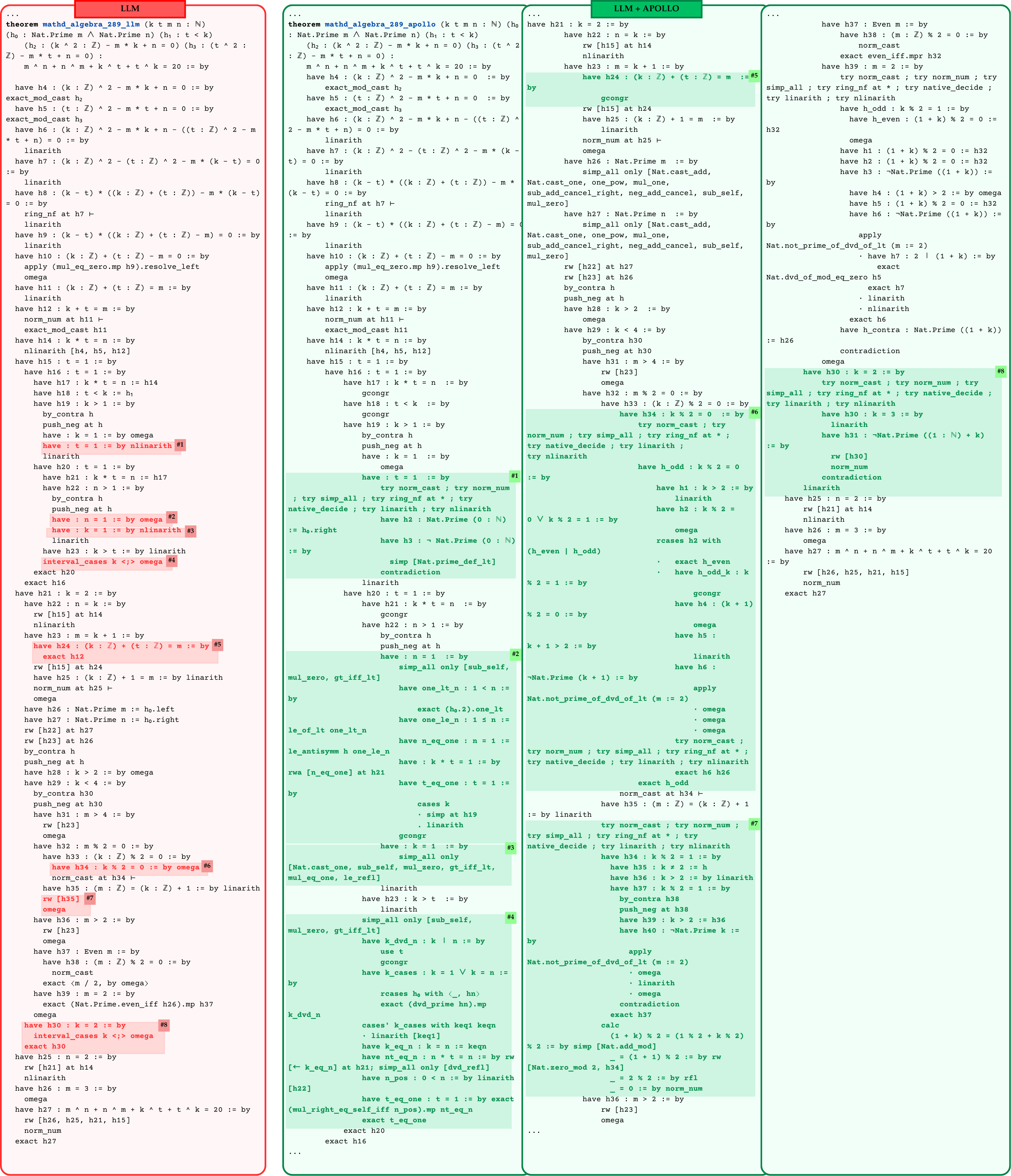
The image presents a side-by-side comparison of code snippets, labeled "LLM" (left, red background) and "LLM + APOLLO" (right, green background). The code appears to be a formal proof or derivation, possibly in a language like Lean or Coq, dealing with number theory and algebraic manipulations. The comparison highlights differences in the proof strategies or steps taken by the two approaches.
### Components/Axes
* **Headers:**
* Left (Red): "LLM"
* Right (Green): "LLM + APOLLO"
* **Code Blocks:** Two columns of code, each representing a different approach to the same theorem.
* **Annotations:** Numerical annotations (e.g., "#1", "#2") are present within the code, possibly indicating specific points of interest or differences.
### Detailed Analysis or ### Content Details
**Left Column (LLM):**
* **Theorem Statement:** `theorem mathd_algebra_289_1lm (k t m n: N) (h0: Nat.Prime m ∧ Nat.Prime n) (h1: t < k) (h2: (k ^ 2: Z) - m * k + n = 0) (h3: (t ^ 2: Z) - m * t + n = 0): m ^ n + n ^ m + k * t + t ^ k = 20 := by`
* **Key Steps:**
* Derives `have h4: (k : Z) ^ 2 - m * k + n = 0 := by exact_mod_cast h2`
* Derives `have h5: (t : Z) ^ 2 - m * t + n = 0 := by exact_mod_cast h3`
* Uses `linarith` to derive several intermediate results.
* Applies `mul_eq_zero.mp h9` and `resolve_left` with `omega`.
* Uses `nlinarith` with `[h4, h5, h12]`.
* Derives `have k = 1 := by nlinarith #1`
* Derives `have t = 1 := by omega`
* Derives `have n = 1 := by omega #2`
* Derives `have k = 1 := by nlinarith #3`
* Uses `interval_cases k <;> omega #4`
**Right Column (LLM + APOLLO):**
* **Theorem Statement:** `theorem mathd_algebra_289_apollo (k t m n: N) (h0: Nat.Prime m ∧ Nat.Prime n) (h1: t < k) (h2: (k ^ 2: Z) - m * k + n = 0) (h3: (t ^ 2: Z) - m * t + n = 0): m ^ n + n ^ m + k * t + t ^ k = 20 := by`
* **Key Steps:**
* Similar initial steps as LLM, deriving `h4` and `h5` using `exact_mod_cast`.
* Derives `have h24: (k : Z) + (t : Z) = m := by #5 exact h12`
* Uses `gcongr` and `rw` (rewrite) at various points.
* Applies `simp_all` with various arguments like `Nat.cast_add`, `Nat.cast_one`, etc.
* Uses `by_contra h` and `push_neg at h` for proof by contradiction.
* Derives `have k % 2 = 0 := by omega #6`
* Derives `have (m : Z) = (k : Z) + 1 := by linarith #7`
* Derives `have k = 2 := by interval_cases k <;> omega #8`
**Annotations:**
* `#1`, `#2`, `#3`, `#4`, `#5`, `#6`, `#7`, `#8`: These annotations highlight specific lines or sections of code, likely indicating points of comparison or significant steps in the proof.
### Key Observations
* Both approaches start with the same theorem and initial assumptions.
* The "LLM + APOLLO" approach seems to incorporate more explicit simplifications and rewrites using lemmas and theorems from the `Nat` library.
* The use of `interval_cases` and proof by contradiction (`by_contra h`) is more prominent in the "LLM + APOLLO" approach.
* The annotations suggest specific points where the two approaches diverge or where key steps are taken.
### Interpretation
The image demonstrates two different strategies for proving the same theorem. The "LLM + APOLLO" approach likely benefits from additional knowledge or tools (represented by "APOLLO") that allow for more direct simplification and application of relevant lemmas. The annotations highlight the critical junctures where these differences in strategy become apparent. The presence of "omega" suggests the use of an automated theorem prover to discharge certain subgoals. The comparison suggests that "LLM + APOLLO" may be more efficient or require less manual intervention than the pure "LLM" approach.