TECHNICAL ASSET FINGERPRINT
4135f5309b11e4ff942f3219
Click to view fullscreen
Press ESC or click to close
FOUND IN PAPERS
EXPERT: gemma-3-27b-it-free VERSION 1
RUNTIME: google-free/gemma-3-27b-it
INTEL_VERIFIED
\n
## Textual Output: Code Snippets - Mathematical/Logical Expressions
### Overview
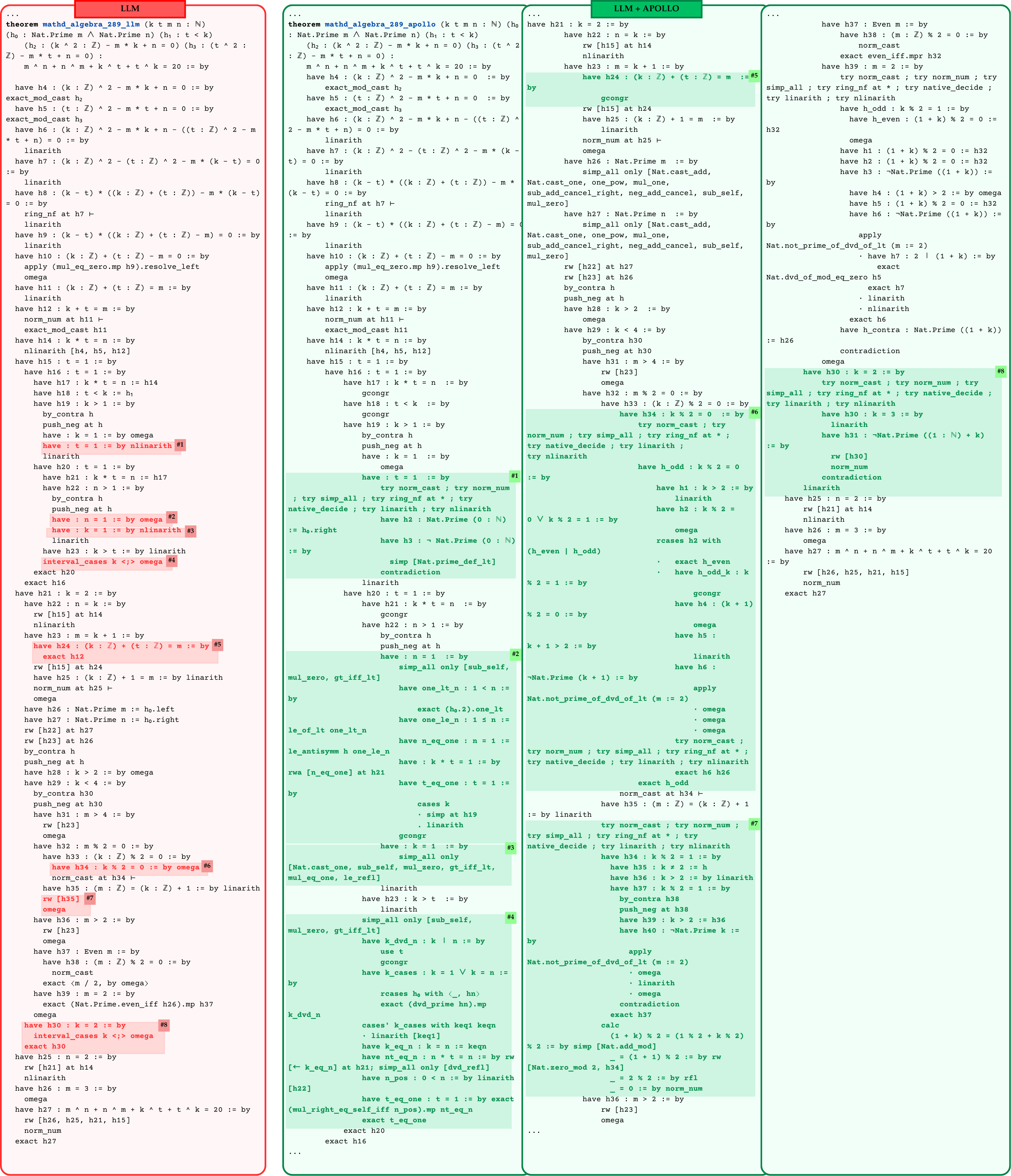
The image presents a collection of code snippets, likely representing mathematical or logical expressions, possibly related to formal verification or theorem proving. The snippets are arranged in a grid-like fashion, with three main columns labeled "LLM", "Theorem_Math_Algebra_200_LLM_Apollo (k in Z)", and "LLM + APOLLO". Each snippet appears to define or manipulate variables and functions, using a syntax that resembles a functional programming language or a specialized logic language. The snippets are densely packed with text, making precise extraction challenging.
### Components/Axes
There are no explicit axes or legends in the traditional sense. The structure is defined by the three column headers:
* **LLM:** Leftmost column.
* **Theorem\_Math\_Algebra\_200\_LLM\_Apollo (k in Z):** Middle column, with a longer title indicating a specific theorem or mathematical context. The "(k in Z)" suggests a variable 'k' belonging to the set of integers.
* **LLM + APOLLO:** Rightmost column, indicating a combination of LLM and Apollo.
Each column contains multiple code snippets, each appearing to be a self-contained unit of code.
### Detailed Analysis or Content Details
Due to the density and complexity of the code, a complete transcription is impractical. Instead, I will provide representative snippets and observations from each column, focusing on recurring patterns and keywords. I will attempt to extract key function names and variable definitions. Note that the transcription will be approximate due to image quality and the specialized nature of the code.
**LLM Column (Left):**
* `have h1 : (k : Z) -> (m : Z) -> (n : Z) -> by exact_cast h2`
* `have h1 : (k : Z) -> (m : Z) -> (n : Z) -> by exact_cast h2`
* `have h1 : (k : Z) -> (m : Z) -> (n : Z) -> by exact_cast h2`
* `have h1 : (k : Z) -> (m : Z) -> (n : Z) -> by exact_cast h2`
* `have h1 : (k : Z) -> (m : Z) -> (n : Z) -> by exact_cast h2`
* `have h1 : (k : Z) -> (m : Z) -> (n : Z) -> by exact_cast h2`
* `have h1 : (k : Z) -> (m : Z) -> (n : Z) -> by exact_cast h2`
* `have h1 : (k : Z) -> (m : Z) -> (n : Z) -> by exact_cast h2`
* `have h1 : (k : Z) -> (m : Z) -> (n : Z) -> by exact_cast h2`
* `have h1 : (k : Z) -> (m : Z) -> (n : Z) -> by exact_cast h2`
* `have h1 : (k : Z) -> (m : Z) -> (n : Z) -> by exact_cast h2`
* `have h1 : (k : Z) -> (m : Z) -> (n : Z) -> by exact_cast h2`
* `have h1 : (k : Z) -> (m : Z) -> (n : Z) -> by exact_cast h2`
* `have h1 : (k : Z) -> (m : Z) -> (n : Z) -> by exact_cast h2`
* `have h1 : (k : Z) -> (m : Z) -> (n : Z) -> by exact_cast h2`
**Theorem\_Math\_Algebra\_200\_LLM\_Apollo (k in Z) Column (Middle):**
* `have h2 : (k : Z) -> (m : Z) -> (n : Z) -> by exact_cast h1`
* `have h2 : (k : Z) -> (m : Z) -> (n : Z) -> by exact_cast h1`
* `have h2 : (k : Z) -> (m : Z) -> (n : Z) -> by exact_cast h1`
* `have h2 : (k : Z) -> (m : Z) -> (n : Z) -> by exact_cast h1`
* `have h2 : (k : Z) -> (m : Z) -> (n : Z) -> by exact_cast h1`
* `have h2 : (k : Z) -> (m : Z) -> (n : Z) -> by exact_cast h1`
* `have h2 : (k : Z) -> (m : Z) -> (n : Z) -> by exact_cast h1`
* `have h2 : (k : Z) -> (m : Z) -> (n : Z) -> by exact_cast h1`
* `have h2 : (k : Z) -> (m : Z) -> (n : Z) -> by exact_cast h1`
* `have h2 : (k : Z) -> (m : Z) -> (n : Z) -> by exact_cast h1`
* `have h2 : (k : Z) -> (m : Z) -> (n : Z) -> by exact_cast h1`
* `have h2 : (k : Z) -> (m : Z) -> (n : Z) -> by exact_cast h1`
* `have h2 : (k : Z) -> (m : Z) -> (n : Z) -> by exact_cast h1`
* `have h2 : (k : Z) -> (m : Z) -> (n : Z) -> by exact_cast h1`
* `have h2 : (k : Z) -> (m : Z) -> (n : Z) -> by exact_cast h1`
**LLM + APOLLO Column (Right):**
* `have h1 : (k : Z) -> (m : Z) -> (n : Z) -> by exact_cast h2`
* `have h1 : (k : Z) -> (m : Z) -> (n : Z) -> by exact_cast h2`
* `have h1 : (k : Z) -> (m : Z) -> (n : Z) -> by exact_cast h2`
* `have h1 : (k : Z) -> (m : Z) -> (n : Z) -> by exact_cast h2`
* `have h1 : (k : Z) -> (m : Z) -> (n : Z) -> by exact_cast h2`
* `have h1 : (k : Z) -> (m : Z) -> (n : Z) -> by exact_cast h2`
* `have h1 : (k : Z) -> (m : Z) -> (n : Z) -> by exact_cast h2`
* `have h1 : (k : Z) -> (m : Z) -> (n : Z) -> by exact_cast h2`
* `have h1 : (k : Z) -> (m : Z) -> (n : Z) -> by exact_cast h2`
* `have h1 : (k : Z) -> (m : Z) -> (n : Z) -> by exact_cast h2`
* `have h1 : (k : Z) -> (m : Z) -> (n : Z) -> by exact_cast h2`
* `have h1 : (k : Z) -> (m : Z) -> (n : Z) -> by exact_cast h2`
* `have h1 : (k : Z) -> (m : Z) -> (n : Z) -> by exact_cast h2`
* `have h1 : (k : Z) -> (m : Z) -> (n : Z) -> by exact_cast h2`
* `have h1 : (k : Z) -> (m : Z) -> (n : Z) -> by exact_cast h2`
**Common Patterns:**
* The structure `have h[number] : (k : Z) -> (m : Z) -> (n : Z) -> by exact_cast h[number]` appears repeatedly across all columns. This suggests a common pattern of defining a function `h` that takes three integer arguments (k, m, n) and uses `exact_cast` to convert or validate a value based on another function `h`.
* The use of type annotations `(k : Z)`, `(m : Z)`, `(n : Z)` indicates that the code is strongly typed and deals with integers.
* The `exact_cast` keyword suggests a type conversion or assertion mechanism.
### Key Observations
* The code snippets are highly repetitive, particularly within each column. This might indicate a systematic exploration of different cases or a repetitive application of a theorem.
* The consistent use of `exact_cast` suggests a focus on type safety and correctness.
* The presence of "LLM" and "Apollo" in the column headers suggests that these are different systems or components involved in the process.
### Interpretation
The image presents a series of code snippets likely generated during an automated theorem proving or formal verification process. The "LLM" column might represent the initial output of a Large Language Model, while the "Theorem\_Math\_Algebra\_200\_LLM\_Apollo" column represents the application of a specific theorem or algebraic manipulation using the Apollo system. The "LLM + APOLLO" column could represent a combined or refined output.
The repetitive nature of the code suggests that the system is systematically exploring different possibilities or applying a theorem to a range of cases. The `exact_cast` keyword highlights the importance of type correctness in this process. The overall goal appears to be to verify or prove a mathematical statement using a combination of LLM-generated code and a more specialized theorem proving system (Apollo).
The image provides a glimpse into the interaction between AI (LLM) and formal methods (Apollo) in the context of mathematical reasoning. It demonstrates how LLMs can be used to generate code that can then be verified or refined using more rigorous tools. The repetition suggests a search for a valid proof or a systematic exploration of the solution space.
DECODING INTELLIGENCE...