## Bar Chart: Throughput Comparison of Decoding Methods Across Datasets
### Overview
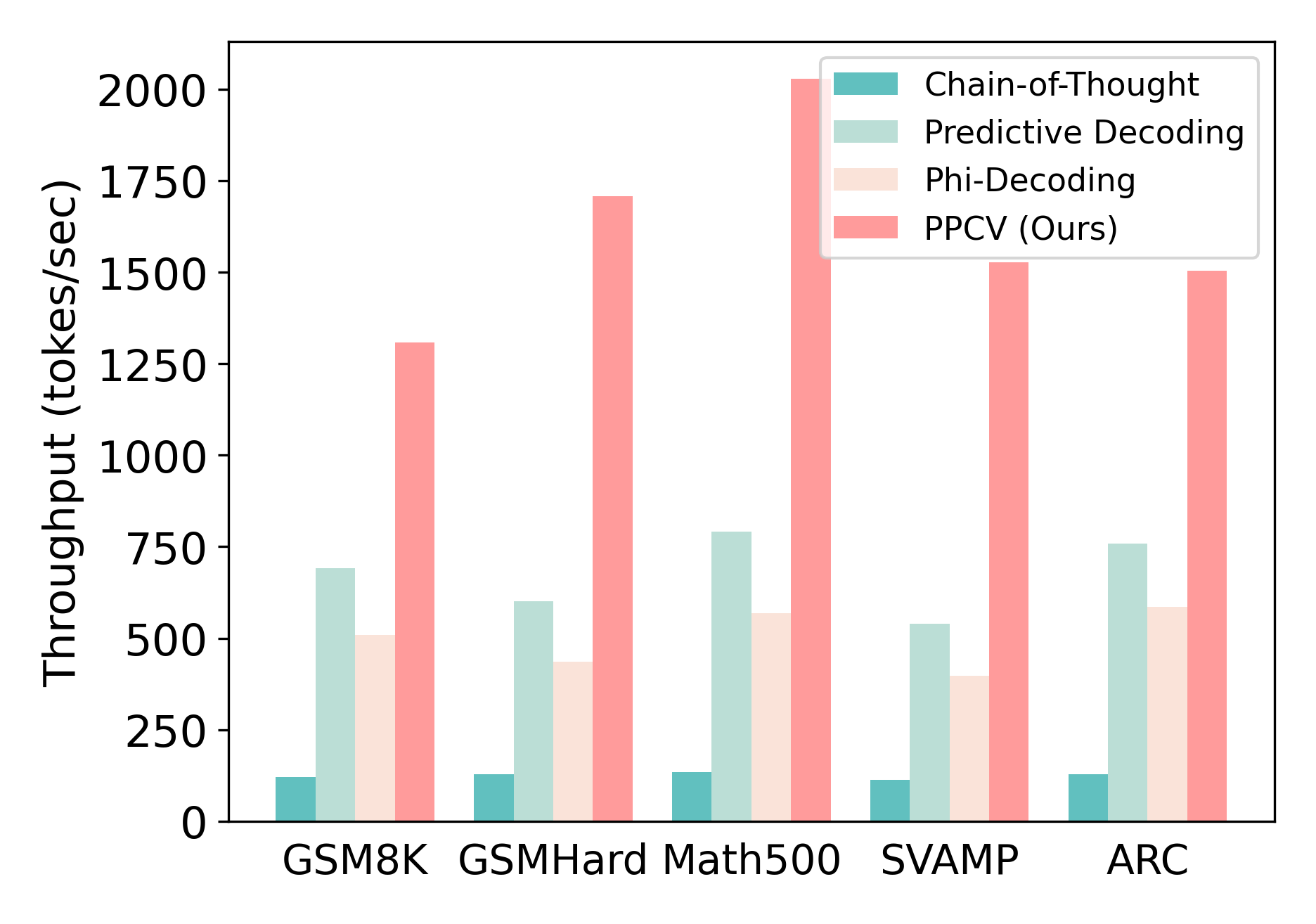
The chart compares the throughput (tokens/second) of four decoding methods—Chain-of-Thought, Predictive Decoding, Phi-Decoding, and PPCV (Ours)—across five datasets: GSM8K, GSMHard, Math500, SVAMP, and ARC. Throughput is measured on a logarithmic scale (y-axis), while datasets are categorical (x-axis). PPCV consistently outperforms other methods, with Chain-of-Thought showing the lowest throughput.
### Components/Axes
- **X-axis (Datasets)**: GSM8K, GSMHard, Math500, SVAMP, ARC (left to right).
- **Y-axis (Throughput)**: Tokens/second, logarithmic scale (0–2000).
- **Legend**:
- Chain-of-Thought: Teal (#008080)
- Predictive Decoding: Light Blue (#ADD8E6)
- Phi-Decoding: Light Orange (#FFA07A)
- PPCV (Ours): Red (#FF6347)
- **Bar Groups**: Each dataset has four adjacent bars, ordered by legend sequence.
### Detailed Analysis
1. **GSM8K**:
- Chain-of-Thought: ~100 tokens/sec (teal)
- Predictive Decoding: ~700 tokens/sec (light blue)
- Phi-Decoding: ~500 tokens/sec (light orange)
- PPCV: ~1300 tokens/sec (red)
2. **GSMHard**:
- Chain-of-Thought: ~120 tokens/sec (teal)
- Predictive Decoding: ~600 tokens/sec (light blue)
- Phi-Decoding: ~450 tokens/sec (light orange)
- PPCV: ~1700 tokens/sec (red)
3. **Math500**:
- Chain-of-Thought: ~130 tokens/sec (teal)
- Predictive Decoding: ~800 tokens/sec (light blue)
- Phi-Decoding: ~550 tokens/sec (light orange)
- PPCV: ~1900 tokens/sec (red)
4. **SVAMP**:
- Chain-of-Thought: ~110 tokens/sec (teal)
- Predictive Decoding: ~550 tokens/sec (light blue)
- Phi-Decoding: ~400 tokens/sec (light orange)
- PPCV: ~1500 tokens/sec (red)
5. **ARC**:
- Chain-of-Thought: ~120 tokens/sec (teal)
- Predictive Decoding: ~750 tokens/sec (light blue)
- Phi-Decoding: ~580 tokens/sec (light orange)
- PPCV: ~1500 tokens/sec (red)
### Key Observations
- **PPCV Dominance**: PPCV (red bars) achieves the highest throughput across all datasets, with values ranging from ~1300 (GSM8K) to ~1900 (Math500).
- **Chain-of-Thought Weakness**: Chain-of-Thought (teal) consistently has the lowest throughput (~100–130 tokens/sec), suggesting inefficiency in token generation.
- **Predictive vs. Phi-Decoding**: Predictive Decoding (light blue) generally outperforms Phi-Decoding (light orange) in GSM8K, GSMHard, and ARC, but Phi-Decoding slightly exceeds it in Math500 and SVAMP.
- **Logarithmic Scale Impact**: The y-axis’s logarithmic nature emphasizes relative differences, making PPCV’s superiority visually stark.
### Interpretation
The data demonstrates that **PPCV (Ours)** is the most efficient decoding method, achieving throughput 2–3x higher than competitors. This suggests PPCV’s architecture or algorithm optimizes token generation speed. Chain-of-Thought’s poor performance may stem from its reliance on sequential reasoning, which is computationally intensive. Predictive and Phi-Decoding methods show moderate efficiency, with Predictive Decoding excelling in complex datasets like Math500. The consistent gap between PPCV and other methods highlights its potential as a superior solution for high-throughput applications. No outliers are observed; trends align with the legend’s color coding and dataset complexity.