TECHNICAL ASSET FINGERPRINT
4167a5d409a3bcde8d8b865b
Click to view fullscreen
Press ESC or click to close
FOUND IN PAPERS
EXPERT: gemini-2.0-flash VERSION 1
RUNTIME: nugit/gemini/gemini-2.0-flash
INTEL_VERIFIED
## Table: Arguments Against Banning Bottled Water
### Overview
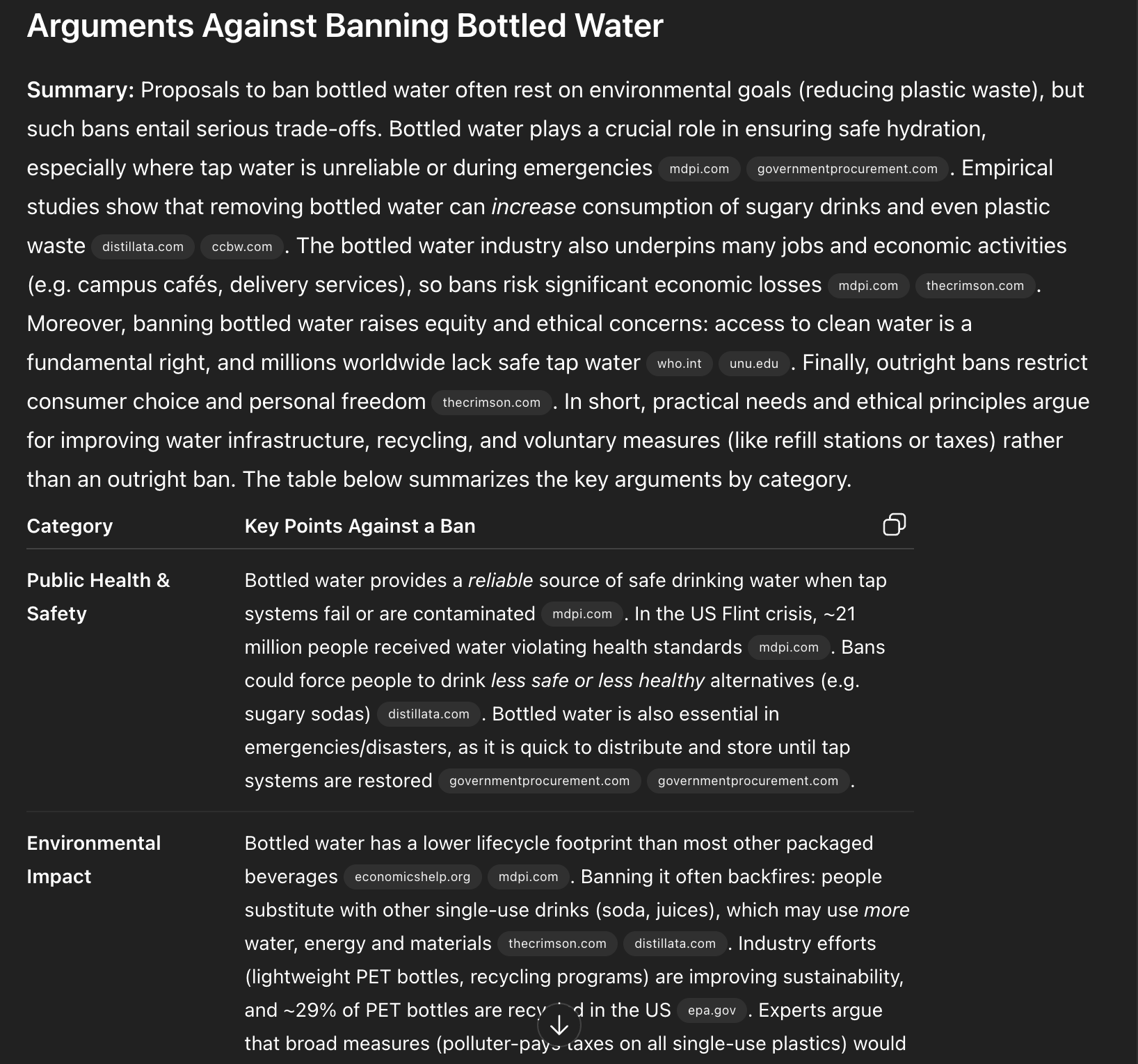
The image presents a summary of arguments against banning bottled water, categorized by "Public Health & Safety" and "Environmental Impact". It includes a brief summary of the arguments followed by a two-column table outlining the key points against a ban.
### Components/Axes
* **Title:** Arguments Against Banning Bottled Water
* **Summary:** A paragraph summarizing the main arguments against banning bottled water.
* **Table Columns:**
* Category (Left Column)
* Key Points Against a Ban (Right Column)
* **Categories:**
* Public Health & Safety
* Environmental Impact
### Detailed Analysis
**Summary Text:**
> Proposals to ban bottled water often rest on environmental goals (reducing plastic waste), but such bans entail serious trade-offs. Bottled water plays a crucial role in ensuring safe hydration, especially where tap water is unreliable or during emergencies. Empirical studies show that removing bottled water can *increase* consumption of sugary drinks and even plastic waste. The bottled water industry also underpins many jobs and economic activities (e.g. campus cafés, delivery services), so bans risk significant economic losses. Moreover, banning bottled water raises equity and ethical concerns: access to clean water is a fundamental right, and millions worldwide lack safe tap water. Finally, outright bans restrict consumer choice and personal freedom. In short, practical needs and ethical principles argue for improving water infrastructure, recycling, and voluntary measures (like refill stations or taxes) rather than an outright ban. The table below summarizes the key arguments by category.
**Table Content:**
| Category | Key Points Against a Ban 3.
### Key Observations
* The arguments are presented in a structured manner, with clear categories and supporting points.
* The summary highlights the key trade-offs associated with banning bottled water, emphasizing its role in hydration and potential negative consequences.
* The table provides specific examples and data points to support the arguments against a ban.
### Interpretation
The image presents a case against banning bottled water by highlighting its benefits and potential drawbacks of a ban. The "Public Health & Safety" category emphasizes the importance of bottled water as a reliable source of hydration, especially during emergencies and when tap water is compromised. The "Environmental Impact" category argues that bottled water's lifecycle footprint is lower than other packaged beverages and that banning it could lead to increased consumption of less sustainable alternatives. The inclusion of statistics, such as the recycling rate of PET bottles, aims to strengthen the argument that the environmental impact of bottled water is being addressed. Overall, the image suggests that a more nuanced approach, such as improving infrastructure and promoting voluntary measures, may be more effective than an outright ban.
DECODING INTELLIGENCE...