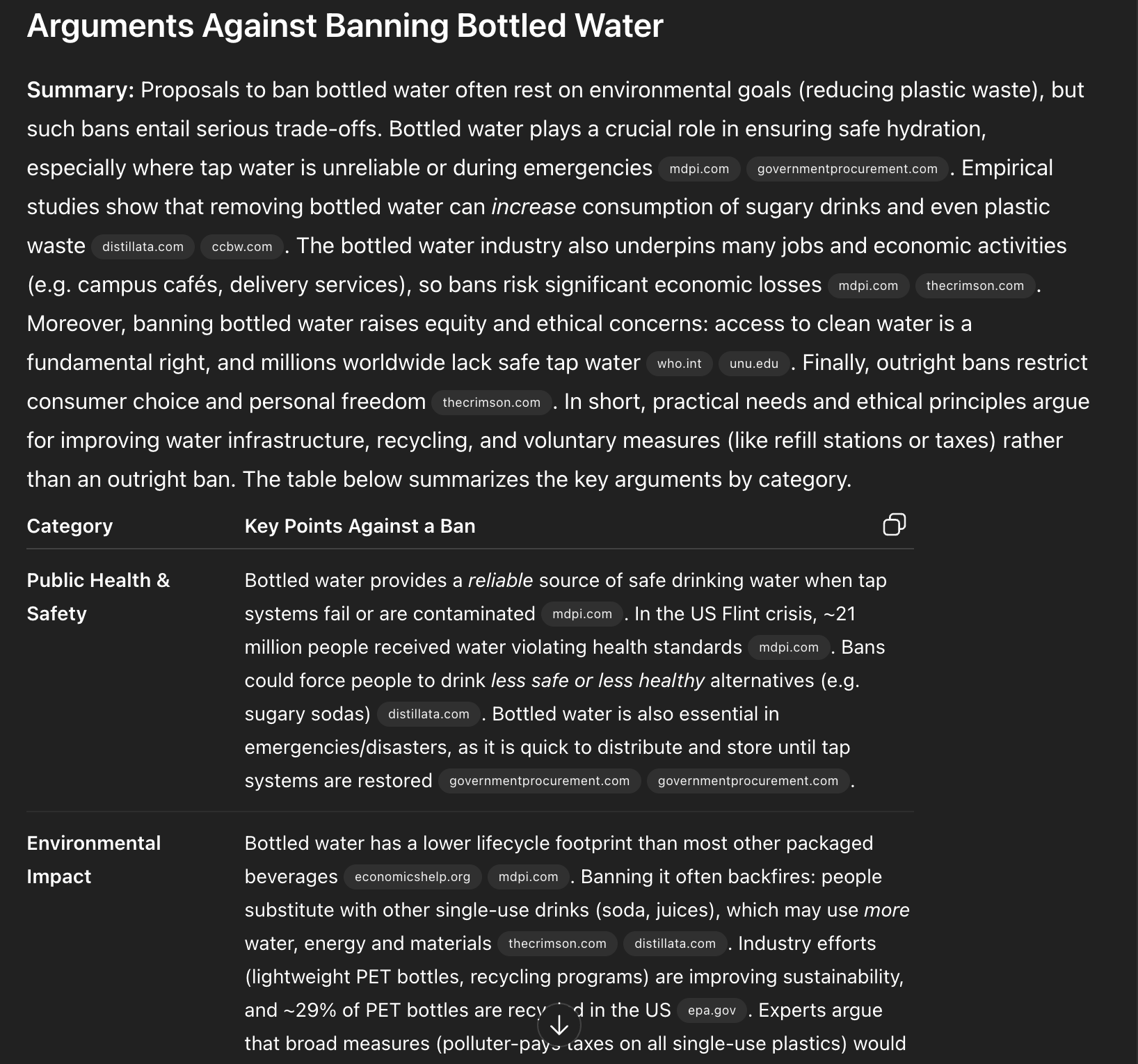
## Text Document: Arguments Against Banning Bottled Water
### Overview
The image is a screenshot of a digital document or article presenting arguments against the prohibition of bottled water. The content is structured with a title, a summary paragraph, and the beginning of a two-column table that categorizes and details the key points. The text is in English. The document cites multiple external sources, indicated by small, gray, pill-shaped badges containing domain names (e.g., `mdpi.com`, `distillata.com`). The bottom of the image is cut off, showing only the start of the "Environmental Impact" category in the table.
### Components/Axes
* **Title:** "Arguments Against Banning Bottled Water"
* **Summary Section:** A paragraph outlining the core thesis that bans have serious trade-offs, touching on public health, environmental backfire effects, economic impacts, equity concerns, and consumer freedom.
* **Table Structure:**
* **Column 1 Header:** "Category"
* **Column 2 Header:** "Key Points Against a Ban"
* **Visible Categories:** "Public Health & Safety", "Environmental Impact" (partially visible).
* **Citations:** Embedded source references appear as gray badges with white text. The following domains are visible: `mdpi.com`, `governmentprocurement.com`, `distillata.com`, `ccbw.com`, `thecrimson.com`, `who.int`, `unu.edu`, `economicshelp.org`, `epa.gov`.
### Detailed Analysis
**Summary Paragraph Transcription:**
"Proposals to ban bottled water often rest on environmental goals (reducing plastic waste), but such bans entail serious trade-offs. Bottled water plays a crucial role in ensuring safe hydration, especially where tap water is unreliable or during emergencies `mdpi.com` `governmentprocurement.com`. Empirical studies show that removing bottled water can *increase* consumption of sugary drinks and even plastic waste `distillata.com` `ccbw.com`. The bottled water industry also underpins many jobs and economic activities (e.g. campus cafés, delivery services), so bans risk significant economic losses `mdpi.com` `thecrimson.com`. Moreover, banning bottled water raises equity and ethical concerns: access to clean water is a fundamental right, and millions worldwide lack safe tap water `who.int` `unu.edu`. Finally, outright bans restrict consumer choice and personal freedom `thecrimson.com`. In short, practical needs and ethical principles argue for improving water infrastructure, recycling, and voluntary measures (like refill stations or taxes) rather than an outright ban. The table below summarizes the key arguments by category."
**Table Content - Row 1:**
* **Category:** "Public Health & Safety"
* **Key Points:** "Bottled water provides a *reliable* source of safe drinking water when tap systems fail or are contaminated `mdpi.com`. In the US Flint crisis, ~21 million people received water violating health standards `mdpi.com`. Bans could force people to drink *less safe* or *less healthy* alternatives (e.g. sugary sodas) `distillata.com`. Bottled water is also essential in emergencies/disasters, as it is quick to distribute and store until tap systems are restored `governmentprocurement.com` `governmentprocurement.com`."
**Table Content - Row 2 (Partially Visible):**
* **Category:** "Environmental Impact"
* **Key Points (Visible Text):** "Bottled water has a lower lifecycle footprint than most other packaged beverages `economicshelp.org` `mdpi.com`. Banning it often backfires: people substitute with other single-use drinks (soda, juices), which may use *more* water, energy and materials `thecrimson.com` `distillata.com`. Industry efforts (lightweight PET bottles, recycling programs) are improving sustainability, and ~29% of PET bottles are recycled in the US `epa.gov`. Experts argue that broad measures (polluter-pay taxes on all single-use plastics) would..." [Text cuts off].
### Key Observations
1. **Argument Structure:** The document uses a clear, categorized format to present counter-arguments, moving from immediate human concerns (health, safety) to broader systemic issues (environment, economy, ethics).
2. **Use of Emphasis:** Italics are used strategically to highlight key adjectives (*reliable*, *increase*, *less safe*, *more*), strengthening the rhetorical contrast.
3. **Citation Density:** Arguments are heavily supported by inline citations, suggesting an evidence-based approach. Some sources are cited multiple times within a single point (e.g., `mdpi.com` appears three times in the "Public Health & Safety" section).
4. **Specific Data Points:** The text includes concrete figures: "~21 million people" affected in the Flint crisis and "~29% of PET bottles are recycled in the US."
5. **Visual Layout:** The table uses a clean, two-column layout with bold category headers for easy scanning. A "copy" icon is visible in the top-right corner of the table header row.
### Interpretation
This document constructs a pragmatic and ethical case against bottled water bans by framing them as a well-intentioned but potentially counterproductive policy. The core argument is that bans ignore the complex role bottled water plays as a safety net for public health, a less environmentally damaging option compared to substitutes, and a pillar of economic activity and personal choice.
The **Peircean investigative reading** reveals the underlying sign: the document positions itself not as a defense of the bottled water industry per se, but as a critique of simplistic, single-solution environmentalism. It argues that the *effect* of a ban (increased consumption of less healthy/more damaging alternatives, economic loss, reduced access) contradicts the intended *cause* (environmental protection). The proposed alternative—improving infrastructure, recycling, and targeted measures like taxes—suggests a preference for systemic, nuanced solutions over outright prohibition. The heavy citation implies an appeal to authority and empirical evidence to counter what might be an emotionally driven environmental narrative. The cut-off at "Environmental Impact" leaves the final argument about "polluter-pay taxes" incomplete, but it points toward a regulatory rather than prohibitive framework.