## Screenshot: Arguments Against Banning Bottled Water
### Overview
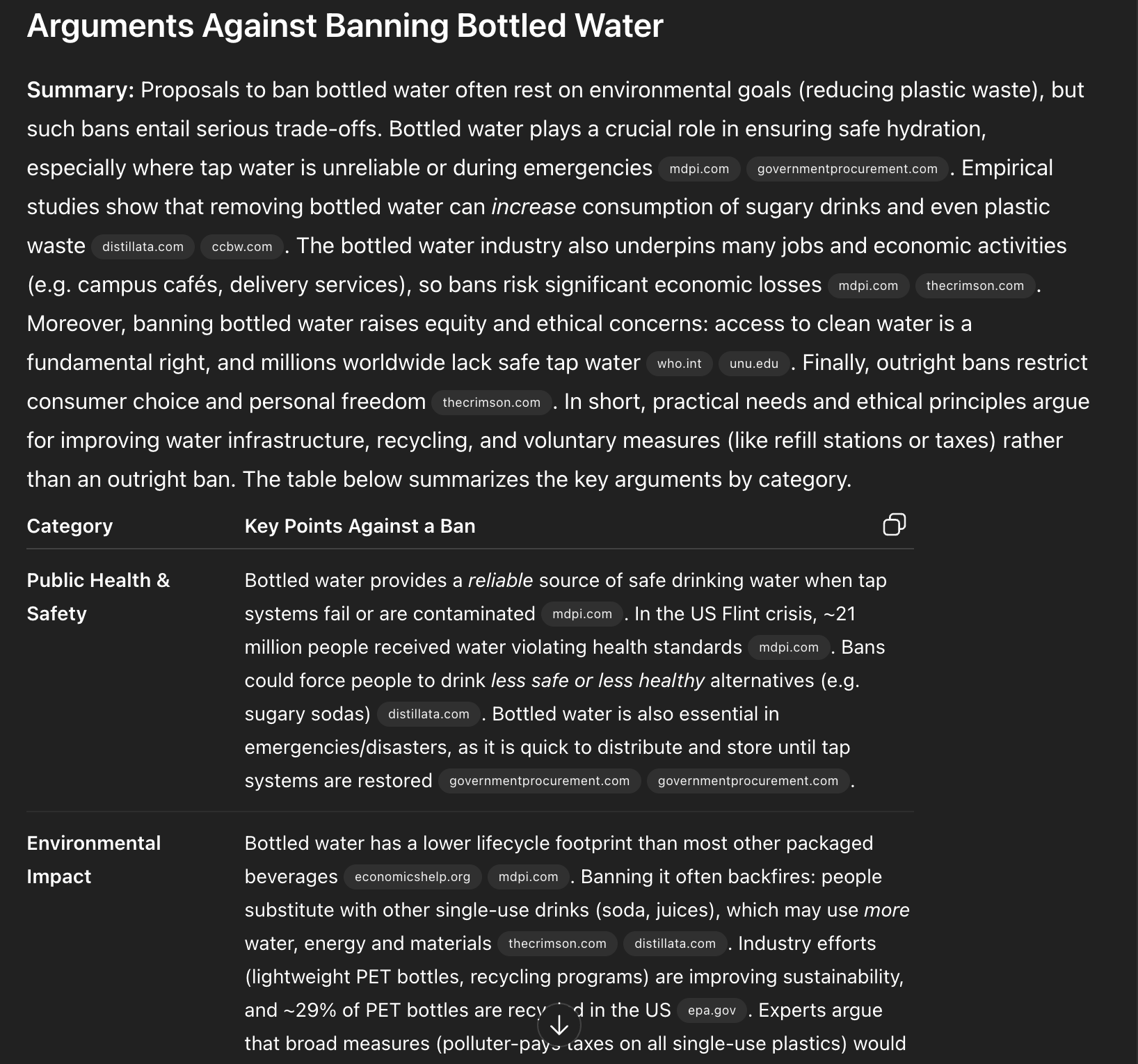
The image is a screenshot of a document titled "Arguments Against Banning Bottled Water." It includes a summary section and a structured table categorizing key arguments against such bans. The text is presented in white on a dark background, with citations (e.g., `mdpi.com`, `thecrimson.com`) embedded in parentheses.
### Components/Axes
- **Summary Section**:
- Text discussing trade-offs of banning bottled water, emphasizing its role in emergencies, economic impacts, and ethical concerns.
- Mentions empirical studies and sources like `distillata.com` and `governmentprocurement.com`.
- **Table**:
- **Columns**:
1. **Category** (e.g., Public Health & Safety, Environmental Impact).
2. **Key Points Against a Ban** (detailed arguments with citations).
### Detailed Analysis
#### Summary Section
- Proposals to ban bottled water prioritize environmental goals (e.g., reducing plastic waste) but risk trade-offs:
- Bottled water ensures safe hydration where tap water is unreliable (e.g., emergencies).
- Removing bottled water may increase consumption of sugary drinks and plastic waste (sources: `distillata.com`, `ccbw.com`).
- The bottled water industry supports jobs and economic activities (e.g., campus cafés, delivery services).
- Bans raise equity concerns: millions lack access to safe tap water globally (`who.int`, `unu.edu`).
- Ethical principles favor improving infrastructure/recycling over bans.
#### Table: Key Points Against a Ban
1. **Public Health & Safety**
- Bottled water provides a reliable safe drinking water source when tap systems fail or are contaminated (source: `mdpi.com`).
- Example: ~21 million people in the US Flint crisis received water violating health standards (source: `mdpi.com`).
- Bans could force reliance on less healthy alternatives (e.g., sugary sodas) (source: `distillata.com`).
- Critical in emergencies/disasters due to quick distribution (source: `governmentprocurement.com`).
2. **Environmental Impact**
- Bottled water has a lower lifecycle footprint than most packaged beverages (source: `economicshelp.org`).
- Substituting bottled water with single-use drinks (e.g., soda) may increase water/energy use (source: `thecrimson.com`).
- Industry efforts improve sustainability: ~29% PET bottle recycling rate in the US (source: `epa.gov`).
- Broad measures (e.g., polluter-pays taxes) could address plastic waste more effectively.
### Key Observations
- The document emphasizes **practicality** and **ethical necessity** of bottled water in vulnerable scenarios.
- Data points (e.g., Flint crisis, recycling rates) are approximate and cited with sources.
- Arguments contrast bottled water’s benefits with risks of alternatives, framing bans as counterproductive.
### Interpretation
The document argues that banning bottled water overlooks its critical role in public health, economic stability, and emergency preparedness. While acknowledging environmental concerns, it advocates for targeted solutions (e.g., recycling incentives, infrastructure investment) rather than outright bans. The use of empirical studies and statistics (e.g., Flint crisis, recycling rates) strengthens its case, though the approximate nature of some data (e.g., ~21 million affected) introduces uncertainty. The focus on equity and consumer choice highlights a tension between environmental goals and immediate human needs.