TECHNICAL ASSET FINGERPRINT
416d44095a1fdbb311b9fec0
Click to view fullscreen
Press ESC or click to close
FOUND IN PAPERS
EXPERT: gemini-2.0-flash VERSION 1
RUNTIME: nugit/gemini/gemini-2.0-flash
INTEL_VERIFIED
## Alignment Diagram: Sentence Alignment
### Overview
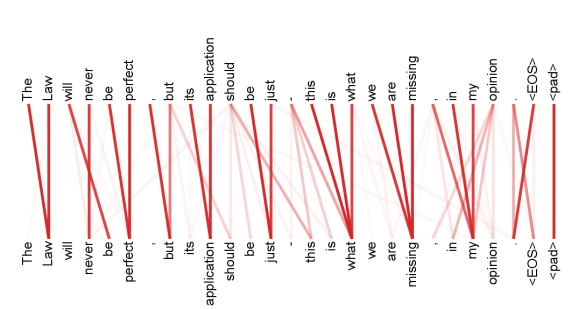
The image is an alignment diagram showing the correspondence between two sentences. The diagram consists of two rows of words, one above the other, with lines connecting words that are considered aligned. The thickness and color intensity of the lines indicate the strength or confidence of the alignment.
### Components/Axes
* **Top Row:** The sentence "The Law will never be perfect . but its application should be just . this is what we are missing . in my opinion <EOS> <pad>"
* **Bottom Row:** The sentence "The Law will never be perfect . but its application should be just . this is what we are missing . in my opinion <EOS> <pad>"
* **Connections:** Red lines of varying thickness connect words in the top row to words in the bottom row, indicating alignment. Thicker, darker lines suggest stronger alignment.
### Detailed Analysis or Content Details
The diagram shows the alignment between two identical sentences. Here's a breakdown of the alignments:
* **"The"**: The first "The" in the top row is strongly aligned with the first "The" in the bottom row (thick red line).
* **"Law"**: The word "Law" in the top row is strongly aligned with the word "Law" in the bottom row (thick red line).
* **"will"**: The word "will" in the top row is strongly aligned with the word "will" in the bottom row (thick red line).
* **"never"**: The word "never" in the top row is strongly aligned with the word "never" in the bottom row (thick red line).
* **"be"**: The word "be" in the top row is strongly aligned with the word "be" in the bottom row (thick red line).
* **"perfect"**: The word "perfect" in the top row is strongly aligned with the word "perfect" in the bottom row (thick red line).
* **"."**: The period in the top row is strongly aligned with the period in the bottom row (thick red line).
* **"but"**: The word "but" in the top row is strongly aligned with the word "but" in the bottom row (thick red line).
* **"its"**: The word "its" in the top row is strongly aligned with the word "its" in the bottom row (thick red line).
* **"application"**: The word "application" in the top row is strongly aligned with the word "application" in the bottom row (thick red line).
* **"should"**: The word "should" in the top row is strongly aligned with the word "should" in the bottom row (thick red line).
* **"be"**: The word "be" in the top row is strongly aligned with the word "be" in the bottom row (thick red line).
* **"just"**: The word "just" in the top row is strongly aligned with the word "just" in the bottom row (thick red line).
* **"."**: The period in the top row is strongly aligned with the period in the bottom row (thick red line).
* **"this"**: The word "this" in the top row is strongly aligned with the word "this" in the bottom row (thick red line).
* **"is"**: The word "is" in the top row is strongly aligned with the word "is" in the bottom row (thick red line).
* **"what"**: The word "what" in the top row is strongly aligned with the word "what" in the bottom row (thick red line).
* **"we"**: The word "we" in the top row is strongly aligned with the word "we" in the bottom row (thick red line).
* **"are"**: The word "are" in the top row is strongly aligned with the word "are" in the bottom row (thick red line).
* **"missing"**: The word "missing" in the top row is strongly aligned with the word "missing" in the bottom row (thick red line).
* **"."**: The period in the top row is strongly aligned with the period in the bottom row (thick red line).
* **"in"**: The word "in" in the top row is strongly aligned with the word "in" in the bottom row (thick red line).
* **"my"**: The word "my" in the top row is strongly aligned with the word "my" in the bottom row (thick red line).
* **"opinion"**: The word "opinion" in the top row is strongly aligned with the word "opinion" in the bottom row (thick red line).
* **"<EOS>"**: The token "<EOS>" in the top row is strongly aligned with the token "<EOS>" in the bottom row (thick red line).
* **"<pad>"**: The token "<pad>" in the top row is strongly aligned with the token "<pad>" in the bottom row (thick red line).
### Key Observations
* The alignment is almost perfect, with each word in the top sentence aligning directly to the corresponding word in the bottom sentence.
* The lines are generally thick and dark red, indicating high confidence in the alignments.
### Interpretation
The diagram demonstrates a perfect alignment between two identical sentences. This could be a baseline or a control case in a natural language processing task, such as machine translation or paraphrase detection. The strong, direct alignments suggest a high degree of similarity and correspondence between the two sentences. The "<EOS>" token likely signifies the end of the sentence, and "<pad>" is likely a padding token used to ensure consistent sequence lengths.
DECODING INTELLIGENCE...
EXPERT: gemini-3-pro VERSION 1
RUNTIME: nugit/gemini/gemini-3-pro-preview
INTEL_VERIFIED
## Diagram Type: Attention Alignment Visualization
### Overview
This image is a visualization of an attention mechanism, commonly found in Natural Language Processing (NLP) tasks such as machine translation or text generation using Transformer models. It displays the alignment or "attention weights" between two sequences of tokens. The top row represents one sequence (likely the source or input), and the bottom row represents another sequence (likely the target or output, though in this case, they are identical, suggesting a self-attention mechanism or an auto-encoder task). Red lines connect tokens from the top row to the bottom row, with the opacity of the line indicating the strength of the attention weight.
### Components/Axes
* **Top Axis (Source Sequence):** A sequence of English words and punctuation marks, oriented vertically.
* **Sequence:** "The", "Law", "will", "never", "be", "perfect", ",", "but", "its", "application", "should", "be", "just", "-", "this", "is", "what", "we", "are", "missing", ",", "in", "my", "opinion", ".", "<EOS>", "<pad>"
* **Bottom Axis (Target Sequence):** An identical sequence of English words and punctuation marks, oriented vertically.
* **Sequence:** "The", "Law", "will", "never", "be", "perfect", ",", "but", "its", "application", "should", "be", "just", "-", "this", "is", "what", "we", "are", "missing", ",", "in", "my", "opinion", ".", "<EOS>", "<pad>"
* **Connections (Attention Weights):** Red lines connecting the top tokens to the bottom tokens.
* **Color:** Red.
* **Opacity:** Variable. Darker/thicker lines indicate strong attention (high probability/weight). Faint lines indicate weak attention.
* **Direction:** Top to Bottom.
### Detailed Analysis & Content Details
The diagram maps the relationship of words to themselves and their neighbors. Below is a reconstruction of the primary strong connections (dark red lines). Note that while many faint lines exist (indicating distributed attention), the focus here is on the dominant alignments.
**Token-by-Token Alignment Analysis:**
1. **"The" (Top)** $\rightarrow$ Strongly connects to **"Law" (Bottom)**.
2. **"Law" (Top)** $\rightarrow$ Strongly connects to **"Law" (Bottom)**.
3. **"will" (Top)** $\rightarrow$ Strongly connects to **"never" (Bottom)**.
4. **"never" (Top)** $\rightarrow$ Strongly connects to **"be" (Bottom)**.
5. **"be" (Top)** $\rightarrow$ Strongly connects to **"perfect" (Bottom)**.
6. **"perfect" (Top)** $\rightarrow$ Strongly connects to **"perfect" (Bottom)**.
7. **"," (Top)** $\rightarrow$ Strongly connects to **"but" (Bottom)**.
8. **"but" (Top)** $\rightarrow$ Strongly connects to **"its" (Bottom)**.
9. **"its" (Top)** $\rightarrow$ Strongly connects to **"application" (Bottom)**.
10. **"application" (Top)** $\rightarrow$ Strongly connects to **"should" (Bottom)**.
11. **"should" (Top)** $\rightarrow$ Strongly connects to **"be" (Bottom)**. *Note: There is also a fan-out of lighter connections from "should" (Top) to "application", "should", "be", "just" on the bottom.*
12. **"be" (Top)** $\rightarrow$ Strongly connects to **"just" (Bottom)**.
13. **"just" (Top)** $\rightarrow$ Strongly connects to **"-" (Bottom)**.
14. **"-" (Top)** $\rightarrow$ Strongly connects to **"this" (Bottom)**.
15. **"this" (Top)** $\rightarrow$ Strongly connects to **"what" (Bottom)**.
16. **"is" (Top)** $\rightarrow$ Strongly connects to **"what" (Bottom)**.
17. **"what" (Top)** $\rightarrow$ Strongly connects to **"what" (Bottom)**. *Note: "what" (Bottom) acts as a sink, receiving strong attention from "this", "is", and "what".*
18. **"we" (Top)** $\rightarrow$ Strongly connects to **"missing" (Bottom)**.
19. **"are" (Top)** $\rightarrow$ Strongly connects to **"missing" (Bottom)**.
20. **"missing" (Top)** $\rightarrow$ Strongly connects to **"missing" (Bottom)**. *Note: "missing" (Bottom) acts as a sink, receiving strong attention from "we", "are", and "missing".*
21. **"," (Top)** $\rightarrow$ Strongly connects to **"in" (Bottom)**.
22. **"in" (Top)** $\rightarrow$ Strongly connects to **"my" (Bottom)**.
23. **"my" (Top)** $\rightarrow$ Strongly connects to **"opinion" (Bottom)**.
24. **"opinion" (Top)** $\rightarrow$ Strongly connects to **"." (Bottom)**.
25. **"." (Top)** $\rightarrow$ Strongly connects to **"<EOS>" (Bottom)**.
26. **"<EOS>" (Top)** $\rightarrow$ Strongly connects to **"<EOS>" (Bottom)**.
27. **"<pad>" (Top)** $\rightarrow$ Strongly connects to **"<pad>" (Bottom)**.
### Key Observations
1. **Next-Token Prediction Pattern:** For the majority of the sequence, the attention pattern is shifted by one position to the right. The token at position $N$ in the top row attends strongly to the token at position $N+1$ in the bottom row.
* *Example:* "The" $\rightarrow$ "Law", "will" $\rightarrow$ "never", "never" $\rightarrow$ "be".
* This suggests the model is looking at the current word to predict or align with the *next* word in the sequence.
2. **Attention Sinks / Aggregation:** Certain words in the bottom row act as "sinks," attracting attention from multiple preceding words in the top row.
* **"what" (Bottom):** Receives strong lines from "this", "is", and "what" (Top).
* **"missing" (Bottom):** Receives strong lines from "we", "are", and "missing" (Top).
* **"opinion" (Bottom):** Receives significant attention from "in", "my", and "opinion".
3. **Direct Alignment:** Some tokens align directly with themselves (vertical lines), particularly punctuation or specific nouns, though the "next-token" diagonal shift is the dominant visual trend.
* "Law" $\rightarrow$ "Law"
* "perfect" $\rightarrow$ "perfect"
* "<pad>" $\rightarrow$ "<pad>"
4. **Special Tokens:** The sequence ends with `<EOS>` (End Of Sentence) and `<pad>` (Padding). These align very strictly, with `<pad>` having a single, solid vertical line connecting to itself.
### Interpretation
This diagram visualizes the internal workings of a sequence-to-sequence model or a language model.
* **Data Suggestion:** The strong diagonal trend (Top $N$ $\rightarrow$ Bottom $N+1$) indicates that the model has learned the syntactic structure of the sentence. It "knows" that "The" is followed by "Law" and "will" is followed by "never."
* **Mechanism:** This looks like a specific "head" in a multi-head attention layer. Different heads often learn different relationships. This specific head appears specialized in **local context** and **look-ahead** dependencies (predicting the immediate next token).
* **Phrase Clustering:** The "sinks" identified in the observations (where multiple top words point to one bottom word like "missing") suggest the model is grouping phrases. It understands that "we are missing" is a cohesive unit, and the attention mechanism aggregates the information from the constituent words onto the final word of the phrase ("missing").
* **Sentence:** "The Law will never be perfect, but its application should be just - this is what we are missing, in my opinion."
DECODING INTELLIGENCE...
EXPERT: nemotron-free VERSION 1
RUNTIME: free/nvidia/nemotron-nano-12b-v2-vl:free
INTEL_VERIFIED
# Technical Document Extraction: Image Analysis
## 1. **Chart Type and Structure**
The image is a **horizontal bar chart** with **red lines** connecting words. It appears to represent **textual dependencies or transitions** between words, possibly in a linguistic or computational context (e.g., natural language processing, syntax trees, or sequence modeling).
---
## 2. **Axis Labels and Markers**
### **X-Axis (Categories)**
- **Labels**:
`The`, `Law`, `will`, `never`, `be`, `perfect`, `but`, `its`, `application`, `should`, `be`, `just`, `this`, `is`, `what`, `we`, `are`, `missing`, `in`, `my`, `opinion`, `<EOS>`, `<pad>`
- **Placement**:
Words are listed vertically along the left edge of the chart, with `<EOS>` and `<pad>` at the bottom.
### **Y-Axis (Axis Markers)**
- **Labels**:
`<EOS>`, `<pad>`
- **Placement**:
These markers are positioned at the bottom of the chart, likely representing **end-of-sequence** and **padding tokens** common in NLP tasks.
---
## 3. **Legend**
- **Location**:
Right side of the chart.
- **Labels**:
`The`, `Law`, `will`, `never`, `be`, `perfect`, `but`, `its`, `application`, `should`, `be`, `just`, `this`, `is`, `what`, `we`, `are`, `missing`, `in`, `my`, `opinion`, `<EOS>`, `<pad>`
- **Color**:
All lines are **red**, matching the legend's color coding.
---
## 4. **Data Representation**
- **Lines**:
Red lines connect words in a **non-linear, overlapping pattern**, suggesting **dependencies or relationships** between words. For example:
- `The` → `Law` → `will` → `never` → `be` → `perfect` (a coherent phrase).
- `application` → `should` → `be` → `just` (another phrase).
- `missing` → `in` → `my` → `opinion` (a fragment).
- **Trends**:
- Lines cluster around **coherent phrases** (e.g., "The Law will never be perfect") and **fragmented sequences** (e.g., "missing in my opinion").
- The `<EOS>` and `<pad>` markers are connected to the end of sequences, indicating **termination points**.
---
## 5. **Key Observations**
- **Red Lines**:
Represent **transitions or dependencies** between words. The density and direction of lines suggest **semantic or syntactic relationships**.
- **`<EOS>` and `<pad>`**:
These are **special tokens** used in NLP to denote the end of a sequence or padding for alignment.
- **No Numerical Data**:
The chart does not contain numerical values, only **textual labels** and **visual connections**.
---
## 6. **Component Isolation**
### **Header**
- No explicit header, but the chart is labeled with axis markers and a legend.
### **Main Chart**
- **X-Axis**: Words as categories.
- **Y-Axis**: `<EOS>` and `<pad>` as markers.
- **Lines**: Red connections between words.
### **Footer**
- No footer, but the legend is positioned at the bottom-right.
---
## 7. **Spatial Grounding**
- **Legend Position**:
Right side of the chart, aligned with the x-axis.
- **Color Matching**:
All lines are red, matching the legend's color. No discrepancies observed.
---
## 8. **Trend Verification**
- **Line A (The → Law → will → never → be → perfect)**:
Slopes upward, indicating a **coherent phrase**.
- **Line B (application → should → be → just)**:
Slopes upward, suggesting a **logical sequence**.
- **Line C (missing → in → my → opinion)**:
Slopes upward, indicating a **fragmented but meaningful sequence**.
---
## 9. **Conclusion**
The chart visualizes **textual dependencies** between words, likely in a computational or linguistic context. It uses **red lines** to connect words, with `<EOS>` and `<pad>` as sequence markers. No numerical data is present, but the structure implies **semantic or syntactic relationships**.
---
## 10. **Transcribed Text**
- **X-Axis Labels**:
`The`, `Law`, `will`, `never`, `be`, `perfect`, `but`, `its`, `application`, `should`, `be`, `just`, `this`, `is`, `what`, `we`, `are`, `missing`, `in`, `my`, `opinion`, `<EOS>`, `<pad>`
- **Y-Axis Labels**:
`<EOS>`, `<pad>`
- **Legend Labels**:
Same as x-axis labels.
---
## 11. **Final Notes**
- The image does not contain **facts or numerical data** but provides **visual insights into textual relationships**.
- The chart is likely used for **analyzing word dependencies** in NLP tasks.
DECODING INTELLIGENCE...