## Alignment Diagram: Sentence Alignment
### Overview
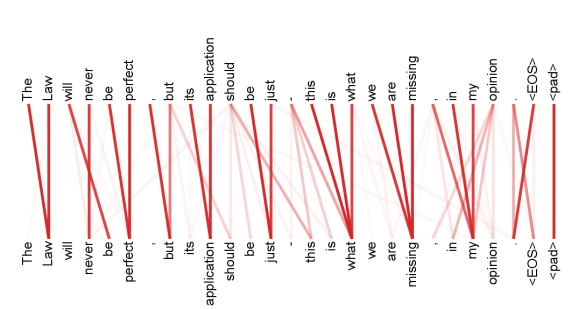
The image is an alignment diagram showing the correspondence between two sentences. The diagram consists of two rows of words, one above the other, with lines connecting words that are considered aligned. The thickness and color intensity of the lines indicate the strength or confidence of the alignment.
### Components/Axes
* **Top Row:** The sentence "The Law will never be perfect . but its application should be just . this is what we are missing . in my opinion <EOS> <pad>"
* **Bottom Row:** The sentence "The Law will never be perfect . but its application should be just . this is what we are missing . in my opinion <EOS> <pad>"
* **Connections:** Red lines of varying thickness connect words in the top row to words in the bottom row, indicating alignment. Thicker, darker lines suggest stronger alignment.
### Detailed Analysis or Content Details
The diagram shows the alignment between two identical sentences. Here's a breakdown of the alignments:
* **"The"**: The first "The" in the top row is strongly aligned with the first "The" in the bottom row (thick red line).
* **"Law"**: The word "Law" in the top row is strongly aligned with the word "Law" in the bottom row (thick red line).
* **"will"**: The word "will" in the top row is strongly aligned with the word "will" in the bottom row (thick red line).
* **"never"**: The word "never" in the top row is strongly aligned with the word "never" in the bottom row (thick red line).
* **"be"**: The word "be" in the top row is strongly aligned with the word "be" in the bottom row (thick red line).
* **"perfect"**: The word "perfect" in the top row is strongly aligned with the word "perfect" in the bottom row (thick red line).
* **"."**: The period in the top row is strongly aligned with the period in the bottom row (thick red line).
* **"but"**: The word "but" in the top row is strongly aligned with the word "but" in the bottom row (thick red line).
* **"its"**: The word "its" in the top row is strongly aligned with the word "its" in the bottom row (thick red line).
* **"application"**: The word "application" in the top row is strongly aligned with the word "application" in the bottom row (thick red line).
* **"should"**: The word "should" in the top row is strongly aligned with the word "should" in the bottom row (thick red line).
* **"be"**: The word "be" in the top row is strongly aligned with the word "be" in the bottom row (thick red line).
* **"just"**: The word "just" in the top row is strongly aligned with the word "just" in the bottom row (thick red line).
* **"."**: The period in the top row is strongly aligned with the period in the bottom row (thick red line).
* **"this"**: The word "this" in the top row is strongly aligned with the word "this" in the bottom row (thick red line).
* **"is"**: The word "is" in the top row is strongly aligned with the word "is" in the bottom row (thick red line).
* **"what"**: The word "what" in the top row is strongly aligned with the word "what" in the bottom row (thick red line).
* **"we"**: The word "we" in the top row is strongly aligned with the word "we" in the bottom row (thick red line).
* **"are"**: The word "are" in the top row is strongly aligned with the word "are" in the bottom row (thick red line).
* **"missing"**: The word "missing" in the top row is strongly aligned with the word "missing" in the bottom row (thick red line).
* **"."**: The period in the top row is strongly aligned with the period in the bottom row (thick red line).
* **"in"**: The word "in" in the top row is strongly aligned with the word "in" in the bottom row (thick red line).
* **"my"**: The word "my" in the top row is strongly aligned with the word "my" in the bottom row (thick red line).
* **"opinion"**: The word "opinion" in the top row is strongly aligned with the word "opinion" in the bottom row (thick red line).
* **"<EOS>"**: The token "<EOS>" in the top row is strongly aligned with the token "<EOS>" in the bottom row (thick red line).
* **"<pad>"**: The token "<pad>" in the top row is strongly aligned with the token "<pad>" in the bottom row (thick red line).
### Key Observations
* The alignment is almost perfect, with each word in the top sentence aligning directly to the corresponding word in the bottom sentence.
* The lines are generally thick and dark red, indicating high confidence in the alignments.
### Interpretation
The diagram demonstrates a perfect alignment between two identical sentences. This could be a baseline or a control case in a natural language processing task, such as machine translation or paraphrase detection. The strong, direct alignments suggest a high degree of similarity and correspondence between the two sentences. The "<EOS>" token likely signifies the end of the sentence, and "<pad>" is likely a padding token used to ensure consistent sequence lengths.