\n
## Diagram: Connection Map of Words
### Overview
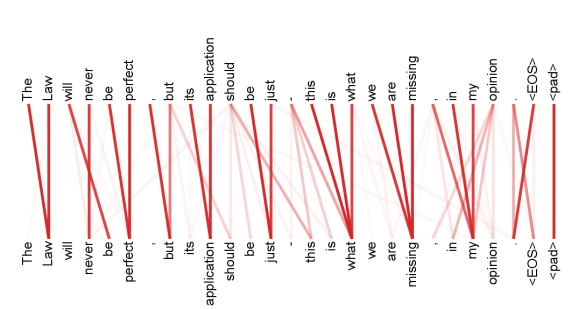
The image depicts a connection map between words, visualized as a series of lines connecting each word to every other word. The words are arranged horizontally along both the x and y axes. The lines are a reddish-pink color and appear to represent some form of relationship or association between the words. The background is a light gray.
### Components/Axes
The diagram consists of the following words, arranged along both axes:
* "The"
* "Law"
* "will"
* "never"
* "be"
* "perfect"
* "but"
* "its"
* "application"
* "should"
* "just"
* "this"
* "is"
* "what"
* "we"
* "are"
* "missing"
* "in"
* "my"
* "opinion"
* "<EOS>"
* "<pad>"
There are no explicit axis titles or a legend. The axes are implicitly defined by the arrangement of the words.
### Detailed Analysis
The diagram shows a full connection matrix, meaning every word is connected to every other word with a line. The lines are all the same color, indicating that the type of relationship between the words is consistent across all connections. The lines are relatively thin and numerous, creating a dense network of connections.
There is no numerical data associated with the connections. The diagram is purely visual, representing the presence or absence of a connection between words.
### Key Observations
The diagram demonstrates that every word is related to every other word in the set. The density of the connections suggests a high degree of interconnectedness between the concepts represented by these words. The inclusion of "<EOS>" and "<pad>" suggests this data may be related to a language model or text processing task, where these tokens are used for sentence boundary and padding purposes.
### Interpretation
This diagram likely represents a co-occurrence or association matrix derived from a corpus of text. Each line indicates that two words appeared together within a certain context (e.g., within a sentence or a fixed-size window). The diagram suggests that all the words in the set are relevant to the same underlying topic or domain. The presence of "<EOS>" and "<pad>" further supports the hypothesis that this diagram is a visualization of data used in natural language processing.
The diagram doesn't reveal the *strength* of the relationships between words, only their *existence*. It's possible that some connections are more frequent or significant than others, but this information is not conveyed in the visualization. The diagram is a high-level overview of the relationships between words, and further analysis would be needed to understand the nuances of these connections.
The choice of words ("Law", "perfect", "opinion", "missing") suggests a possible theme related to legal reasoning, evaluation, or critique. However, without knowing the source text, it's difficult to draw definitive conclusions.