# Technical Document Extraction: Image Analysis
## 1. **Chart Type and Structure**
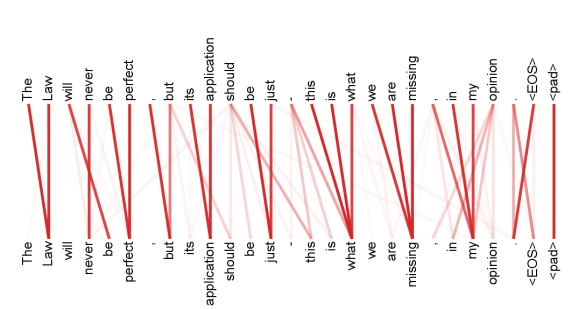
The image is a **horizontal bar chart** with **red lines** connecting words. It appears to represent **textual dependencies or transitions** between words, possibly in a linguistic or computational context (e.g., natural language processing, syntax trees, or sequence modeling).
---
## 2. **Axis Labels and Markers**
### **X-Axis (Categories)**
- **Labels**:
`The`, `Law`, `will`, `never`, `be`, `perfect`, `but`, `its`, `application`, `should`, `be`, `just`, `this`, `is`, `what`, `we`, `are`, `missing`, `in`, `my`, `opinion`, `<EOS>`, `<pad>`
- **Placement**:
Words are listed vertically along the left edge of the chart, with `<EOS>` and `<pad>` at the bottom.
### **Y-Axis (Axis Markers)**
- **Labels**:
`<EOS>`, `<pad>`
- **Placement**:
These markers are positioned at the bottom of the chart, likely representing **end-of-sequence** and **padding tokens** common in NLP tasks.
---
## 3. **Legend**
- **Location**:
Right side of the chart.
- **Labels**:
`The`, `Law`, `will`, `never`, `be`, `perfect`, `but`, `its`, `application`, `should`, `be`, `just`, `this`, `is`, `what`, `we`, `are`, `missing`, `in`, `my`, `opinion`, `<EOS>`, `<pad>`
- **Color**:
All lines are **red**, matching the legend's color coding.
---
## 4. **Data Representation**
- **Lines**:
Red lines connect words in a **non-linear, overlapping pattern**, suggesting **dependencies or relationships** between words. For example:
- `The` → `Law` → `will` → `never` → `be` → `perfect` (a coherent phrase).
- `application` → `should` → `be` → `just` (another phrase).
- `missing` → `in` → `my` → `opinion` (a fragment).
- **Trends**:
- Lines cluster around **coherent phrases** (e.g., "The Law will never be perfect") and **fragmented sequences** (e.g., "missing in my opinion").
- The `<EOS>` and `<pad>` markers are connected to the end of sequences, indicating **termination points**.
---
## 5. **Key Observations**
- **Red Lines**:
Represent **transitions or dependencies** between words. The density and direction of lines suggest **semantic or syntactic relationships**.
- **`<EOS>` and `<pad>`**:
These are **special tokens** used in NLP to denote the end of a sequence or padding for alignment.
- **No Numerical Data**:
The chart does not contain numerical values, only **textual labels** and **visual connections**.
---
## 6. **Component Isolation**
### **Header**
- No explicit header, but the chart is labeled with axis markers and a legend.
### **Main Chart**
- **X-Axis**: Words as categories.
- **Y-Axis**: `<EOS>` and `<pad>` as markers.
- **Lines**: Red connections between words.
### **Footer**
- No footer, but the legend is positioned at the bottom-right.
---
## 7. **Spatial Grounding**
- **Legend Position**:
Right side of the chart, aligned with the x-axis.
- **Color Matching**:
All lines are red, matching the legend's color. No discrepancies observed.
---
## 8. **Trend Verification**
- **Line A (The → Law → will → never → be → perfect)**:
Slopes upward, indicating a **coherent phrase**.
- **Line B (application → should → be → just)**:
Slopes upward, suggesting a **logical sequence**.
- **Line C (missing → in → my → opinion)**:
Slopes upward, indicating a **fragmented but meaningful sequence**.
---
## 9. **Conclusion**
The chart visualizes **textual dependencies** between words, likely in a computational or linguistic context. It uses **red lines** to connect words, with `<EOS>` and `<pad>` as sequence markers. No numerical data is present, but the structure implies **semantic or syntactic relationships**.
---
## 10. **Transcribed Text**
- **X-Axis Labels**:
`The`, `Law`, `will`, `never`, `be`, `perfect`, `but`, `its`, `application`, `should`, `be`, `just`, `this`, `is`, `what`, `we`, `are`, `missing`, `in`, `my`, `opinion`, `<EOS>`, `<pad>`
- **Y-Axis Labels**:
`<EOS>`, `<pad>`
- **Legend Labels**:
Same as x-axis labels.
---
## 11. **Final Notes**
- The image does not contain **facts or numerical data** but provides **visual insights into textual relationships**.
- The chart is likely used for **analyzing word dependencies** in NLP tasks.