## Diagram: Category Theory Transformations
### Overview
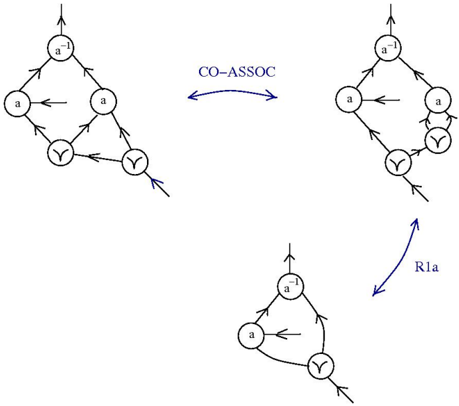
The image depicts a series of transformations in category theory, represented by diagrams with nodes and arrows. The transformations are labeled as "CO-ASSOC" and "R1a". The diagrams show how different compositions of morphisms (represented by the nodes and arrows) are equivalent under these transformations.
### Components/Axes
* **Nodes:** Represented by circles, labeled with "a", "a<sup>-1</sup>", or a "Y" symbol. These likely represent objects or morphisms in a category.
* **Arrows:** Indicate the direction of morphisms or transformations between objects.
* **Labels:**
* "CO-ASSOC": Indicates a co-associativity transformation.
* "R1a": Indicates a specific rule or transformation, possibly related to a right identity.
### Detailed Analysis
The image can be broken down into three distinct diagrams, connected by transformation arrows.
**Diagram 1 (Top-Left):**
* A node labeled "a<sup>-1</sup>" is at the top.
* Two nodes labeled "a" are on the left and right sides, slightly below the top node.
* Two nodes with the "Y" symbol are at the bottom.
* Arrows connect the nodes, forming a network. One arrow points from the left "a" node back towards the "a<sup>-1</sup>" node.
* One arrow exits the bottom-right "Y" node.
**Diagram 2 (Top-Right):**
* Similar structure to Diagram 1, with nodes labeled "a<sup>-1</sup>", "a", "a", and two "Y" symbols.
* The "Y" symbols are positioned closer together than in Diagram 1.
* Arrows connect the nodes, forming a network.
* One arrow exits the bottom-right "Y" node.
**Diagram 3 (Bottom):**
* A node labeled "a<sup>-1</sup>" is at the top.
* A node labeled "a" is on the left side, slightly below the top node.
* One node with the "Y" symbol is at the bottom.
* Arrows connect the nodes, forming a network.
* One arrow exits the bottom "Y" node.
**Transformations:**
* A double-headed arrow labeled "CO-ASSOC" connects Diagram 1 to Diagram 2, indicating a co-associativity transformation.
* A curved arrow labeled "R1a" connects Diagram 2 to Diagram 3, indicating a transformation rule.
### Key Observations
* The diagrams represent compositions of morphisms and their transformations.
* The "CO-ASSOC" transformation likely rearranges the order of composition.
* The "R1a" transformation likely simplifies the diagram by applying a specific rule.
* The "Y" symbol likely represents a specific type of morphism or operation.
### Interpretation
The image illustrates how different compositions of morphisms are equivalent under the "CO-ASSOC" and "R1a" transformations. This is a fundamental concept in category theory, where the focus is on the relationships between objects and morphisms rather than the specific nature of the objects themselves. The diagrams provide a visual representation of these relationships and how they can be manipulated using these transformations. The "CO-ASSOC" transformation demonstrates that the order in which morphisms are composed does not affect the overall result, while the "R1a" transformation simplifies the diagram by applying a specific rule, possibly related to an identity morphism. The "Y" symbol likely represents a specific type of morphism or operation that is relevant to these transformations.