## Text Block: Narrative of Acquiring a Toy
### Overview
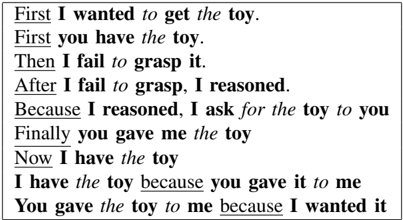
The image contains a block of text describing a sequential narrative about acquiring a toy. The text uses bolded temporal and causal markers (e.g., "First," "Then," "Because") to structure the story, which progresses from desire to resolution.
### Components/Axes
- **Temporal Markers**: Bolded words like "First," "Then," "After," "Because," "Finally," and "Now" indicate the order of events.
- **Causal Link**: The phrase "because" explicitly connects actions to motivations.
- **Key Entities**: Repeated references to "the toy," "you," and "I" establish the actors and object.
### Detailed Analysis
1. **First I wanted to get the toy.**
- Bolded "First" introduces the initial desire.
2. **First you have the toy.**
- Bolded "First" shifts focus to the other party’s possession.
3. **Then I fail to grasp it.**
- Bolded "Then" marks a failed attempt.
4. **After I fail to grasp, I reasoned.**
- Bolded "After" introduces a reflective pause.
5. **Because I reasoned, I ask for the toy to you.**
- Bolded "Because" links reasoning to action.
6. **Finally you gave me the toy.**
- Bolded "Finally" concludes the sequence.
7. **Now I have the toy because you gave it to me.**
- Bolded "Now" emphasizes the outcome.
8. **You gave the toy to me because I wanted it.**
- Bolded "because" reinforces causality.
### Key Observations
- The narrative follows a **problem-solution structure**, with each step building on the previous one.
- Temporal markers ("First," "Then," "Finally") and causal markers ("Because") create a logical flow.
- The repetition of "First" and "Now" bookends the story, framing it as a beginning-to-end process.
- The use of "I" and "you" establishes a **dyadic interaction** (speaker and recipient).
### Interpretation
The text demonstrates a **causal chain of events** driven by desire, failure, reflection, and resolution. The bolded markers serve as narrative scaffolding, guiding the reader through the speaker’s emotional and logical journey. The final sentences explicitly tie the recipient’s action ("gave the toy") to the speaker’s motivation ("wanted it"), emphasizing reciprocity and cause-effect relationships. This structure could model decision-making processes, negotiation dynamics, or instructional storytelling.
No numerical data, charts, or diagrams are present. The image solely contains textual content with explicit temporal and causal relationships.