## Grid Diagram: 4x4 Matrix with Textual and Symbolic Elements
### Overview
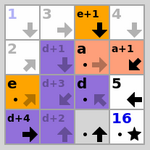
The image depicts a 4x4 grid composed of cells with varying colors, textual labels, numerical values, directional arrows, and symbolic markers. Each cell contains a combination of elements, suggesting a structured system with potential dependencies, operations, or relationships.
### Components/Axes
- **Grid Structure**:
- 4 rows and 4 columns, forming a matrix.
- Cells are colored in white, gray, orange, purple, pink, and blue.
- **Textual Labels**:
- Numbers (1, 2, 3, 4, 5, 16), letters (a, d, e), and expressions (e+1, d+1, d+2, d+3, d+4).
- Symbols: Star (⭐), dot (•), and directional arrows (↑, ↓, ←, →).
- **Color Coding**:
- Colors may represent categories or groups (e.g., orange for "e", purple for "d", pink for "a").
- No explicit legend is visible, so color assignments are inferred from context.
### Detailed Analysis
#### Row 1 (Top Row):
1. **Cell (1,1)**: White background, gray downward arrow (↓), labeled "1".
2. **Cell (1,2)**: White background, gray right arrow (→), labeled "3".
3. **Cell (1,3)**: Orange background, black downward arrow (↓), labeled "e+1".
4. **Cell (1,4)**: White background, gray downward arrow (↓), labeled "4".
#### Row 2:
1. **Cell (2,1)**: White background, gray upward arrow (↑), labeled "2".
2. **Cell (2,2)**: Purple background, black downward arrow (↓), labeled "d+1".
3. **Cell (2,3)**: Pink background, right arrow (→), labeled "a".
4. **Cell (2,4)**: Pink background, black downward arrow (↓), labeled "a+1".
#### Row 3:
1. **Cell (3,1)**: Orange background, right arrow (→), labeled "e".
2. **Cell (3,2)**: Purple background, black downward arrow (↓), labeled "d+3".
3. **Cell (3,3)**: Purple background, black left arrow (←), labeled "d".
4. **Cell (3,4)**: White background, left arrow (←), labeled "5".
#### Row 4 (Bottom Row):
1. **Cell (4,1)**: Purple background, right arrow (→), labeled "d+4".
2. **Cell (4,2)**: Purple background, upward arrow (↑), labeled "d+2".
3. **Cell (4,3)**: Gray background, dot (•) and upward arrow (↑), no text.
4. **Cell (4,4)**: White background, black star (⭐), labeled "16".
### Key Observations
- **Numerical Progression**: Numbers increase from 1 to 16, but not in strict sequential order (e.g., 1, 3, 4, 2, 5, 16).
- **Directional Arrows**: Arrows may indicate movement, dependencies, or flow between cells (e.g., "e+1" with a downward arrow could imply a transformation or operation).
- **Symbolic Markers**: The star (⭐) in the bottom-right cell (16) may denote a special node or endpoint.
- **Color Grouping**:
- Orange cells (e, e+1) likely relate to "e".
- Purple cells (d, d+1, d+2, d+3, d+4) likely relate to "d".
- Pink cells (a, a+1) likely relate to "a".
### Interpretation
The grid appears to represent a computational or algorithmic system with:
1. **Variables**: "a", "d", and "e" as key entities, with operations (e.g., "d+1", "e+1").
2. **Directional Relationships**: Arrows suggest dependencies or transitions (e.g., "d+1" with a downward arrow might indicate a step in a process).
3. **Numerical Values**: The numbers (1–16) could represent states, indices, or weights. The star (⭐) in cell (4,4) may signify a terminal or critical value.
4. **Color-Coded Categories**: The use of distinct colors (orange, purple, pink) likely groups related elements, though the exact meaning of colors is not explicitly defined.
### Notable Patterns
- **Arrows and Operations**: Cells with expressions (e.g., "e+1", "d+1") often have directional arrows, suggesting a link between operations and movement.
- **Asymmetry in Numbers**: The number 16 in the bottom-right cell stands out as the largest value, possibly indicating a final state or maximum.
- **Missing Labels**: Some cells (e.g., cell (4,3)) lack textual labels, relying solely on symbols (dot and arrow).
### Conclusion
This grid likely models a structured system with variables, operations, and directional dependencies. The absence of a legend limits definitive interpretation of color coding, but the textual and symbolic elements suggest a computational or algorithmic framework. Further context (e.g., a legend, explanatory text) would clarify the relationships between elements.