## Line Chart with Confidence Band: Step Length vs Reasoning Tokens for Four Shot Easy Blocksworld
### Overview
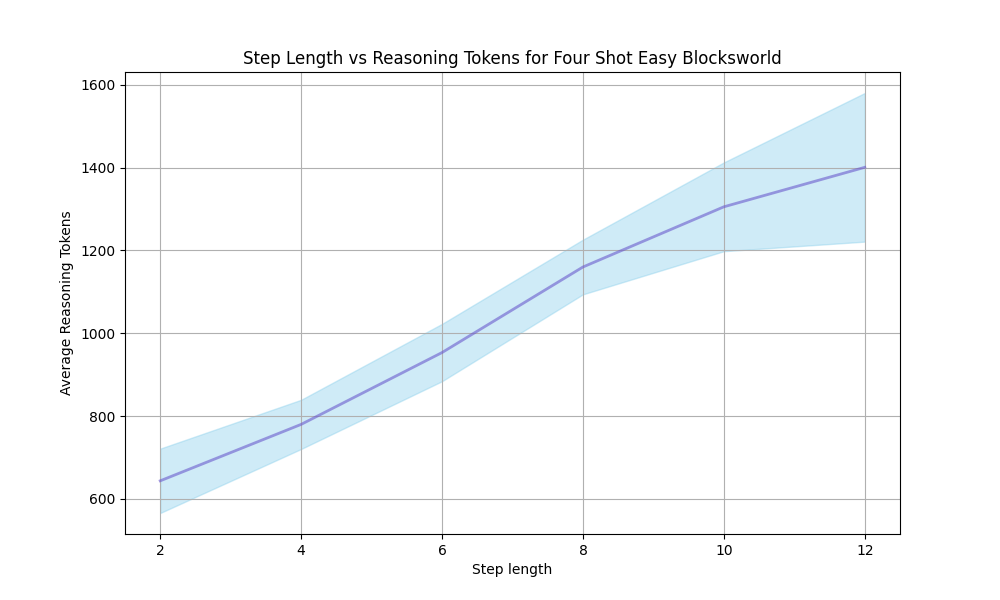
This is a line chart displaying the relationship between "Step length" and "Average Reasoning Tokens" for a task identified as "Four Shot Easy Blocksworld." The chart shows a clear positive correlation, with the average number of reasoning tokens increasing as the step length increases. A shaded region around the central trend line indicates the variability or confidence interval of the data.
### Components/Axes
* **Chart Title:** "Step Length vs Reasoning Tokens for Four Shot Easy Blocksworld" (centered at the top).
* **X-Axis (Horizontal):**
* **Label:** "Step length"
* **Scale:** Linear scale with major tick marks and labels at 2, 4, 6, 8, 10, and 12.
* **Y-Axis (Vertical):**
* **Label:** "Average Reasoning Tokens"
* **Scale:** Linear scale with major tick marks and labels at 600, 800, 1000, 1200, 1400, and 1600.
* **Data Series:**
* A single, solid purple line representing the mean or average trend.
* A light blue shaded area surrounding the purple line, representing the spread, standard deviation, or confidence interval of the data. The band is narrower at lower step lengths and widens significantly as step length increases.
* **Legend:** No separate legend is present. The title and axis labels provide the necessary context.
### Detailed Analysis
**Trend Verification:** The purple line exhibits a consistent, near-linear upward slope from left to right, confirming a positive relationship between the variables.
**Data Point Extraction (Approximate Values from the Purple Mean Line):**
* At Step length = 2: Average Reasoning Tokens ≈ 640
* At Step length = 4: Average Reasoning Tokens ≈ 790
* At Step length = 6: Average Reasoning Tokens ≈ 950
* At Step length = 8: Average Reasoning Tokens ≈ 1160
* At Step length = 10: Average Reasoning Tokens ≈ 1310
* At Step length = 12: Average Reasoning Tokens ≈ 1400
**Confidence Band Analysis (Approximate Bounds):**
* **Step length = 2:** The band spans roughly from 560 to 720 tokens (width ≈ 160).
* **Step length = 6:** The band spans roughly from 880 to 1020 tokens (width ≈ 140).
* **Step length = 12:** The band spans roughly from 1220 to 1580 tokens (width ≈ 360).
* **Observation:** The width of the confidence band is not constant. It appears relatively narrow at step lengths 2-6, then expands considerably at step lengths 8, 10, and 12, indicating greater variance or uncertainty in the average reasoning token count for longer step lengths.
### Key Observations
1. **Strong Positive Correlation:** There is a direct and strong positive correlation between step length and the average number of reasoning tokens required.
2. **Increasing Variance:** The uncertainty or variability in the token count (represented by the width of the blue band) increases substantially with step length. The prediction interval is much wider for a step length of 12 than for a step length of 2.
3. **Non-Perfect Linearity:** While the overall trend is linear, the slope appears to steepen slightly between step lengths 6 and 8 before possibly leveling off marginally between 10 and 12.
### Interpretation
The data suggests that for the "Four Shot Easy Blocksworld" task, solving problems that require more steps (longer step length) necessitates a proportionally greater amount of "reasoning" as measured by token generation. This implies a computational or cognitive cost that scales with problem complexity.
The most critical insight is the **widening confidence band**. This indicates that while the *average* reasoning cost increases predictably, the *specific* cost for any given instance becomes much less predictable as the problem gets longer. For short problems (step length 2-6), the model's reasoning effort is relatively consistent. For longer problems (step length 8+), the reasoning process becomes highly variable—some long problems may be solved with reasoning close to the average, while others may require significantly more or fewer tokens. This could point to factors like the specific configuration of the block world, the chosen solution path, or the model's strategy becoming more influential and variable as the problem scale increases.