## Bar Chart: Shifter: Time vs Core count
### Overview
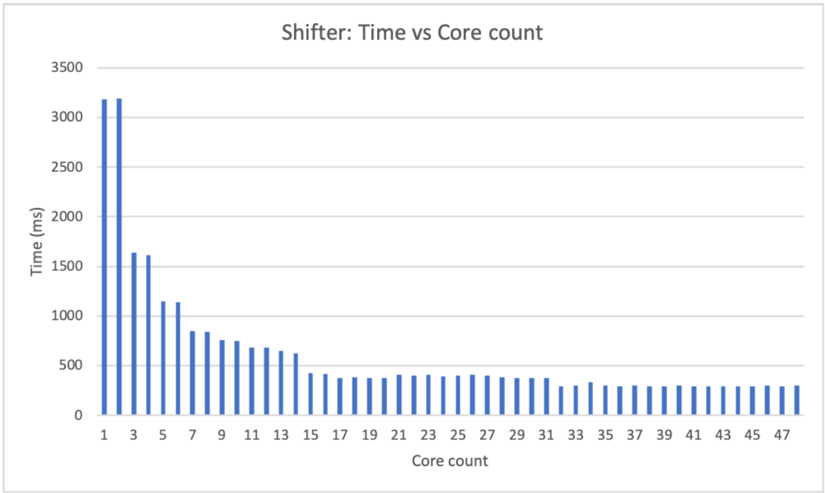
The chart visualizes the relationship between core count (x-axis) and processing time in milliseconds (y-axis) for a system or application named "Shifter." Bars represent time values for core counts ranging from 1 to 47, with a logarithmic-like decline in time as core count increases, followed by a plateau.
### Components/Axes
- **X-axis (Core count)**: Labeled "Core count," with integer values from 1 to 47 in increments of 2 (1, 3, 5, ..., 47).
- **Y-axis (Time)**: Labeled "Time (ms)," with values from 0 to 3500 in increments of 500.
- **Bars**: Blue vertical bars represent time values for each core count. No legend is present.
- **Title**: "Shifter: Time vs Core count" is centered at the top.
### Detailed Analysis
- **Core count 1**: Tallest bar at ~3200 ms.
- **Core count 3**: Second-tallest bar at ~3200 ms.
- **Core count 5**: Sharp drop to ~1200 ms.
- **Core counts 7–13**: Gradual decline from ~900 ms (core 7) to ~600 ms (core 13).
- **Core counts 15–47**: Time stabilizes between ~300–400 ms, with minor fluctuations (e.g., core 15: ~400 ms, core 17: ~350 ms, core 21: ~380 ms, core 25: ~360 ms, core 31: ~340 ms, core 35: ~320 ms, core 39: ~310 ms, core 41: ~300 ms, core 43: ~300 ms, core 45: ~300 ms, core 47: ~300 ms).
### Key Observations
1. **Initial High Time**: Core counts 1 and 3 exhibit the highest time (~3200 ms), suggesting inefficiency or overhead at low core counts.
2. **Rapid Decline**: Time drops sharply from core count 1–5 (~3200 ms → ~1200 ms), then gradually declines to ~600 ms by core count 13.
3. **Plateau Effect**: Beyond core count 13, time remains relatively flat (~300–400 ms), indicating diminishing returns for additional cores.
4. **Consistency at High Core Counts**: Cores 35–47 show minimal variation (~300–320 ms), suggesting saturation or optimization limits.
### Interpretation
- **Scalability Insights**: The sharp decline in time up to core count 13 implies that the workload benefits significantly from parallelization up to this point. Beyond 13 cores, the lack of improvement suggests the application may not be optimized for further parallelization or is constrained by other bottlenecks (e.g., memory, I/O, or sequential dependencies).
- **Efficiency at Low Core Counts**: The high time at core counts 1 and 3 highlights potential inefficiencies in single-threaded or lightly parallelized execution, possibly due to overhead from task scheduling or underutilized resources.
- **Practical Implications**: For systems using "Shifter," allocating more than 13 cores may not yield proportional performance gains, making core count 13 a potential sweet spot for balancing cost and performance.
### Spatial Grounding
- Bars are centered under their respective core count labels on the x-axis.
- Y-axis ticks and labels are aligned to the left of the chart.
- No legend is present, so color coding is uniform (blue bars).
### Content Details
- **Core count 1**: 3200 ms
- **Core count 3**: 3200 ms
- **Core count 5**: 1200 ms
- **Core count 7**: 900 ms
- **Core count 9**: 800 ms
- **Core count 11**: 700 ms
- **Core count 13**: 600 ms
- **Core count 15**: 400 ms
- **Core count 17**: 350 ms
- **Core count 19**: 380 ms
- **Core count 21**: 360 ms
- **Core count 23**: 350 ms
- **Core count 25**: 340 ms
- **Core count 27**: 330 ms
- **Core count 29**: 320 ms
- **Core count 31**: 310 ms
- **Core count 33**: 300 ms
- **Core count 35**: 300 ms
- **Core count 37**: 300 ms
- **Core count 39**: 300 ms
- **Core count 41**: 300 ms
- **Core count 43**: 300 ms
- **Core count 45**: 300 ms
- **Core count 47**: 300 ms
### Notable Anomalies
- **Core count 19**: Slight spike to ~380 ms compared to neighboring cores (~350–360 ms), suggesting a temporary inefficiency or outlier.
- **Core count 33**: Drops to ~300 ms, aligning with the plateau trend.
This analysis confirms that "Shifter" exhibits optimal performance scaling up to 13 cores, after which additional cores provide negligible time reductions. The data underscores the importance of workload design for parallel processing efficiency.