\n
## Diagram: Coin Flip Sequence & Prediction
### Overview
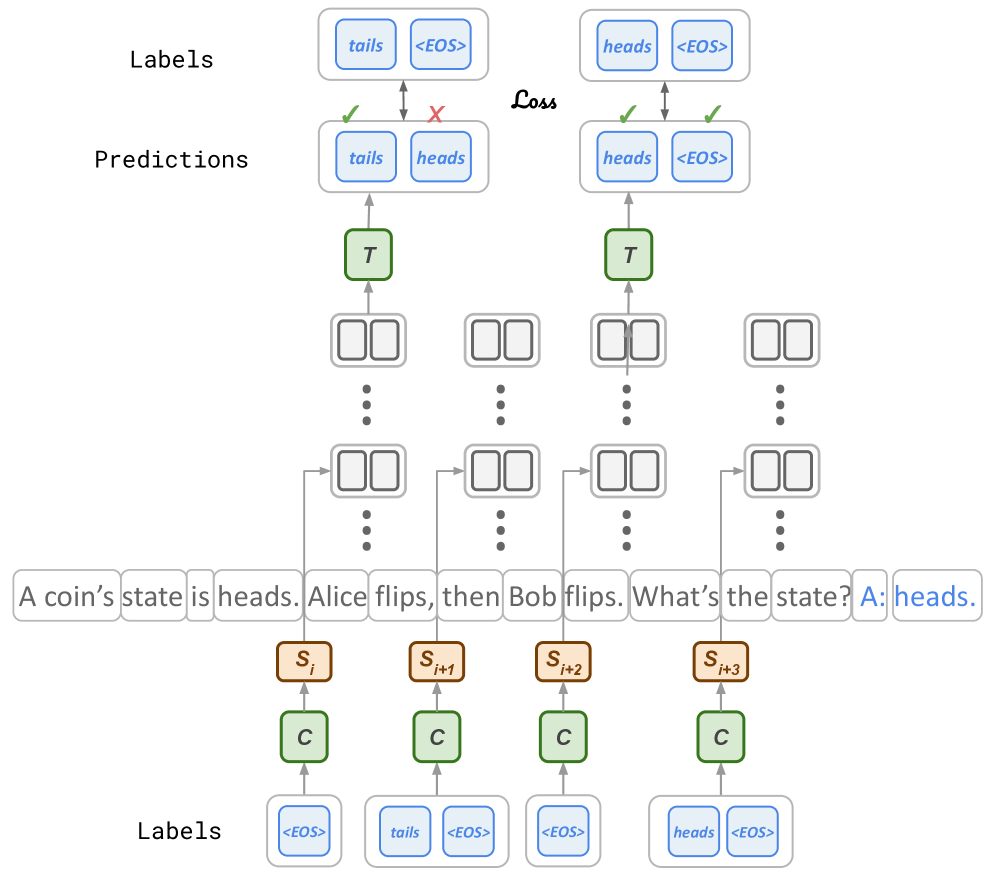
The image depicts a diagram illustrating a sequence of coin flips and a prediction model attempting to predict the outcome. It shows two parallel sequences, one representing the true labels and the other representing the model's predictions. A loss function is indicated where the prediction differs from the label. The diagram also includes a question-answer scenario related to the coin flip sequence.
### Components/Axes
The diagram is structured into two main sections, separated by a question. The top section shows the "Labels" and "Predictions" with associated arrows and a loss calculation. The bottom section shows a sequence of states (S<sub>i</sub>, S<sub>i+1</sub>, S<sub>i+2</sub>, S<sub>i+3</sub>) with corresponding labels.
Labels: "tails", "<EOS>", "heads"
Predictions: "tails", "heads", "heads", "<EOS>"
Loss: "L<sub>oss</sub>"
States: S<sub>i</sub>, S<sub>i+1</sub>, S<sub>i+2</sub>, S<sub>i+3</sub>
Question: "A coin's state is heads. Alice flips, then Bob flips. What's the state? A: heads."
### Detailed Analysis or Content Details
**Top Section:**
* **Labels:** The labels sequence starts with "tails", followed by "<EOS>". Then "heads" followed by "<EOS>". The arrows indicate a flow from the label to the prediction.
* **Predictions:** The predictions sequence starts with "tails", then "heads", then "heads", and ends with "<EOS>".
* **Loss:** A red "X" symbol labeled "L<sub>oss</sub>" connects the "tails" label to the "heads" prediction, indicating a discrepancy and thus a loss.
**Bottom Section:**
* **States:** Four states are shown: S<sub>i</sub>, S<sub>i+1</sub>, S<sub>i+2</sub>, and S<sub>i+3</sub>. Each state is represented by a "C" inside a square.
* **Labels (Bottom):** The labels associated with the states are: "<EOS>", "tails", "<EOS>", "heads". The arrows indicate a flow from the label to the state.
**Question & Answer:**
* The question states: "A coin's state is heads. Alice flips, then Bob flips. What's the state? A: heads."
### Key Observations
* The model correctly predicts "heads" after an initial incorrect prediction of "tails".
* The "<EOS>" token appears to signify the end of a sequence.
* The loss is only incurred when the prediction does not match the label.
* The question-answer section provides context for the coin flip sequence.
### Interpretation
This diagram illustrates a simplified model for predicting coin flip outcomes. The model attempts to learn the sequence of flips and predict the next state. The loss function quantifies the error between the predicted and actual outcomes. The "<EOS>" token suggests the model is trained on sequences of variable length. The question-answer section implies a sequential process where Alice and Bob take turns flipping the coin, and the model is trying to predict the final state. The diagram demonstrates a basic example of sequence prediction, potentially within a reinforcement learning or Markov decision process framework. The use of "C" within the state boxes is unclear without further context, but could represent the coin itself or a hidden state within the model. The diagram is a conceptual illustration rather than a presentation of specific numerical data.