## Diagram: Transformer Architecture with SoundStream Token Processing
### Overview
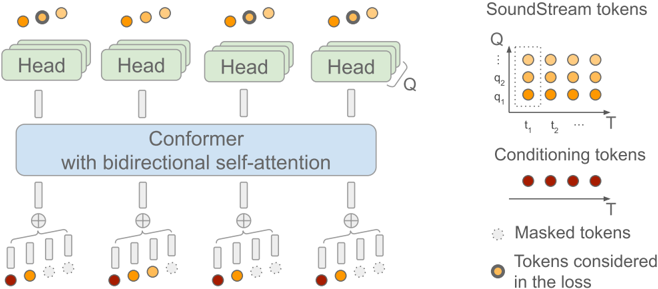
The diagram illustrates a transformer-based architecture with bidirectional self-attention mechanisms and SoundStream token processing. It combines multiple attention heads, a conformer block, and token conditioning elements. The right side shows a matrix representation of token relationships and conditioning mechanisms.
### Components/Axes
**Left Diagram Components:**
- **Head Blocks (4 instances):** Stacked green rectangles labeled "Head" with three colored dots (orange, gray, light orange) above each
- **Conformer Block:** Central blue rectangle labeled "Conformer with bidirectional self-attention"
- **Vertical Processing Lines:** Four vertical lines beneath each Head block with colored dots (red, orange, gray, light orange)
- **Bidirectional Arrows:** Gray bidirectional arrows connecting Head blocks to Conformer
**Right Diagram Components:**
- **SoundStream Tokens Grid:** 3x4 matrix labeled "SoundStream tokens" with:
- Vertical axis labeled "Q" (queries)
- Horizontal axis labeled "T" (time steps)
- Orange and gray dots representing tokens
- **Conditioning Tokens:** Red dots labeled "Conditioning tokens" with timeline T
- **Legend:** Color-coded key explaining:
- Gray dots: Masked tokens
- Orange dots: Tokens considered in the loss
- Red dots: Conditioning tokens
### Detailed Analysis
**Left Diagram Flow:**
1. Input tokens enter four parallel Head blocks
2. Each Head processes tokens through bidirectional self-attention
3. Processed tokens from all Heads combine in the Conformer block
4. Bidirectional arrows indicate information flow between Heads and Conformer
**Right Diagram Structure:**
1. SoundStream tokens form a 3x4 matrix (3 queries × 4 time steps)
2. Orange dots represent active tokens in the loss function
3. Gray dots indicate masked tokens (ignored during training)
4. Conditioning tokens (red) appear as a separate timeline below the matrix
### Key Observations
1. **Bidirectional Processing:** The Conformer's bidirectional self-attention allows tokens to interact with both past and future context
2. **Token Masking:** 25% of SoundStream tokens (3/12) are masked (gray dots), likely for pre-training objectives
3. **Conditioning Mechanism:** Red dots show separate conditioning tokens that may provide additional context
4. **Temporal Structure:** The T axis suggests sequential processing of time steps in SoundStream tokens
### Interpretation
This architecture demonstrates a hybrid approach combining:
- **Multi-head Attention:** Four parallel attention heads capture different contextual relationships
- **Token Conditioning:** Red dots suggest auxiliary information is injected during processing
- **Masked Token Training:** Gray dots indicate standard transformer pre-training techniques
- **Temporal Awareness:** The T axis emphasizes sequential processing capabilities
The bidirectional self-attention in the Conformer block enables the model to understand context from both directions simultaneously, while the SoundStream token matrix shows how the model handles sequential data with both active (orange) and masked (gray) tokens. The conditioning tokens (red) likely provide additional supervisory signals during training.