\n
## Sudoku Puzzle Grid: Unsolved State with Clues
### Overview
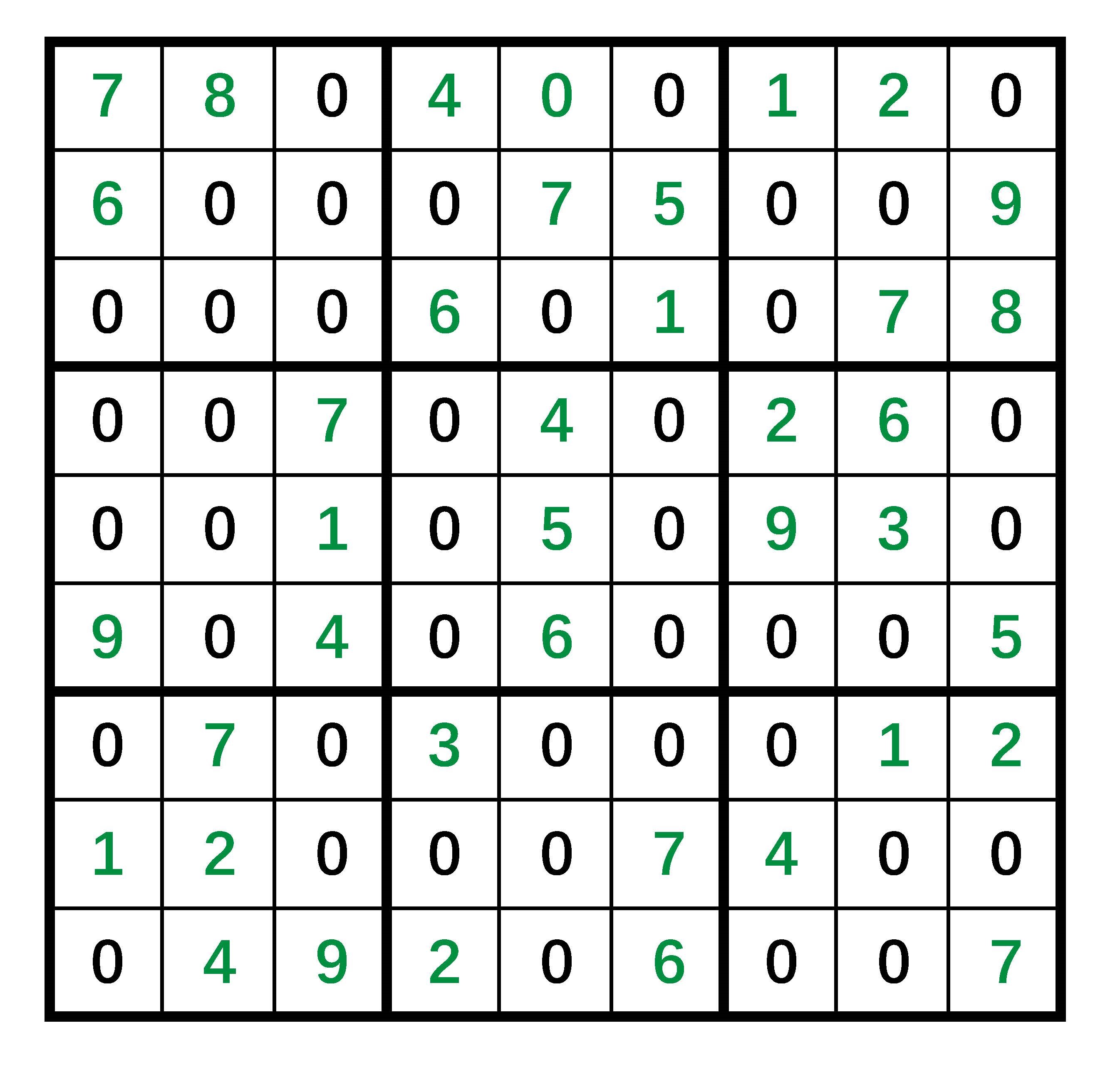
The image displays a standard 9x9 Sudoku puzzle grid in an unsolved state. The grid is composed of 81 individual cells arranged in 9 rows and 9 columns, further subdivided into nine 3x3 subgrids (boxes) demarcated by thicker black borders. The cells contain numerical digits from 0 to 9. A distinct color-coding scheme is used: non-zero digits (the puzzle's given clues) are rendered in green, while zeros (representing empty or unsolved cells) are rendered in black. There are no external labels, titles, axes, or legends; the information is contained entirely within the grid's structure and cell contents.
### Components/Axes
* **Grid Structure:** A 9x9 matrix. Thick black lines separate the grid into nine 3x3 boxes.
* **Cell Content:** Each cell contains a single digit. The digits are either green (non-zero) or black (zero).
* **Spatial Layout:** The grid is centered in the image frame. The numbers are uniformly sized and centered within their respective cells.
* **Color Legend (Implicit):**
* **Green:** Pre-filled clue numbers.
* **Black (Zero):** Empty cell placeholder.
### Detailed Analysis
The complete grid content, transcribed row by row from top to bottom, left to right. The color of each digit is noted in parentheses.
**Row 1 (Top):** 7 (Green), 8 (Green), 0 (Black), 4 (Green), 0 (Black), 0 (Black), 1 (Green), 2 (Green), 0 (Black)
**Row 2:** 6 (Green), 0 (Black), 0 (Black), 0 (Black), 7 (Green), 5 (Green), 0 (Black), 0 (Black), 9 (Green)
**Row 3:** 0 (Black), 0 (Black), 0 (Black), 6 (Green), 0 (Black), 1 (Green), 0 (Black), 7 (Green), 8 (Green)
**Row 4:** 0 (Black), 0 (Black), 7 (Green), 0 (Black), 4 (Green), 0 (Black), 2 (Green), 6 (Green), 0 (Black)
**Row 5:** 0 (Black), 0 (Black), 1 (Green), 0 (Black), 5 (Green), 0 (Black), 9 (Green), 3 (Green), 0 (Black)
**Row 6:** 9 (Green), 0 (Black), 4 (Green), 0 (Black), 6 (Green), 0 (Black), 0 (Black), 0 (Black), 5 (Green)
**Row 7:** 0 (Black), 7 (Green), 0 (Black), 3 (Green), 0 (Black), 0 (Black), 0 (Black), 1 (Green), 2 (Green)
**Row 8:** 1 (Green), 2 (Green), 0 (Black), 0 (Black), 0 (Black), 7 (Green), 4 (Green), 0 (Black), 0 (Black)
**Row 9 (Bottom):** 0 (Black), 4 (Green), 9 (Green), 2 (Green), 0 (Black), 6 (Green), 0 (Black), 0 (Black), 7 (Green)
**Data Summary:**
* **Total Cells:** 81
* **Given Clues (Green, non-zero):** 41
* **Empty Cells (Black, zero):** 40
### Key Observations
1. **Clue Distribution:** The 41 given clues are distributed across all rows, columns, and 3x3 boxes. No row or column is completely empty. The central 3x3 box (Rows 4-6, Columns 4-6) contains 5 clues.
2. **Digit Frequency:** The digit '0' is the most frequent (40 instances). Among the clue digits (1-9), the frequency varies. For example, '7' appears 7 times as a clue, while '3' appears only twice.
3. **Visual Pattern:** The green clues create a scattered visual pattern across the grid, with some clusters (e.g., top-right corner of the grid) and some sparse areas (e.g., the left side of the middle row).
### Interpretation
This image represents the **initial state of a Sudoku puzzle**. The green numbers are the fixed, given clues that define the unique solution path. The black zeros mark the cells that a solver must fill with digits 1-9, following Sudoku rules: each row, each column, and each of the nine 3x3 subgrids must contain all digits from 1 to 9 exactly once.
The puzzle appears to be of **moderate difficulty**. The clue count (41) is on the higher side for a standard puzzle (which often has 22-30 clues), suggesting it may be more accessible. However, difficulty also depends on the strategic placement of clues, not just their quantity. The distribution shows some interconnected constraints, particularly in the central rows and columns, which would guide the logical deduction process.
The use of '0' for empty cells is a common digital or programming convention, differing from the traditional blank cell in paper puzzles. This format is optimized for data entry or algorithmic processing. The color differentiation (green vs. black) provides immediate visual parsing between the puzzle's fixed constraints and its variable, solvable elements.