\n
## Diagram: Level of Detail (LOD) Comparison
### Overview
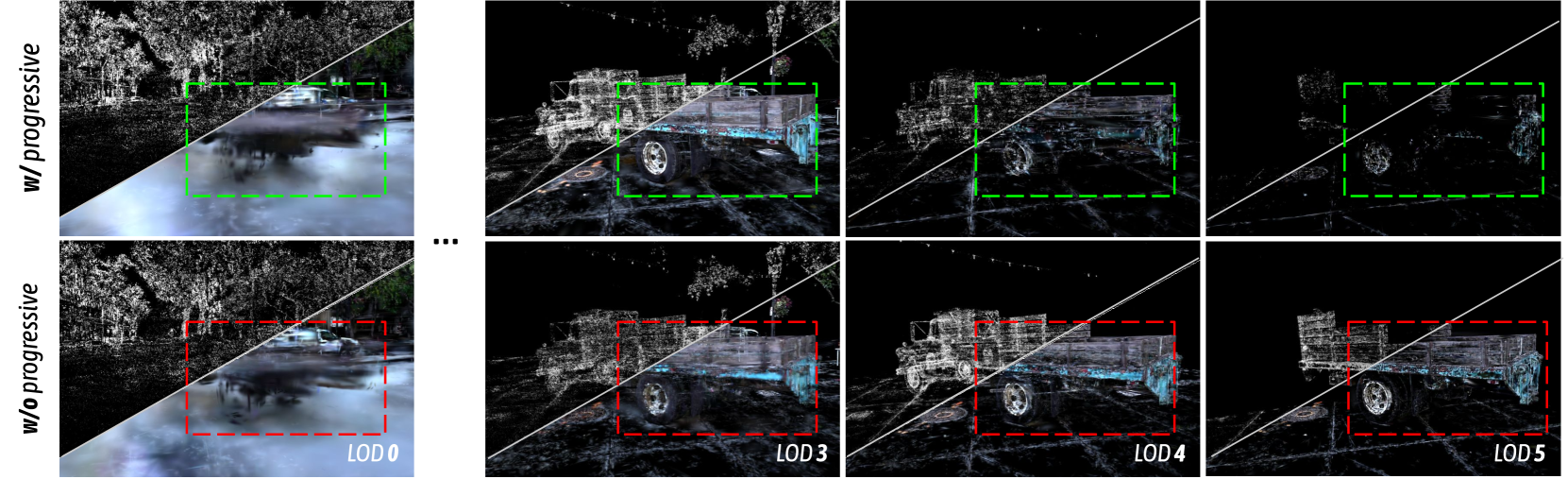
This diagram presents a visual comparison of a 3D reconstruction of a vehicle and its surrounding environment under different Levels of Detail (LOD). The diagram is organized as a 2x3 grid, comparing reconstructions "with progressive" refinement and "without progressive" refinement. Each cell displays the scene at a specific LOD, ranging from LOD 0 to LOD 5. A green dashed rectangle highlights a region of interest around the vehicle in the "with progressive" images, while a red dashed rectangle does the same in the "without progressive" images.
### Components/Axes
The diagram does not have traditional axes. Instead, it uses a grid layout to represent different LODs. The rows are labeled "w/ progressive" (with progressive refinement) and "w/o progressive" (without progressive refinement). The columns represent increasing LOD levels: LOD 0, LOD 3, LOD 4, and LOD 5. The images themselves are the primary components, visually demonstrating the effect of each LOD.
### Detailed Analysis or Content Details
The diagram shows the following:
* **Top-Left (w/ progressive, LOD 0):** A very coarse representation of the scene. The vehicle is barely discernible, appearing as a blurry shape. The environment is also highly simplified.
* **Top-Center (w/ progressive, LOD 3):** The vehicle is more defined, with some basic shape recognition. Details are still limited, but the overall form is apparent.
* **Top-Right (w/ progressive, LOD 4):** Further refinement of the vehicle's shape. More details are visible, such as the wheels and the general structure of the truck bed.
* **Top-Far Right (w/ progressive, LOD 5):** The highest level of detail. The vehicle is clearly recognizable, with a significant amount of detail visible, including the tires, body panels, and some internal structure.
* **Bottom-Left (w/o progressive, LOD 0):** Similar to the top-left image, a very coarse representation.
* **Bottom-Center (w/o progressive, LOD 3):** The vehicle is somewhat more defined than in LOD 0, but still lacks significant detail.
* **Bottom-Right (w/o progressive, LOD 4):** The vehicle is more detailed than in LOD 3, but appears blockier and less refined than the corresponding image in the "w/ progressive" row.
* **Bottom-Far Right (w/o progressive, LOD 5):** The highest level of detail without progressive refinement. The vehicle is recognizable, but the details are less smooth and appear more angular compared to the LOD 5 image in the "w/ progressive" row.
The green dashed rectangle consistently frames the vehicle in the "w/ progressive" images, while the red dashed rectangle does the same in the "w/o progressive" images.
### Key Observations
* The "w/ progressive" refinement consistently produces more detailed and smoother reconstructions at each LOD level compared to the "w/o progressive" refinement.
* As the LOD increases, the level of detail in both sets of images improves, but the improvement is more pronounced in the "w/ progressive" images.
* The "w/o progressive" images appear to have more noticeable artifacts and a blockier appearance, especially at higher LOD levels.
* The LOD 0 images in both rows are very similar, indicating that the initial coarse representation is the same regardless of the refinement method.
### Interpretation
This diagram demonstrates the impact of progressive refinement on the quality of 3D reconstructions at different Levels of Detail. The "w/ progressive" approach results in significantly more detailed and visually appealing reconstructions, particularly at higher LOD levels. This suggests that progressive refinement is an effective technique for improving the accuracy and realism of 3D models. The difference between the two approaches highlights the importance of iterative refinement in 3D reconstruction, where details are gradually added to the model as the LOD increases. The use of dashed rectangles consistently framing the vehicle allows for a direct visual comparison of the reconstruction quality at each LOD level. The diagram suggests that the progressive method is superior for applications requiring high-fidelity 3D models, while the non-progressive method might be suitable for applications where computational efficiency is more critical than visual quality.