## Image Grid: Comparative Analysis of Progressive Rendering Techniques
### Overview
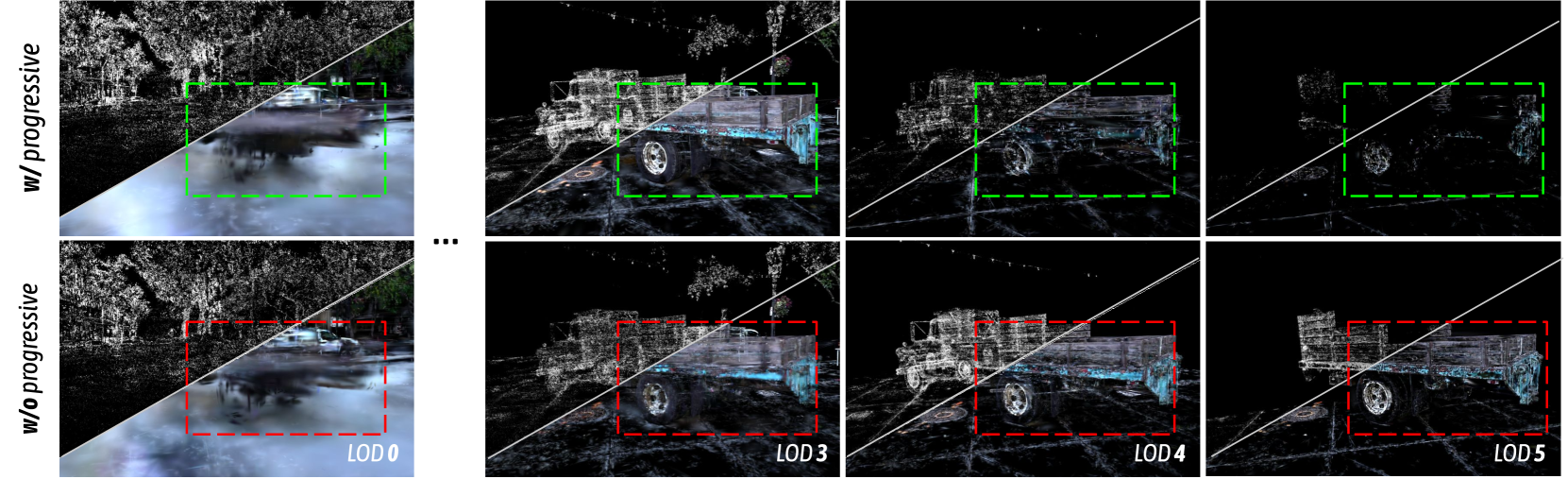
The image presents an 8-panel grid comparing visual outputs under two rendering conditions: "w/progressive" (with progressive rendering) and "w/o progressive" (without progressive rendering). Each row represents one condition, while columns depict different Level of Detail (LOD) states (LOD 0, 3, 4, 5). Spatial annotations include dashed bounding boxes (green for "w/progressive", red for "w/o progressive") and diagonal reference lines.
### Components/Axes
- **Rows**:
- Top row: "w/progressive" (progressive rendering enabled)
- Bottom row: "w/o progressive" (progressive rendering disabled)
- **Columns**:
- Column 1: LOD 0 (lowest detail)
- Column 2: LOD 3 (intermediate detail)
- Column 3: LOD 4 (higher detail)
- Column 4: LOD 5 (highest detail)
- **Annotations**:
- Green dashed boxes: Highlighted regions in "w/progressive" images
- Red dashed boxes: Highlighted regions in "w/o progressive" images
- Diagonal reference lines: Visual alignment guides across panels
### Detailed Analysis
1. **LOD 0 (Column 1)**:
- Top-left: "w/progressive" shows a vehicle and trees with moderate detail. Green box encloses the vehicle.
- Bottom-left: "w/o progressive" displays the same scene with reduced clarity. Red box encloses the vehicle.
2. **LOD 3 (Column 2)**:
- Top-center: "w/progressive" reveals enhanced vehicle texture and tree geometry. Green box maintains focus on the vehicle.
- Bottom-center: "w/o progressive" shows pixelation and blur. Red box outlines the vehicle with less precision.
3. **LOD 4 (Column 3)**:
- Top-right: "w/progressive" exhibits sharp vehicle details and foliage. Green box aligns with the vehicle's silhouette.
- Bottom-right: "w/o progressive" suffers from artifacts. Red box struggles to contain the vehicle's edges.
4. **LOD 5 (Column 4)**:
- Top-right: "w/progressive" achieves photorealistic quality. Green box tightly frames the vehicle.
- Bottom-right: "w/o progressive" remains grainy. Red box fails to capture fine details.
### Key Observations
- **Progressive Rendering Impact**:
- "w/progressive" consistently maintains sharper edges, richer textures, and better spatial coherence across all LODs.
- "w/o progressive" exhibits progressive degradation in detail fidelity as LOD increases.
- **Bounding Box Behavior**:
- Green boxes (progressive) align more accurately with vehicle geometry, suggesting better object recognition.
- Red boxes (non-progressive) show misalignment and distortion, particularly at higher LODs.
- **Diagonal Reference Lines**:
- Maintain consistent spatial relationships across panels, enabling direct visual comparison.
### Interpretation
The data demonstrates that progressive rendering significantly enhances visual fidelity across all LODs. At LOD 0, differences are subtle but become pronounced at LOD 3 and beyond. The green/red bounding boxes act as qualitative metrics for object detection accuracy, with progressive rendering enabling more precise spatial localization. The diagonal reference lines suggest a controlled experimental setup, isolating variables like texture resolution and anti-aliasing effects. Notably, the absence of progressive rendering introduces artifacts that degrade both aesthetic quality and computational reliability, particularly in high-detail scenarios (LOD 4-5). This aligns with known trade-offs in real-time rendering pipelines, where progressive techniques balance performance and visual quality.