## Line Chart: Mean Pass Rate vs. Mean Number of Tokens Generated
### Overview
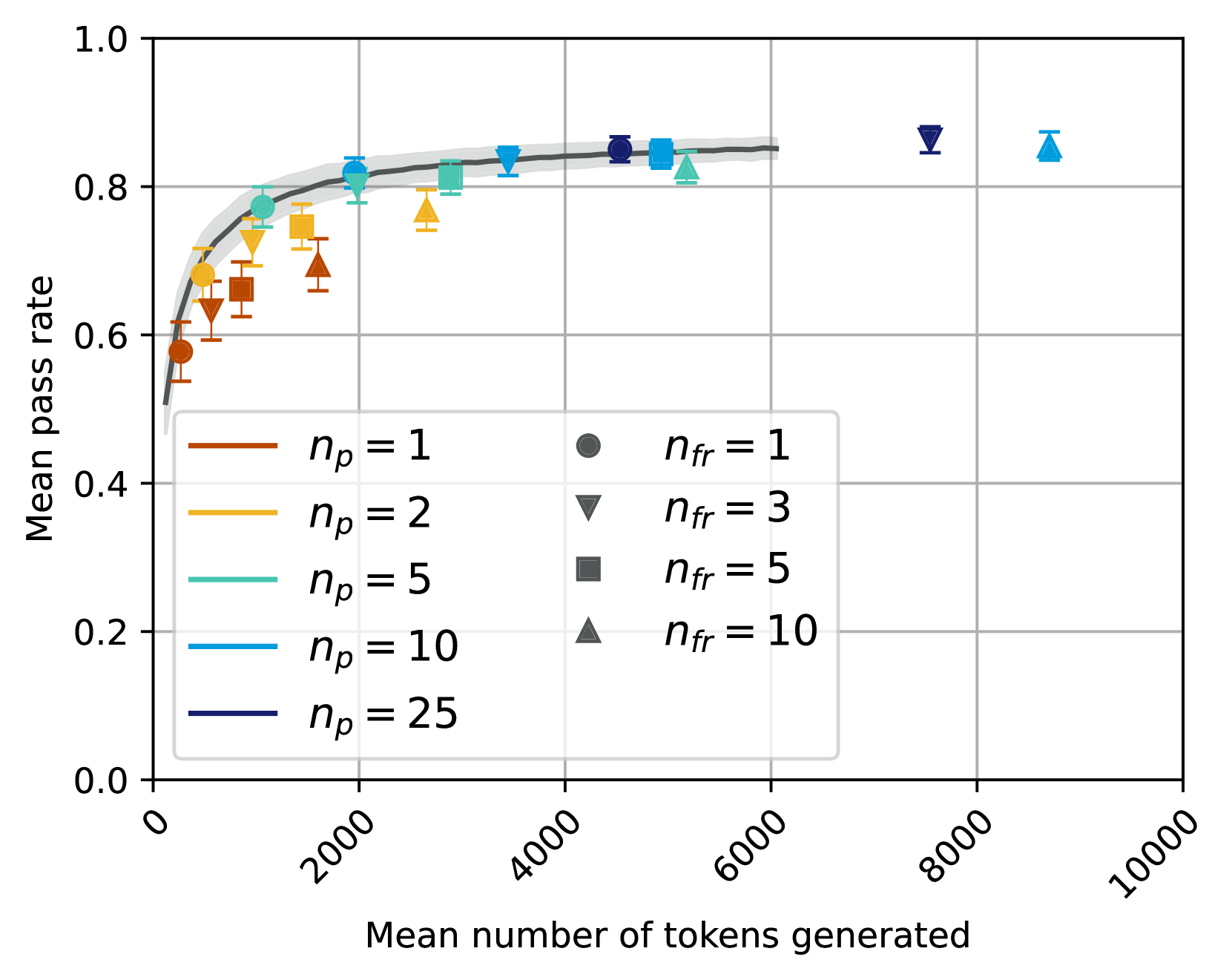
The image is a line chart that plots the mean pass rate against the mean number of tokens generated. The chart displays multiple data series, each representing a different value of `np` (1, 2, 5, 10, 25) and `nfr` (1, 3, 5, 10). The chart shows how the mean pass rate changes as the number of tokens generated increases, for different values of `np` and `nfr`.
### Components/Axes
* **X-axis:** Mean number of tokens generated, ranging from 0 to 10000.
* **Y-axis:** Mean pass rate, ranging from 0.0 to 1.0.
* **Legend (Left):** Located on the left side of the chart, it identifies the lines corresponding to different values of `np`:
* Brown line: `np = 1`
* Yellow line: `np = 2`
* Light Blue line: `np = 5`
* Blue line: `np = 10`
* Dark Blue line: `np = 25`
* **Legend (Right):** Located on the right side of the chart, it identifies the markers corresponding to different values of `nfr`:
* Dark Gray circle: `nfr = 1`
* Dark Gray downward-pointing triangle: `nfr = 3`
* Dark Gray square: `nfr = 5`
* Dark Gray upward-pointing triangle: `nfr = 10`
* A gray shaded region represents a confidence interval or standard deviation around the mean pass rate.
### Detailed Analysis
* **Data Series Trends:**
* The lines for `np = 1`, `np = 2`, `np = 5`, `np = 10`, and `np = 25` all show an upward trend initially, indicating that the mean pass rate increases as the number of tokens generated increases. The rate of increase slows down as the number of tokens generated gets larger, and the lines appear to plateau.
* **Data Points:**
* For `np = 1` (brown line):
* At approximately 2000 tokens, the mean pass rate is around 0.65.
* For `np = 2` (yellow line):
* At approximately 2000 tokens, the mean pass rate is around 0.75.
* For `np = 5` (light blue line):
* At approximately 2000 tokens, the mean pass rate is around 0.82.
* For `np = 10` (blue line):
* At approximately 2000 tokens, the mean pass rate is around 0.82.
* For `np = 25` (dark blue line):
* At approximately 2000 tokens, the mean pass rate is around 0.82.
* For `nfr = 1` (dark gray circle):
* At approximately 200 tokens, the mean pass rate is around 0.6.
* At approximately 5500 tokens, the mean pass rate is around 0.85.
* For `nfr = 3` (dark gray downward-pointing triangle):
* At approximately 1500 tokens, the mean pass rate is around 0.7.
* At approximately 4000 tokens, the mean pass rate is around 0.83.
* At approximately 8000 tokens, the mean pass rate is around 0.87.
* For `nfr = 5` (dark gray square):
* At approximately 1500 tokens, the mean pass rate is around 0.7.
* At approximately 5500 tokens, the mean pass rate is around 0.85.
* At approximately 9000 tokens, the mean pass rate is around 0.86.
* For `nfr = 10` (dark gray upward-pointing triangle):
* At approximately 1500 tokens, the mean pass rate is around 0.7.
* At approximately 5500 tokens, the mean pass rate is around 0.85.
* At approximately 9000 tokens, the mean pass rate is around 0.86.
### Key Observations
* The mean pass rate generally increases with the mean number of tokens generated, but the rate of increase diminishes as the number of tokens increases.
* The lines for different values of `np` converge as the number of tokens generated increases, suggesting that the impact of `np` on the mean pass rate becomes less significant at higher token counts.
* The markers for different values of `nfr` are scattered, but generally show a similar trend of increasing mean pass rate with the number of tokens generated.
* The gray shaded region indicates the variability or uncertainty in the mean pass rate.
### Interpretation
The chart suggests that increasing the number of tokens generated generally improves the mean pass rate, but there is a point of diminishing returns. The values of `np` and `nfr` also influence the mean pass rate, but their impact may be less significant at higher token counts. The gray shaded region provides information about the reliability of the observed trends. The data could represent the performance of a language model or some other system that generates tokens, where the pass rate indicates the proportion of successful generations.