## Text Document: Instruction Set for Generating Depth-2 Questions
### Overview
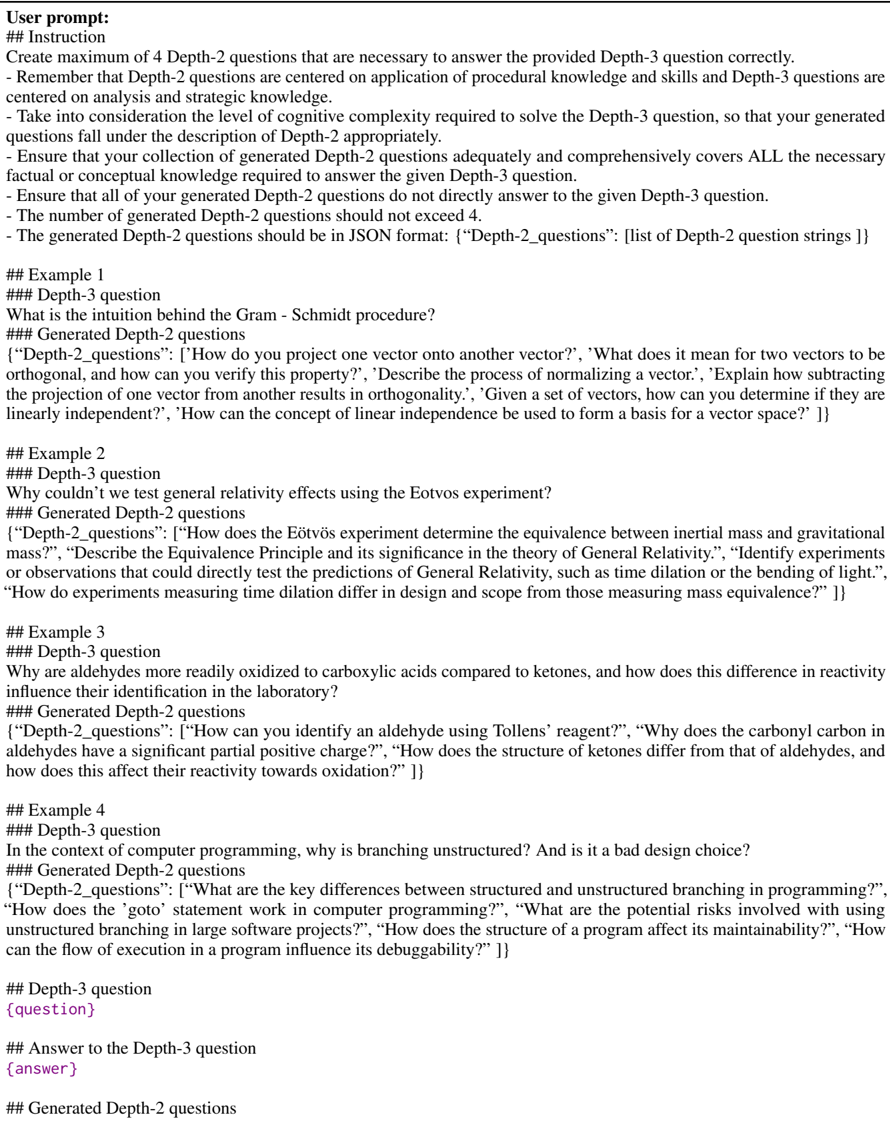
The image is a screenshot of a technical instruction document. It provides a detailed methodology and examples for creating "Depth-2" questions designed to support the answering of a more complex "Depth-3" question. The document is structured with a main instruction block followed by four illustrative examples and concludes with placeholders for a new question and answer.
### Components/Axes
The document is organized into the following sequential sections:
1. **User prompt:** A header indicating the start of the instruction.
2. **## Instruction:** The core set of rules and guidelines.
3. **## Example 1 through ## Example 4:** Four complete examples demonstrating the application of the instructions.
4. **## Depth-3 question:** A placeholder for a new question to be processed.
5. **## Answer to the Depth-3 question:** A placeholder for the corresponding answer.
6. **## Generated Depth-2 questions:** A placeholder for the final output.
### Detailed Analysis / Content Details
**1. Instruction Block (## Instruction):**
The instructions specify the following rules for generating Depth-2 questions:
* Create a maximum of 4 Depth-2 questions necessary to answer a provided Depth-3 question.
* Depth-2 questions focus on **procedural knowledge and skills**.
* Depth-3 questions focus on **analysis and strategic knowledge**.
* The cognitive complexity of the generated Depth-2 questions must be appropriate for the Depth-3 question.
* The collection of Depth-2 questions must comprehensively cover all necessary factual or conceptual knowledge to answer the Depth-3 question.
* The Depth-2 questions must **not** directly answer the given Depth-3 question.
* The number of generated Depth-2 questions should not exceed 4.
* The output must be in JSON format: `{"Depth-2_questions": [list of Depth-2 question strings]}`.
**2. Example 1:**
* **Depth-3 question:** "What is the intuition behind the Gram - Schmidt procedure?"
* **Generated Depth-2 questions (JSON):**
```json
{"Depth-2_questions": ["How do you project one vector onto another vector?", "What does it mean for two vectors to be orthogonal, and how can you verify this property?", "Describe the process of normalizing a vector.", "Explain how subtracting the projection of one vector from another results in orthogonality.", "Given a set of vectors, how can you determine if they are linearly independent?", "How can the concept of linear independence be used to form a basis for a vector space?"]}
```
*Note: This example generates 6 questions, which exceeds the stated maximum of 4 in the instructions.*
**3. Example 2:**
* **Depth-3 question:** "Why couldn't we test general relativity effects using the Eotvos experiment?"
* **Generated Depth-2 questions (JSON):**
```json
{"Depth-2_questions": ["How does the Eötvös experiment determine the equivalence between inertial mass and gravitational mass?", "Describe the Equivalence Principle and its significance in the theory of General Relativity.", "Identify experiments or observations that could directly test the predictions of General Relativity, such as time dilation or the bending of light.", "How do experiments measuring time dilation differ in design and scope from those measuring mass equivalence?"]}
```
**4. Example 3:**
* **Depth-3 question:** "Why are aldehydes more readily oxidized to carboxylic acids compared to ketones, and how does this difference in reactivity influence their identification in the laboratory?"
* **Generated Depth-2 questions (JSON):**
```json
{"Depth-2_questions": ["How can you identify an aldehyde using Tollens' reagent?", "Why does the carbonyl carbon in aldehydes have a significant partial positive charge?", "How does the structure of ketones differ from that of aldehydes, and how does this affect their reactivity towards oxidation?"]}
```
**5. Example 4:**
* **Depth-3 question:** "In the context of computer programming, why is branching unstructured? And is it a bad design choice?"
* **Generated Depth-2 questions (JSON):**
```json
{"Depth-2_questions": ["What are the key differences between structured and unstructured branching in programming?", "How does the 'goto' statement work in computer programming?", "What are the potential risks involved with using unstructured branching in large software projects?", "How does the structure of a program affect its maintainability?", "How can the flow of execution in a program influence its debuggability?"]}
```
*Note: This example generates 5 questions, which exceeds the stated maximum of 4 in the instructions.*
**6. Placeholders:**
The document ends with three headers containing placeholders in curly braces, indicating where new content should be inserted:
* `## Depth-3 question`
`{question}`
* `## Answer to the Depth-3 question`
`{answer}`
* `## Generated Depth-2 questions`
### Key Observations
* **Inconsistency in Rule Adherence:** Examples 1 and 4 generate more than the maximum of 4 Depth-2 questions specified in the instructions (6 and 5, respectively). Examples 2 and 3 adhere to the limit (4 and 3, respectively).
* **JSON Format:** All examples correctly use the specified JSON format for the output.
* **Question Nature:** The generated Depth-2 questions successfully focus on procedural "how-to" or foundational concept questions (e.g., "How do you project...", "Describe the process...", "What are the key differences..."), avoiding direct answers to the overarching Depth-3 "why" or analytical questions.
* **Content Coverage:** The sets of Depth-2 questions appear designed to build the prerequisite knowledge needed to tackle the more complex Depth-3 question.
### Interpretation
This document serves as a **prompt engineering template or a few-shot learning guide** for an AI or a human tasked with decomposing complex analytical questions into a structured set of simpler, procedural sub-questions. The core pedagogical principle is that answering a high-level strategic question (Depth-3) requires mastery of several underlying procedural skills and factual knowledge (Depth-2).
The examples demonstrate the desired transformation:
* **From Analysis to Procedure:** Turning "Why..." or "What is the intuition behind..." questions into "How do you...", "Describe the process...", and "What does it mean..." questions.
* **Knowledge Scaffolding:** The generated questions act as a learning scaffold. For instance, to understand the *intuition* behind Gram-Schmidt (Depth-3), one must first understand vector projection, orthogonality, and normalization (Depth-2).
The inconsistencies in question count (violating the "max 4" rule) suggest the examples may be illustrative rather than strict, or that the rule is flexible. The final placeholders indicate this is a reusable template where a user can input any new Depth-3 question and its answer to receive a tailored set of supporting Depth-2 questions. The ultimate goal is to ensure comprehensive conceptual coverage before attempting synthesis or high-level analysis.