## Question Generation Examples
### Overview
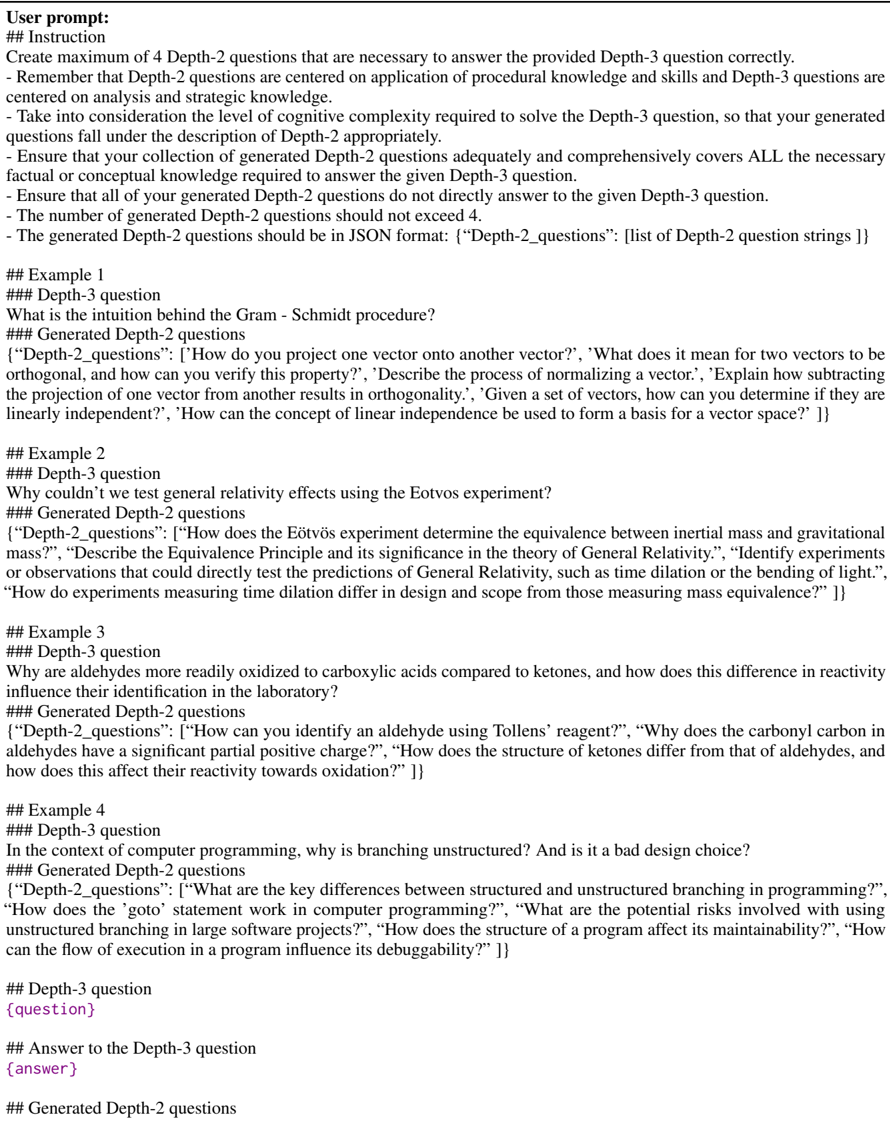
The image presents instructions and examples for generating "Depth-2" questions that appropriately address a given "Depth-3" question. It outlines the criteria for these questions and provides four examples, each containing a Depth-3 question and a set of generated Depth-2 questions in JSON format.
### Components/Axes
* **Instruction:** A set of guidelines for creating Depth-2 questions.
* **Examples:** Four distinct examples, each consisting of:
* **Depth-3 question:** The primary question to be addressed.
* **Generated Depth-2 questions:** A list of questions designed to help answer the Depth-3 question. These are formatted as a JSON object with the key "Depth-2\_questions" and a list of question strings as the value.
* **JSON Format:** The Depth-2 questions are structured in a JSON format: `{"Depth-2_questions": [list of Depth-2 question strings ]}`.
### Detailed Analysis or ### Content Details
**Instruction:**
* Create a maximum of 4 Depth-2 questions.
* Depth-2 questions should focus on the application of procedural knowledge and skills, while Depth-3 questions focus on analysis and strategic knowledge.
* Consider the cognitive complexity required to solve the Depth-3 question.
* Ensure the Depth-2 questions adequately and comprehensively cover the necessary factual or conceptual knowledge.
* Ensure the Depth-2 questions do not directly answer the Depth-3 question.
* The number of generated Depth-2 questions should not exceed 4.
**Example 1:**
* **Depth-3 question:** "What is the intuition behind the Gram - Schmidt procedure?"
* **Generated Depth-2 questions:**
* "How do you project one vector onto another vector?"
* "What does it mean for two vectors to be orthogonal, and how can you verify this property?"
* "Describe the process of normalizing a vector."
* "Explain how subtracting the projection of one vector from another results in orthogonality."
* "Given a set of vectors, how can you determine if they are linearly independent?"
* "How can the concept of linear independence be used to form a basis for a vector space?"
**Example 2:**
* **Depth-3 question:** "Why couldn't we test general relativity effects using the Eotvos experiment?"
* **Generated Depth-2 questions:**
* "How does the Eötvös experiment determine the equivalence between inertial mass and gravitational mass?"
* "Describe the Equivalence Principle and its significance in the theory of General Relativity."
* "Identify experiments or observations that could directly test the predictions of General Relativity, such as time dilation or the bending of light."
* "How do experiments measuring time dilation differ in design and scope from those measuring mass equivalence?"
**Example 3:**
* **Depth-3 question:** "Why are aldehydes more readily oxidized to carboxylic acids compared to ketones, and how does this difference in reactivity influence their identification in the laboratory?"
* **Generated Depth-2 questions:**
* "How can you identify an aldehyde using Tollens' reagent?"
* "Why does the carbonyl carbon in aldehydes have a significant partial positive charge?"
* "How does the structure of ketones differ from that of aldehydes, and how does this affect their reactivity towards oxidation?"
**Example 4:**
* **Depth-3 question:** "In the context of computer programming, why is branching unstructured? And is it a bad design choice?"
* **Generated Depth-2 questions:**
* "What are the key differences between structured and unstructured branching in programming?"
* "How does the 'goto' statement work in computer programming?"
* "What are the potential risks involved with using unstructured branching in large software projects?"
* "How does the structure of a program affect its maintainability?"
* "How can the flow of execution in a program influence its debuggability?"
### Key Observations
* The Depth-3 questions require a higher level of understanding and analysis.
* The Depth-2 questions are designed to break down the Depth-3 question into smaller, more manageable parts.
* The JSON format provides a structured way to represent the generated questions.
* Each example provides a different subject area, showcasing the versatility of the question generation process.
### Interpretation
The image illustrates a method for generating supporting questions (Depth-2) to aid in answering a more complex question (Depth-3). The instructions emphasize the importance of focusing on procedural knowledge for Depth-2 questions and analytical knowledge for Depth-3 questions. The examples demonstrate how to break down complex questions into smaller, more specific inquiries that, when answered, contribute to a comprehensive understanding of the original question. The use of JSON format suggests a potential application in automated question generation or knowledge representation systems. The examples cover diverse topics, indicating the broad applicability of this approach.