## Screenshot: Depth-2 Question Generation Framework
### Overview
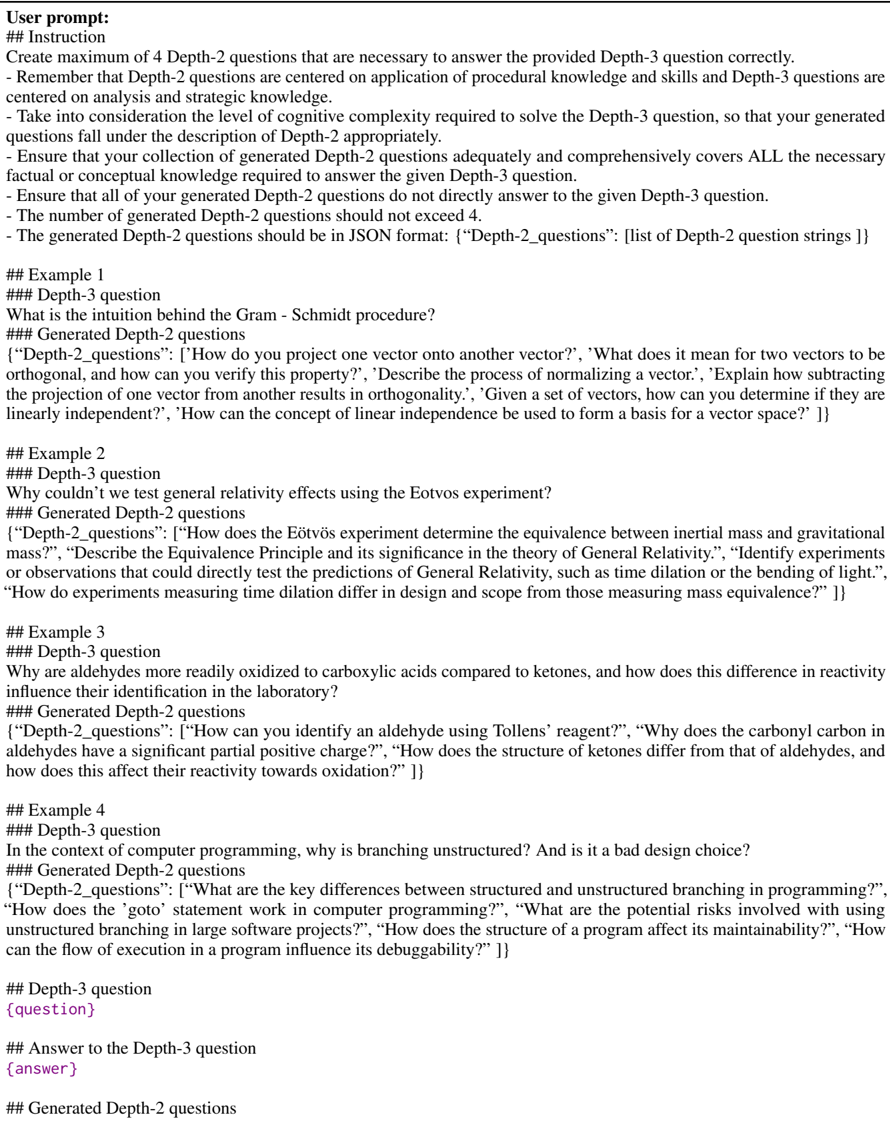
The image contains a structured technical prompt for generating Depth-2 questions to support answering a Depth-3 question. It includes formatting rules, examples, and a JSON output template.
### Components/Axes
1. **User Prompt Section**
- **Labels**:
- `## Instruction`: Defines requirements for generating Depth-2 questions.
- `## Example 1`, `## Example 2`, etc.: Illustrate application of the framework.
- **Content**:
- Rules for Depth-2 questions (e.g., procedural knowledge, cognitive complexity).
- JSON output format: `{"Depth-2_questions": ["list of strings"]}`.
2. **Example Structure**
- **Depth-3 Question**: Complex, open-ended questions (e.g., "What is the intuition behind the Gram-Schmidt procedure?").
- **Generated Depth-2 Questions**:
- Sub-questions addressing procedural steps, definitions, and conceptual relationships.
- Example 1:
- Depth-3: "What is the intuition behind the Gram-Schmidt procedure?"
- Depth-2:
- "How do you project one vector onto another?"
- "What does it mean for two vectors to be orthogonal?"
- "Explain how subtracting the projection of one vector from another results in orthogonality."
- "How can the concept of linear independence be used to form a basis for a vector space?"
3. **JSON Output Template**
- Key: `"Depth-2_questions"`
- Value: Array of strings representing sub-questions.
### Detailed Analysis
- **Formatting Consistency**:
- All examples follow the same structure: `# Depth-3 question` followed by `# Generated Depth-2 questions` in JSON.
- Depth-2 questions avoid directly answering the Depth-3 question but provide foundational knowledge.
- **Content Patterns**:
- Depth-2 questions focus on:
1. **Procedural Steps** (e.g., "How do you project one vector onto another?").
2. **Definitions** (e.g., "What does it mean for two vectors to be orthogonal?").
3. **Conceptual Relationships** (e.g., "How does the structure of ketones differ from aldehydes?").
4. **Application of Principles** (e.g., "How can linear independence form a basis?").
- **Example Variations**:
- **Example 1 (Math)**: Focuses on linear algebra concepts (orthogonality, projections).
- **Example 2 (Physics)**: Relates to relativity and experimental design (Eötvös experiment).
- **Example 3 (Chemistry)**: Compares reactivity of aldehydes vs. ketones.
- **Example 4 (Programming)**: Explores unstructured branching in code.
### Key Observations
1. **Depth-2 Question Design**:
- Questions are intentionally non-answerable in isolation but collectively enable solving the Depth-3 question.
- Emphasis on foundational knowledge (e.g., definitions, procedural steps).
2. **Domain-Specific Adaptability**:
- Framework applies across disciplines (math, physics, chemistry, programming).
3. **JSON Structure**:
- Strict adherence to key-value pairing for programmatic parsing.
### Interpretation
The framework demonstrates a systematic approach to decomposing complex problems into manageable sub-questions. By focusing on procedural, definitional, and conceptual layers, it ensures comprehensive coverage of prerequisite knowledge. The JSON format suggests automation potential, enabling scalable question generation for educational or AI training purposes.
**Notable Insight**: The examples highlight the importance of aligning Depth-2 questions with the cognitive demands of the Depth-3 question, ensuring they address gaps in procedural or strategic understanding rather than factual recall.