\n
## Mathematical Formulas: Laplace Transforms and Differentiation/Integration
### Overview
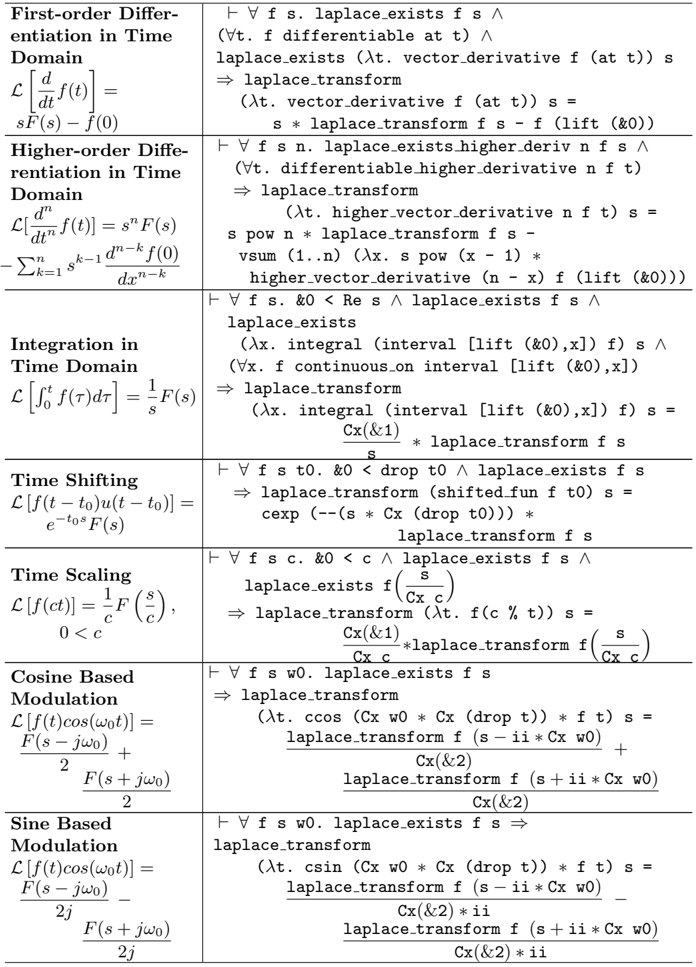
The image presents a collection of mathematical formulas related to Laplace transforms, differentiation, integration, time shifting, time scaling, cosine-based modulation, and sinusoidal modulation. The formulas demonstrate how these operations in the time domain translate to the Laplace domain (s-domain). The formulas are written in a symbolic mathematical notation, likely using LaTeX or a similar typesetting language.
### Components/Axes
There are no axes or traditional chart components. The image consists entirely of mathematical equations. Each equation is a self-contained statement. The equations are arranged vertically, with each representing a different transformation or property.
### Detailed Analysis or Content Details
Here's a transcription of each formula, along with a breakdown of its components:
1. **First-order Differentiation in Time Domain:**
`L{d/dt f(t)} = sF(s) - f(0)`
This formula states that the Laplace transform of the first derivative of a function f(t) is equal to s times the Laplace transform of f(t) minus the initial value of f(t).
2. **Higher-order Differentiation in Time Domain:**
`L{d^n/dt^n f(t)} = s^n F(s) - Σ(k=1 to n-1) sk-1 f^(n-k)(0)`
This formula generalizes the first-order differentiation to higher orders. It states that the Laplace transform of the nth derivative of f(t) is equal to s^n times the Laplace transform of f(t) minus a summation term involving the lower-order derivatives of f(t) evaluated at t=0.
3. **Integration in Time Domain:**
`L{∫f(t) dt} = 1/s F(s)`
This formula states that the Laplace transform of the integral of f(t) is equal to the Laplace transform of f(t) divided by s.
4. **Time Shifting:**
`L{f(t-to)u(t-to)} = e^(-sto)F(s)`
This formula describes the effect of a time shift on the Laplace transform. `u(t-to)` is the unit step function.
5. **Time Scaling:**
`L{f(ct)} = 1/c F(s/c), 0 < c`
This formula describes the effect of time scaling on the Laplace transform.
6. **Cosine Based Modulation:**
`L{f(t)cos(ωt)} = (1/2)[F(s+jω) + F(s-jω)]`
This formula states the Laplace transform of a function f(t) multiplied by a cosine wave.
7. **Sinusoidal Modulation:**
`L{f(t)sin(ωt)} = (j/2)[F(s+jω) - F(s-jω)]`
This formula states the Laplace transform of a function f(t) multiplied by a sine wave.
**Symbolic Notation:**
* `L{}`: Represents the Laplace transform operator.
* `f(t)`: Represents a function of time.
* `F(s)`: Represents the Laplace transform of f(t).
* `s`: Represents the complex frequency variable in the Laplace domain.
* `t`: Represents time.
* `to`: Represents a time shift.
* `c`: Represents a scaling factor.
* `ω`: Represents angular frequency.
* `j`: Represents the imaginary unit (√-1).
* `u(t)`: Represents the unit step function.
* `∫`: Represents the integral operator.
* `d/dt`: Represents the derivative operator.
* `d^n/dt^n`: Represents the nth derivative operator.
* `Σ`: Represents summation.
### Key Observations
The formulas are presented in a consistent format, clearly showing the relationship between the time-domain function and its Laplace transform. The use of symbolic notation is standard in mathematical literature. The formulas build upon each other, starting with basic differentiation and integration and progressing to more complex operations like modulation.
### Interpretation
The image provides a concise reference for fundamental Laplace transform properties. These properties are crucial for solving differential equations, analyzing linear time-invariant systems, and designing control systems. The formulas demonstrate how operations in the time domain are transformed into algebraic operations in the s-domain, which often simplifies the analysis and solution process. The inclusion of initial conditions (f(0), f^(n-k)(0)) in the differentiation formulas highlights the importance of these conditions when using Laplace transforms to solve initial value problems. The modulation formulas are essential for analyzing signals that are amplitude-modulated or frequency-modulated. The formulas are presented in a formal mathematical style, suggesting they are intended for an audience with a strong mathematical background.