# Technical Document Extraction: Scaling Methodologies Diagram
## Overview
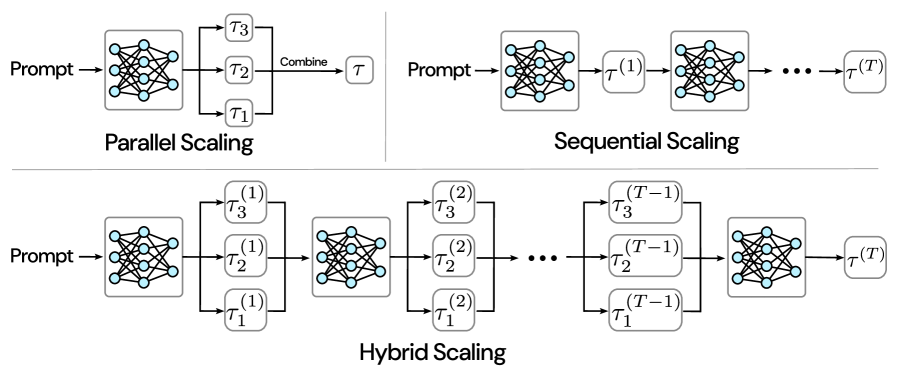
The image illustrates three scaling methodologies for processing prompts through neural network transformations. Each methodology is represented as a flowchart with distinct architectural patterns.
---
## 1. Parallel Scaling
### Components:
- **Input**: Prompt → Neural Network (interconnected nodes)
- **Transformations**:
- τ₁, τ₂, τ₃ (parallel processing branches)
- **Output**: Combined → τ (final output)
### Flow:
1. Prompt enters a neural network
2. Network output splits into three parallel transformation paths:
- τ₁ (bottom)
- τ₂ (middle)
- τ₃ (top)
3. Results from all three transformations are combined
4. Final output labeled as τ
---
## 2. Sequential Scaling
### Components:
- **Input**: Prompt → Neural Network
- **Transformations**:
- τ^(1), τ^(2), ..., τ^(T) (temporal sequence)
- **Output**: Final τ^(T)
### Flow:
1. Prompt enters neural network
2. Sequential application of transformations:
- τ^(1) → τ^(2) → ... → τ^(T)
3. Each transformation builds on previous output
4. Final output labeled as τ^(T)
---
## 3. Hybrid Scaling
### Components:
- **Input**: Prompt → Neural Network
- **Transformations**:
- τ^(1), τ^(2), ..., τ^(T-1) (temporal sequence with parallel processing)
- **Output**: Final τ^(T)
### Flow:
1. Prompt enters neural network
2. Temporal sequence of transformations:
- Stage 1: τ^(1) applied to all three parallel paths (τ₁^(1), τ₂^(1), τ₃^(1))
- Stage 2: τ^(2) applied to all three parallel paths (τ₁^(2), τ₂^(2), τ₃^(2))
- ...
- Stage T-1: τ^(T-1) applied to all three parallel paths
3. Final transformation τ^(T) applied to combined outputs
4. Final output labeled as τ^(T)
---
## Key Observations
1. **Notation Consistency**:
- Lowercase τ (τ₁, τ₂, τ₃) = parallel processing units
- Superscript τ^(n) = temporal sequence stages
2. **Architectural Patterns**:
- Parallel: Horizontal processing
- Sequential: Vertical stacking
- Hybrid: Combination of both
3. **Temporal Progression**:
- Sequential and Hybrid methods show explicit time-dependent progression (τ^(1) → τ^(T))
4. **Combination Logic**:
- Parallel method uses explicit "Combine" step
- Hybrid method implies combination through sequential stages
---
## Diagram Structure
- **X-Axis**: Represents processing stages (parallel branches or temporal sequence)
- **Y-Axis**: Represents transformation depth (individual τ units or temporal stages)
- **Color Coding**: No explicit color legend present; all components use default diagram colors
---
## Technical Implications
1. **Parallel Scaling**:
- Best for independent processing paths
- Requires explicit combination mechanism
2. **Sequential Scaling**:
- Suitable for time-dependent transformations
- Cumulative effect across stages
3. **Hybrid Scaling**:
- Balances parallelism and temporal progression
- Complex implementation but potentially optimal performance
---
## Limitations
- No quantitative performance metrics provided
- No implementation details for transformation functions
- Assumes perfect parallelization capabilities