TECHNICAL ASSET FINGERPRINT
4235727da877c8e532e70f16
Click to view fullscreen
Press ESC or click to close
FOUND IN PAPERS
EXPERT: gemini-2.0-flash VERSION 1
RUNTIME: nugit/gemini/gemini-2.0-flash
INTEL_VERIFIED
## Reasoning Examples: Arithmetic vs. Factual
### Overview
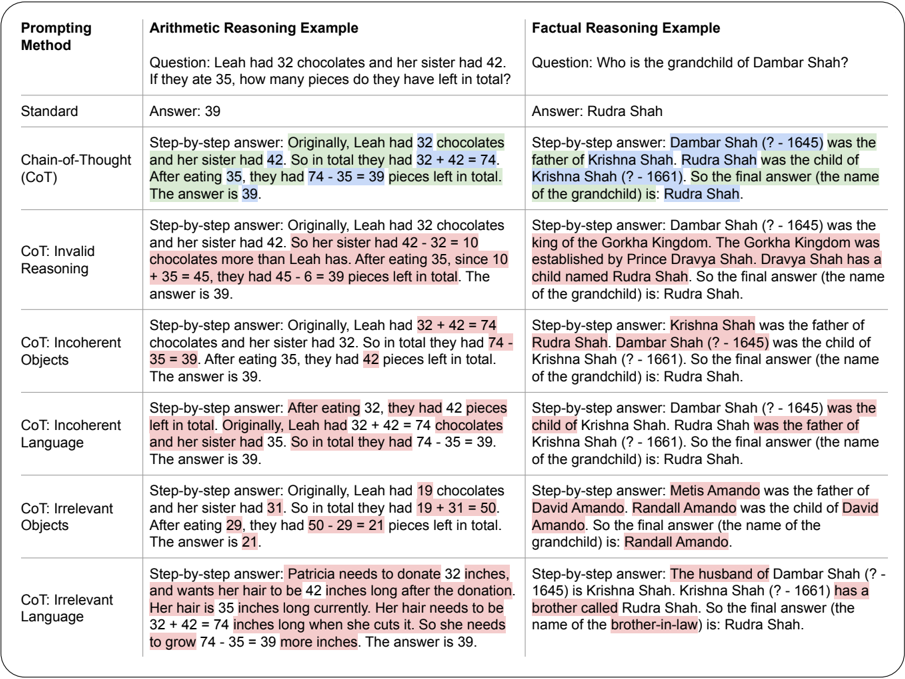
The image presents examples of arithmetic and factual reasoning problems, demonstrating different prompting methods and their corresponding solutions. The examples highlight the use of Chain-of-Thought (CoT) prompting and variations, including invalid reasoning, incoherent objects/language, and irrelevant objects/language.
### Components/Axes
The image is structured into two main columns:
1. **Arithmetic Reasoning Example**: Presents math problems.
2. **Factual Reasoning Example**: Presents knowledge-based questions.
Each column is further divided into rows based on the "Prompting Method" used. The prompting methods are:
* Standard
* Chain-of-Thought (CoT)
* CoT: Invalid Reasoning
* CoT: Incoherent Objects
* CoT: Incoherent Language
* CoT: Irrelevant Objects
* CoT: Irrelevant Language
### Detailed Analysis or ### Content Details
**1. Arithmetic Reasoning Example**
* **Standard**:
* Question: Leah had 32 chocolates and her sister had 42. If they ate 35, how many pieces do they have left in total?
* Answer: 39
* **Chain-of-Thought (CoT)**:
* Step-by-step answer: Originally, Leah had 32 chocolates and her sister had 42. So in total they had 32 + 42 = 74. After eating 35, they had 74 - 35 = 39 pieces left in total. The answer is 39.
* **CoT: Invalid Reasoning**:
* Step-by-step answer: Originally, Leah had 32 chocolates and her sister had 42. So her sister had 42 - 32 = 10 chocolates more than Leah has. After eating 35, since 10 + 35 = 45, they had 45 - 6 = 39 pieces left in total. The answer is 39.
* **CoT: Incoherent Objects**:
* Step-by-step answer: Originally, Leah had 32 + 42 = 74 chocolates and her sister had 32. So in total they had 74 - 35 = 39. After eating 35, they had 42 pieces left in total. The answer is 39.
* **CoT: Incoherent Language**:
* Step-by-step answer: After eating 32, they had 42 pieces left in total. Originally, Leah had 32 + 42 = 74 chocolates and her sister had 35. So in total they had 74 - 35 = 39. The answer is 39.
* **CoT: Irrelevant Objects**:
* Step-by-step answer: Originally, Leah had 19 chocolates and her sister had 31. So in total they had 19 + 31 = 50. After eating 29, they had 50 - 29 = 21 pieces left in total. The answer is 21.
* **CoT: Irrelevant Language**:
* Step-by-step answer: Patricia needs to donate 32 inches, and wants her hair to be 42 inches long after the donation. Her hair is 35 inches long currently. Her hair needs to be 32 + 42 = 74 inches long when she cuts it. So she needs to grow 74 - 35 = 39 more inches. The answer is 39.
**2. Factual Reasoning Example**
* **Standard**:
* Question: Who is the grandchild of Dambar Shah?
* Answer: Rudra Shah
* **Chain-of-Thought (CoT)**:
* Step-by-step answer: Dambar Shah (? - 1645) was the father of Krishna Shah. Rudra Shah was the child of Krishna Shah (? - 1661). So the final answer (the name of the grandchild) is: Rudra Shah.
* **CoT: Invalid Reasoning**:
* Step-by-step answer: Dambar Shah (? - 1645) was the king of the Gorkha Kingdom. The Gorkha Kingdom was established by Prince Dravya Shah. Dravya Shah has a child named Rudra Shah. So the final answer (the name of the grandchild) is: Rudra Shah.
* **CoT: Incoherent Objects**:
* Step-by-step answer: Krishna Shah was the father of Rudra Shah. Dambar Shah (? - 1645) was the child of Krishna Shah (? - 1661). So the final answer (the name of the grandchild) is: Rudra Shah.
* **CoT: Incoherent Language**:
* Step-by-step answer: Dambar Shah (? - 1645) was the child of Krishna Shah. Rudra Shah was the father of Krishna Shah (? - 1661). So the final answer (the name of the grandchild) is: Rudra Shah.
* **CoT: Irrelevant Objects**:
* Step-by-step answer: Metis Amando was the father of David Amando. Randall Amando was the child of David Amando. So the final answer (the name of the grandchild) is: Randall Amando.
* **CoT: Irrelevant Language**:
* Step-by-step answer: The husband of Dambar Shah (? - 1645) is Krishna Shah. Krishna Shah (? - 1661) has a brother called Rudra Shah. So the final answer (the name of the brother-in-law) is: Rudra Shah.
### Key Observations
* The "Standard" prompting method provides a direct question and answer without intermediate steps.
* The "Chain-of-Thought (CoT)" method breaks down the problem into smaller, logical steps to arrive at the final answer.
* The "CoT: Invalid Reasoning" method contains flawed logic or incorrect assumptions in the step-by-step reasoning.
* The "CoT: Incoherent Objects" method introduces irrelevant or nonsensical objects into the reasoning process.
* The "CoT: Incoherent Language" method uses confusing or grammatically incorrect language in the reasoning process.
* The "CoT: Irrelevant Objects" method introduces objects that are not related to the question.
* The "CoT: Irrelevant Language" method introduces language that is not related to the question.
### Interpretation
The image demonstrates how different prompting methods can affect the reasoning process and the accuracy of the final answer. The Chain-of-Thought (CoT) method aims to improve reasoning by explicitly outlining the steps taken to solve a problem. However, the variations of CoT (invalid reasoning, incoherent objects/language, irrelevant objects/language) highlight potential pitfalls in the reasoning process, where flawed logic, irrelevant information, or nonsensical statements can lead to incorrect or nonsensical answers. The examples illustrate the importance of careful and coherent reasoning in both arithmetic and factual problem-solving.
DECODING INTELLIGENCE...
EXPERT: nemotron-free VERSION 1
RUNTIME: free/nvidia/nemotron-nano-12b-v2-vl:free
INTEL_VERIFIED
## Table: Prompting Methods for Arithmetic and Factual Reasoning
### Overview
The image presents a comparative table analyzing the effectiveness of different prompting methods in solving arithmetic and factual reasoning tasks. The table is divided into two main sections: **Arithmetic Reasoning Example** and **Factual Reasoning Example**, each containing a question and responses generated by various prompting strategies.
### Components/Axes
- **Columns**:
1. **Prompting Method**: Lists the type of prompting strategy (e.g., Standard, Chain-of-Thought [CoT], CoT: Invalid Reasoning).
2. **Arithmetic Reasoning Example**: Contains a math problem and answers.
3. **Factual Reasoning Example**: Contains a historical/genealogical question and answers.
- **Rows**:
- **Standard**: Baseline method with direct answers.
- **Chain-of-Thought (CoT)**: Step-by-step reasoning.
- **CoT: Invalid Reasoning**: Step-by-step with logical errors.
- **CoT: Incoherent Objects**: Step-by-step with nonsensical object references.
- **CoT: Incoherent Language**: Step-by-step with grammatically incoherent text.
- **CoT: Irrelevant Objects**: Step-by-step with unrelated object details.
- **CoT: Irrelevant Language**: Step-by-step with irrelevant contextual details.
### Detailed Analysis
#### Arithmetic Reasoning Example
- **Question**: "Leah had 32 chocolates and her sister had 42. If they ate 35, how many pieces do they have left in total?"
- **Standard Answer**: 39 (correct).
- **CoT (Valid)**: Correct step-by-step: `32 + 42 = 74`; `74 - 35 = 39`.
- **CoT: Invalid Reasoning**: Incorrect logic: `42 - 32 = 10`; `10 + 35 = 45`; `45 - 6 = 39` (highlighted error in subtraction).
- **CoT: Incoherent Objects**: Incorrect object references: `32 + 32 = 64`; `64 - 35 = 29` (highlighted error in sister’s chocolates).
- **CoT: Incoherent Language**: Grammatical errors: `After eating 32, they had 42 pieces left` (highlighted inconsistency).
- **CoT: Irrelevant Objects**: Incorrect values: `19 + 31 = 50`; `50 - 29 = 21` (highlighted irrelevant numbers).
- **CoT: Irrelevant Language**: Unrelated details: `Patricia’s hair donation` (highlighted irrelevance).
#### Factual Reasoning Example
- **Question**: "Who is the grandchild of Dambar Shah?"
- **Standard Answer**: Rudra Shah (correct).
- **CoT (Valid)**: Correct genealogy: `Dambar Shah → Krishna Shah → Rudra Shah`.
- **CoT: Invalid Reasoning**: Incorrect logic: `Dambar Shah → Gorkha Kingdom → Rudra Shah` (highlighted error in kingdom reference).
- **CoT: Incoherent Objects**: Incorrect object references: `Dambar Shah → Krishna Shah → Rudra Shah` (highlighted redundant steps).
- **CoT: Incoherent Language**: Grammatical errors: `Dambar Shah was the child of Krishna Shah` (highlighted incorrect parentage).
- **CoT: Irrelevant Objects**: Incorrect values: `Metis Amando → David Amando → Randall Amando` (highlighted unrelated names).
- **CoT: Irrelevant Language**: Unrelated details: `Patricia’s hair donation` (highlighted irrelevance).
### Key Observations
1. **Arithmetic Errors**:
- CoT: Invalid Reasoning and CoT: Incoherent Objects introduce logical errors (e.g., incorrect subtraction/addition).
- CoT: Incoherent Language and Irrelevant Objects/Irrelevant Language include irrelevant or nonsensical details.
2. **Factual Reasoning Robustness**:
- Despite irrelevant details (e.g., CoT: Irrelevant Language), the correct answer (Rudra Shah) is often maintained.
- CoT: Invalid Reasoning and CoT: Incoherent Objects occasionally derail the reasoning but still arrive at the correct answer.
3. **Highlighted Errors**:
- Pink highlights emphasize incorrect arithmetic operations (e.g., `42 - 32 = 10`).
- Red highlights mark irrelevant or incoherent text (e.g., `Patricia’s hair donation`).
### Interpretation
The table demonstrates how prompting methods impact reasoning accuracy:
- **Standard prompting** provides correct answers but lacks explanatory depth.
- **Chain-of-Thought (CoT)** improves transparency but is vulnerable to errors when logic is flawed (e.g., CoT: Invalid Reasoning).
- **Incoherent or irrelevant prompts** degrade performance in arithmetic tasks but show resilience in factual reasoning, suggesting that factual knowledge is more robust to contextual noise.
- The highlighted errors reveal common pitfalls, such as misapplying operations or introducing unrelated details.
This analysis underscores the importance of structured prompting for arithmetic tasks, while factual reasoning may tolerate some incoherence due to reliance on stored knowledge.
DECODING INTELLIGENCE...