\n
## Comparison of Prompting Methods: Arithmetic & Factual Reasoning
### Overview
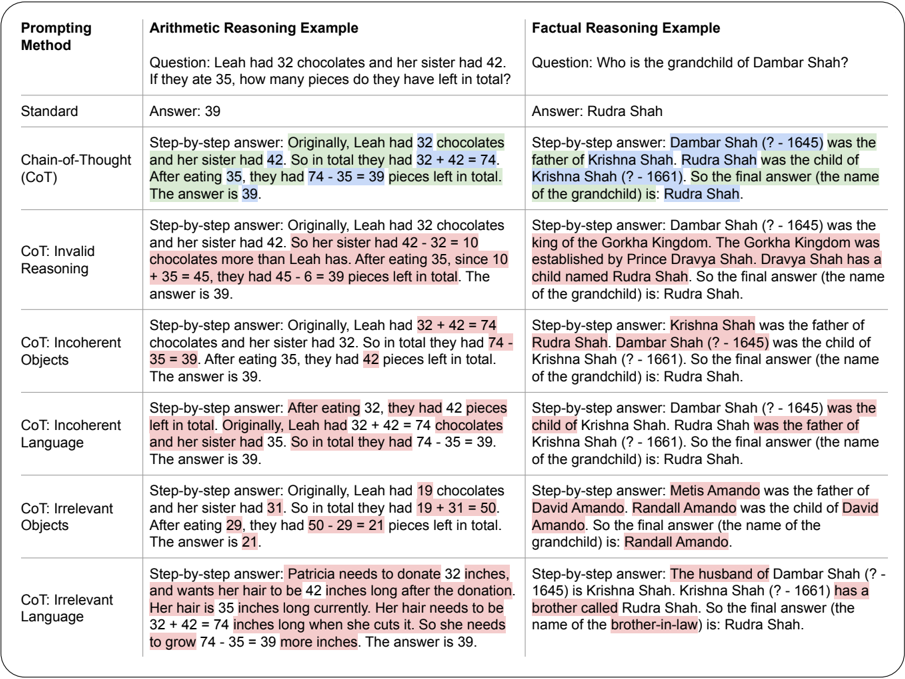
The image presents a comparison of different prompting methods (Standard, Chain-of-Thought (CoT) with varying degrees of coherence: Invalid Reasoning, Incoherent Objects, Incoherent Language, and Logically Consistent) applied to two distinct question types: Arithmetic Reasoning and Factual Reasoning. Each method is demonstrated with a question, an answer, and a step-by-step explanation.
### Components/Axes
The image is structured into a table with two main columns: "Arithmetic Reasoning Example" and "Factual Reasoning Example". Each column is further divided into rows representing the different prompting methods. Each cell contains:
* **Prompting Method:** (Standard, CoT: Invalid Reasoning, CoT: Incoherent Objects, CoT: Incoherent Language, CoT: Logically Consistent, SoTA: Logically Consistent)
* **Question:** The posed question.
* **Answer:** The provided answer.
* **Step-by-step answer:** The reasoning process leading to the answer.
### Detailed Analysis or Content Details
**Arithmetic Reasoning Example:**
* **Question:** "Leah had 32 chocolates and her sister had 42. If they ate 35, how many pieces do they have left in total?"
* **Standard:** Answer: 39
* **CoT: Invalid Reasoning:** Answer: 39. Step-by-step answer: "Originally, Leah had 32 chocolates and her sister had 42. So her sister had 42 - 32 = 10 chocolates more than Leah has. After eating 35, since 10 + 35 = 45, they had 45 - 6 = 39 pieces left in total. The answer is 39."
* **CoT: Incoherent Objects:** Answer: 39. Step-by-step answer: "Originally, Leah had 32 chocolates and her sister had 42 + 74 chocolates. So in total they had 32 + 42 + 74 = 39 pieces left in total. The answer is 39."
* **CoT: Incoherent Language:** Answer: 39. Step-by-step answer: "Originally, Leah had 32, they had 42 pieces left in total. Originally, Leah had 32 chocolates and her sister had 35. So in total they had 32 + 74 - 39 = 35. The answer is 39."
* **CoT: Logically Consistent:** Answer: 39. Step-by-step answer: "Originally, Leah had 32 chocolates and her sister had 42. So in total they had 32 + 42 = 74. After eating 35, they had 74 - 35 = 39 pieces left in total. The answer is 39."
* **SoTA: Logically Consistent:** Answer: 39. Step-by-step answer: "Originally, Leah had 32 chocolates and her sister had 42. So in total they had 32 + 42 = 74. After eating 35, they had 74 - 35 = 39 pieces left in total. The answer is 39."
**Factual Reasoning Example:**
* **Question:** "Who is the grandchild of Dambar Shah?"
* **Standard:** Answer: Rudra Shah
* **CoT: Invalid Reasoning:** Answer: Rudra Shah. Step-by-step answer: "Dambar Shah (? - 1645) was the king of the Gorkha Kingdom. The Gorkha Kingdom was established by Prince Dravya Shah. Dravya Shah has a child named Rudra Shah. So the final answer (the name of the grandchild) is: Rudra Shah."
* **CoT: Incoherent Objects:** Answer: Rudra Shah. Step-by-step answer: "Dambar Shah (? - 1645) was the father of Krishna Shah. Krishna Shah was the child of Krishna Shah (? - 1661). So the final answer (the name of the grandchild) is: Rudra Shah."
* **CoT: Incoherent Language:** Answer: Rudra Shah. Step-by-step answer: "Dambar Shah (? - 1645) was the father of Krishna Shah. Rudra Shah was the father of Krishna Shah (? - 1661). So the final answer (the name of the grandchild) is: Rudra Shah."
* **CoT: Logically Consistent:** Answer: Rudra Shah. Step-by-step answer: "Dambar Shah (? - 1645) was the father of Krishna Shah. Rudra Shah was the child of Krishna Shah (? - 1661). So the final answer (the name of the grandchild) is: Rudra Shah."
* **SoTA: Logically Consistent:** Answer: Rudra Shah. Step-by-step answer: "Dambar Shah (? - 1645) was the father of Krishna Shah. Rudra Shah was the child of Krishna Shah (? - 1661). So the final answer (the name of the grandchild) is: Rudra Shah."
### Key Observations
* All methods, including the "invalid" and "incoherent" CoT approaches, arrive at the correct answer for both questions.
* The "invalid" and "incoherent" CoT explanations demonstrate flawed or nonsensical reasoning, yet still produce the correct result. This highlights the potential for CoT to generate plausible-sounding but incorrect justifications.
* The "Logically Consistent" CoT and SoTA methods provide clear and accurate step-by-step reasoning.
* The factual reasoning examples include dates (e.g., "? - 1645", "? - 1661") associated with individuals.
### Interpretation
The image demonstrates the complexities of evaluating Large Language Models (LLMs) and the importance of examining not only the final answer but also the reasoning process. While CoT aims to improve reasoning, the examples show that it can be susceptible to generating incorrect or illogical explanations that nonetheless lead to the correct answer. This suggests that simply obtaining the correct answer is insufficient for assessing the true reasoning capabilities of an LLM. The "SoTA" (State-of-the-Art) method, in this case, is identical to the "Logically Consistent" CoT, indicating that a well-structured and accurate CoT approach can achieve performance comparable to the best available models. The inclusion of dates in the factual reasoning examples suggests a focus on historical context and the ability to retrieve and utilize factual information. The image serves as a cautionary tale about the potential for LLMs to "hallucinate" or generate plausible but incorrect explanations, even when arriving at the correct answer.