\n
## Heatmap: Classification Accuracies
### Overview
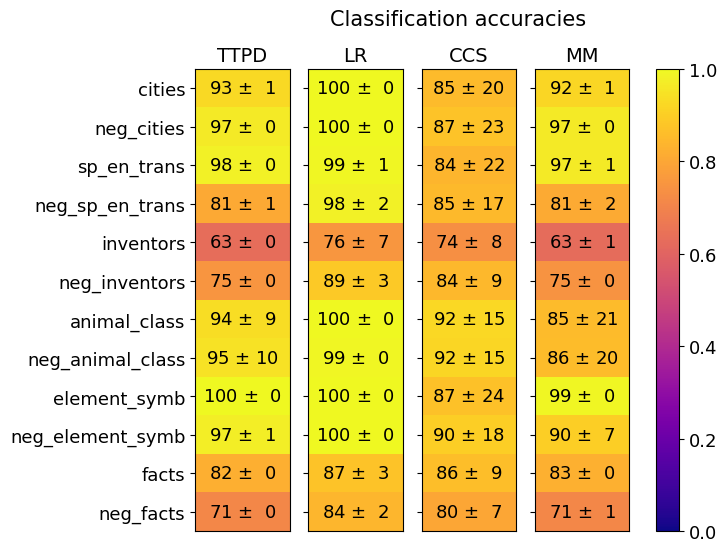
The image is a heatmap titled "Classification accuracies" that visualizes the performance (accuracy with standard deviation) of four different methods or models (TTPD, LR, CCS, MM) across twelve distinct classification tasks or datasets. The tasks include both positive and negative variants (prefixed with "neg_") of categories like cities, translations, inventors, animal classes, element symbols, and facts. Performance is encoded by color, with a scale from 0.0 (dark purple) to 1.0 (bright yellow).
### Components/Axes
* **Title:** "Classification accuracies" (top center).
* **Column Headers (Methods/Models):** TTPD, LR, CCS, MM (top row, left to right).
* **Row Labels (Tasks/Datasets):** Listed vertically on the left side. From top to bottom:
1. `cities`
2. `neg_cities`
3. `sp_en_trans`
4. `neg_sp_en_trans`
5. `inventors`
6. `neg_inventors`
7. `animal_class`
8. `neg_animal_class`
9. `element_symb`
10. `neg_element_symb`
11. `facts`
12. `neg_facts`
* **Color Scale/Legend:** A vertical bar on the far right. It maps color to accuracy value, ranging from **0.0** (dark purple at the bottom) to **1.0** (bright yellow at the top). The gradient passes through blue, teal, green, and orange.
* **Data Cells:** A 12-row by 4-column grid. Each cell contains the mean accuracy followed by "±" and the standard deviation (e.g., "93 ± 1"). The cell's background color corresponds to the mean accuracy value on the color scale.
### Detailed Analysis
The following table reconstructs the data presented in the heatmap. Values are `Mean Accuracy ± Standard Deviation`.
| Task / Dataset | TTPD | LR | CCS | MM |
| :--- | :--- | :--- | :--- | :--- |
| **cities** | 93 ± 1 | 100 ± 0 | 85 ± 20 | 92 ± 1 |
| **neg_cities** | 97 ± 0 | 100 ± 0 | 87 ± 23 | 97 ± 0 |
| **sp_en_trans** | 98 ± 0 | 99 ± 1 | 84 ± 22 | 97 ± 1 |
| **neg_sp_en_trans** | 81 ± 1 | 98 ± 2 | 85 ± 17 | 81 ± 2 |
| **inventors** | 63 ± 0 | 76 ± 7 | 74 ± 8 | 63 ± 1 |
| **neg_inventors** | 75 ± 0 | 89 ± 3 | 84 ± 9 | 75 ± 0 |
| **animal_class** | 94 ± 9 | 100 ± 0 | 92 ± 15 | 85 ± 21 |
| **neg_animal_class** | 95 ± 10 | 99 ± 0 | 92 ± 15 | 86 ± 20 |
| **element_symb** | 100 ± 0 | 100 ± 0 | 87 ± 24 | 99 ± 0 |
| **neg_element_symb** | 97 ± 1 | 100 ± 0 | 90 ± 18 | 90 ± 7 |
| **facts** | 82 ± 0 | 87 ± 3 | 86 ± 9 | 83 ± 0 |
| **neg_facts** | 71 ± 0 | 84 ± 2 | 80 ± 7 | 71 ± 1 |
**Visual Trend Verification by Column (Method):**
* **TTPD:** Shows a mix of high (yellow, e.g., `element_symb` at 100) and moderate (orange, e.g., `inventors` at 63) accuracies. Performance on "neg_" tasks is generally similar to or slightly better than their positive counterparts, except for `neg_facts` (71) which is lower than `facts` (82).
* **LR:** Consistently the highest-performing method, with many cells at or near 100% accuracy (bright yellow). Its lowest score is for `inventors` (76). Standard deviations are very low (0-3), indicating high consistency.
* **CCS:** Exhibits the most variability, both in mean accuracy and, notably, in standard deviation. Many cells have high standard deviations (e.g., ±20, ±24), indicated by the text but not visually encoded in the color. Its color profile is more orange/yellow, with no dark purple cells, but it rarely reaches the perfect yellow of LR.
* **MM:** Performance profile is very similar to TTPD, with nearly identical mean scores for most tasks. It shows slightly lower accuracy on `animal_class` (85 vs 94) and `neg_animal_class` (86 vs 95) compared to TTPD, with correspondingly high standard deviations (±21, ±20).
### Key Observations
1. **Task Difficulty:** The `inventors` and `neg_inventors` tasks yield the lowest accuracies across all methods, suggesting they are the most challenging classification problems in this set.
2. **Method Superiority:** The **LR** method demonstrates dominant and stable performance, achieving 99-100% accuracy on 8 out of 12 tasks.
3. **High Variance in CCS:** The **CCS** method is characterized by high uncertainty (large standard deviations) across nearly all tasks, even when its mean accuracy is relatively high.
4. **Symmetry in Positive/Negative Pairs:** For most category pairs (e.g., `cities`/`neg_cities`), the accuracies are very similar within each method. The major exception is the `facts`/`neg_facts` pair, where the negative version is notably harder for TTPD, LR, and MM.
5. **Color-Accuracy Correlation:** The brightest yellow cells (accuracy ~1.0) are concentrated in the **LR** column and the `element_symb` row. The darkest orange/red cells (accuracy ~0.6-0.7) are found in the `inventors` row for TTPD and MM.
### Interpretation
This heatmap provides a comparative benchmark of four classification methods. The data suggests that the **LR** method is not only the most accurate but also the most reliable (low variance) for this specific set of tasks. Its near-perfect performance on tasks like `cities`, `neg_cities`, and `element_symb` indicates these may be "easier" or more linearly separable problems for the model architecture used.
The **CCS** method's high standard deviations are a critical finding. They imply that its performance is highly sensitive to the specific data split or initialization, making it less trustworthy despite sometimes respectable mean accuracy. This could be due to model instability or a smaller effective training set.
The consistent difficulty of the `inventors` task across all methods points to an inherent challenge in the data itself—perhaps the features defining inventors are more ambiguous, the dataset is noisier, or the class is more imbalanced. The general symmetry between positive and negative task pairs suggests the models are learning the core concept (e.g., "city-ness") rather than just memorizing a specific list, with the `facts` pair being a notable outlier that may require further investigation into the nature of the "neg_facts" data.
In summary, the visualization efficiently communicates that method choice (LR being superior) and task nature (inventors being hard) are the primary drivers of performance in this evaluation, while also flagging the high variance of CCS as a potential concern for deployment.