## Line Chart: Pass@k vs k
### Overview
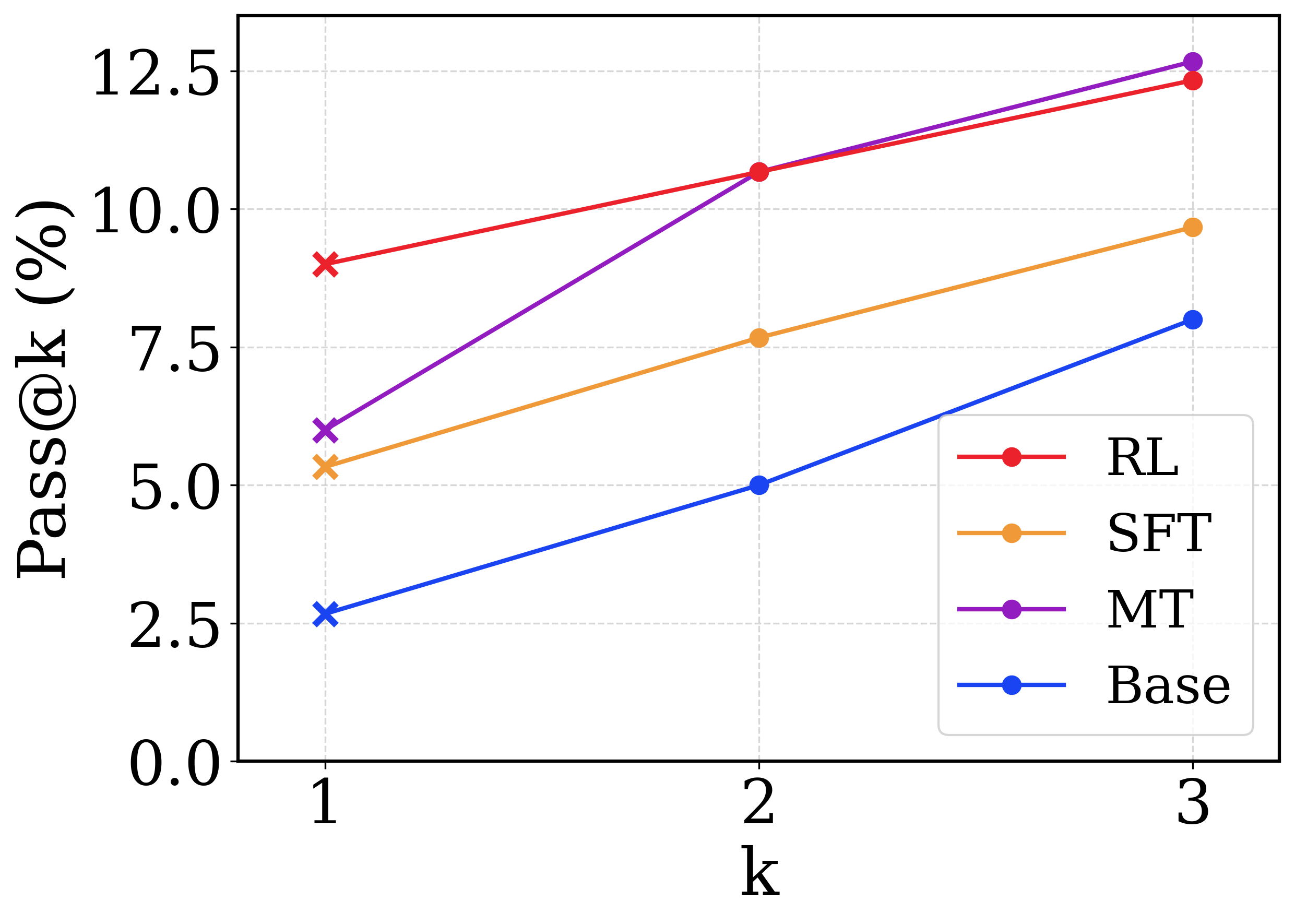
The image is a line chart comparing the performance of four different methods (RL, SFT, MT, and Base) based on the "Pass@k" metric for varying values of 'k' (1, 2, and 3). The chart plots "Pass@k (%)" on the y-axis and 'k' on the x-axis. Each method is represented by a distinct colored line.
### Components/Axes
* **X-axis:** 'k' with values 1, 2, and 3.
* **Y-axis:** "Pass@k (%)" ranging from 0.0 to 12.5, with increments of 2.5.
* **Legend:** Located on the right side of the chart, associating colors with methods:
* Red: RL
* Orange: SFT
* Purple: MT
* Blue: Base
### Detailed Analysis
* **RL (Red):** The red line represents the RL method. It starts at approximately 9% at k=1, increases to about 10.7% at k=2, and reaches approximately 12.3% at k=3.
* **SFT (Orange):** The orange line represents the SFT method. It starts at approximately 5.5% at k=1, increases to about 7.7% at k=2, and reaches approximately 9.8% at k=3.
* **MT (Purple):** The purple line represents the MT method. It starts at approximately 6.2% at k=1, increases to about 9% at k=2, and reaches approximately 12.5% at k=3.
* **Base (Blue):** The blue line represents the Base method. It starts at approximately 2.7% at k=1, increases to about 5.1% at k=2, and reaches approximately 8% at k=3.
### Key Observations
* All methods show an increasing trend in "Pass@k (%)" as 'k' increases.
* The MT method shows the highest increase in "Pass@k (%)" between k=1 and k=3.
* The Base method consistently shows the lowest "Pass@k (%)" values across all 'k' values.
* The RL method starts with a high "Pass@k (%)" at k=1, but its increase is less steep compared to MT.
### Interpretation
The chart suggests that increasing the value of 'k' generally improves the "Pass@k" performance for all tested methods. The MT method appears to benefit the most from increasing 'k', as it shows the steepest increase in "Pass@k (%)". The Base method consistently underperforms compared to the other methods. The RL method, while starting with a relatively high "Pass@k (%)" at k=1, does not increase as much as the MT method as 'k' increases. This indicates that the MT method may be more effective at leveraging higher values of 'k' to improve performance.