## Flow Diagram: Selected Articles by Publication Type and Year
### Overview
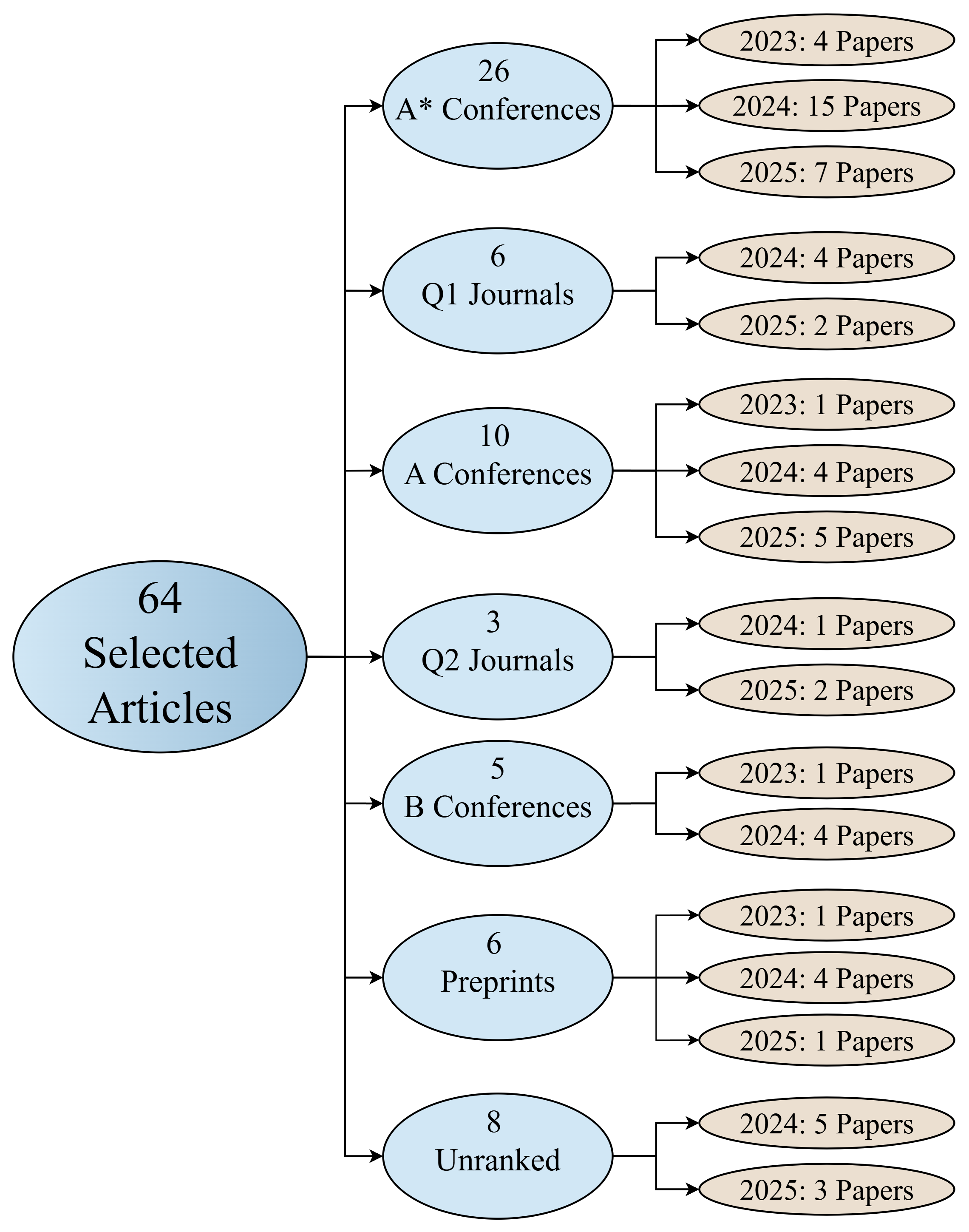
The image is a flow diagram illustrating the distribution of 64 selected articles across different publication types (conferences, journals, preprints, and unranked) and years (2023, 2024, and 2025). The diagram starts with the total number of selected articles and branches out to show the breakdown by publication type, followed by the number of papers published in each year for each type.
### Components/Axes
* **Main Node (Left):** "64 Selected Articles"
* **Publication Types (Middle):**
* 26 A* Conferences
* 6 Q1 Journals
* 10 A Conferences
* 3 Q2 Journals
* 5 B Conferences
* 6 Preprints
* 8 Unranked
* **Years (Right):** 2023, 2024, 2025
* **Data Representation:** The number of articles is explicitly stated within each node.
### Detailed Analysis or ### Content Details
**1. A* Conferences:**
* Total: 26
* 2023: 4 Papers
* 2024: 15 Papers
* 2025: 7 Papers
**2. Q1 Journals:**
* Total: 6
* 2024: 4 Papers
* 2025: 2 Papers
**3. A Conferences:**
* Total: 10
* 2023: 1 Papers
* 2024: 4 Papers
* 2025: 5 Papers
**4. Q2 Journals:**
* Total: 3
* 2024: 1 Papers
* 2025: 2 Papers
**5. B Conferences:**
* Total: 5
* 2023: 1 Papers
* 2024: 4 Papers
**6. Preprints:**
* Total: 6
* 2023: 1 Papers
* 2024: 4 Papers
* 2025: 1 Papers
**7. Unranked:**
* Total: 8
* 2024: 5 Papers
* 2025: 3 Papers
### Key Observations
* A* Conferences account for the largest share of selected articles (26 out of 64).
* 2024 appears to be the most productive year overall, with a high number of papers across multiple publication types.
* Q2 Journals have the fewest selected articles (3).
### Interpretation
The diagram provides a clear overview of the distribution of selected articles across different publication venues and years. The high number of A* conference papers suggests a focus on top-tier conferences. The data also indicates a potential trend or emphasis on publishing in 2024, as it has the highest number of papers across several categories. The relatively low number of Q2 journal articles might indicate a preference for higher-ranked journals or conferences in the selection process. The "Unranked" category suggests that some articles were selected from sources not formally ranked, possibly including newer or less established publications.