\n
## Bar Chart: Preference Proportions for Different Models
### Overview
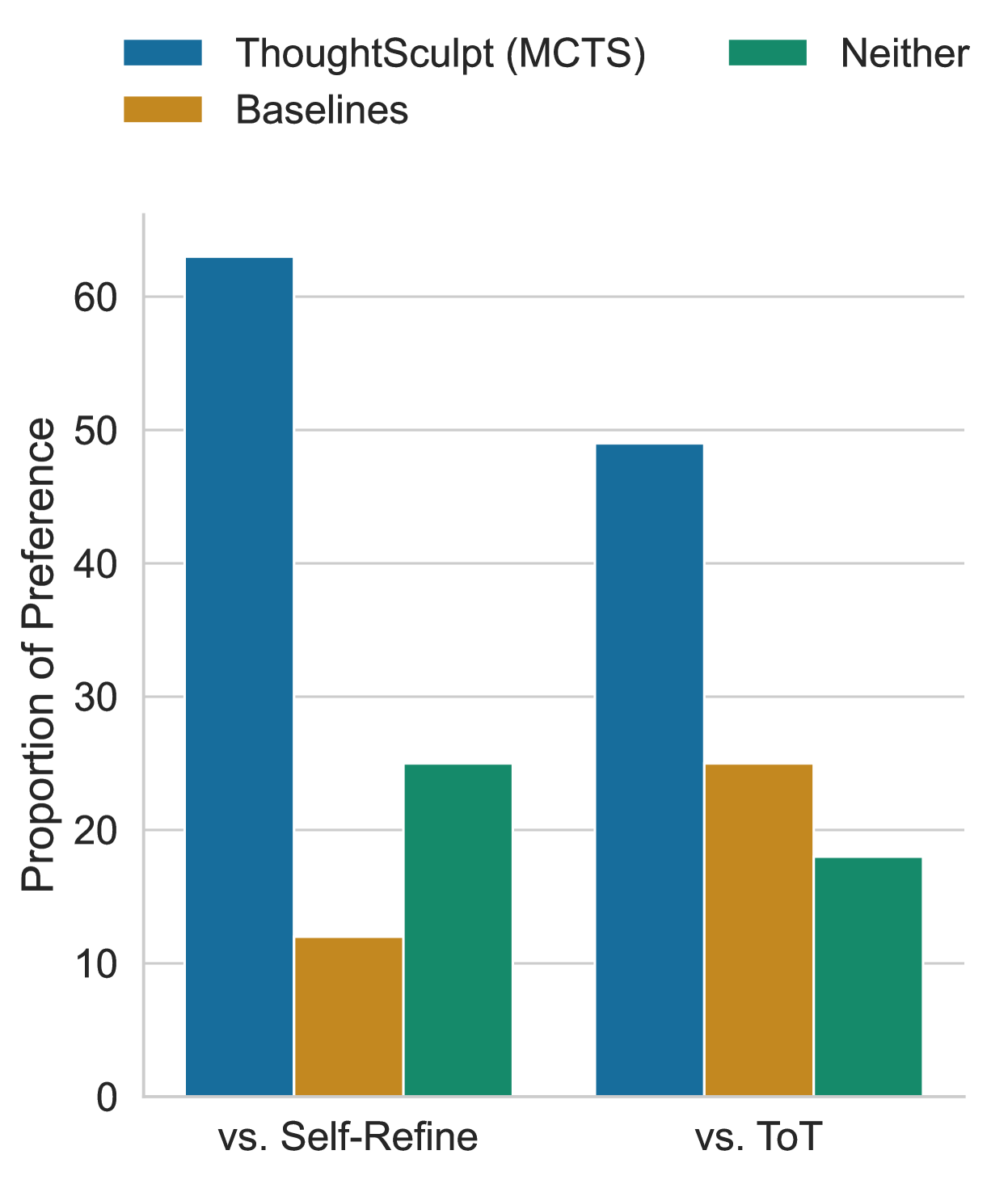
This bar chart compares the proportion of preference for "ThoughtSculpt (MCTS)" and "Baselines" models against "Self-Refine" and "ToT" models. The y-axis represents the "Proportion of Preference" (in percentage), and the x-axis shows the comparison pairs ("vs. Self-Refine" and "vs. ToT"). A third category, "Neither", is also included in the comparison.
### Components/Axes
* **X-axis:** Comparison pairs: "vs. Self-Refine", "vs. ToT"
* **Y-axis:** Proportion of Preference (0% to 65%)
* **Legend:**
* ThoughtSculpt (MCTS) - Blue
* Baselines - Orange
* Neither - Green
### Detailed Analysis
The chart consists of six bars, grouped into two pairs corresponding to the x-axis labels.
**vs. Self-Refine:**
* **ThoughtSculpt (MCTS):** The blue bar slopes upward, reaching approximately 64% preference.
* **Baselines:** The orange bar is absent.
* **Neither:** The green bar reaches approximately 24% preference.
**vs. ToT:**
* **ThoughtSculpt (MCTS):** The blue bar slopes downward, reaching approximately 48% preference.
* **Baselines:** The orange bar reaches approximately 23% preference.
* **Neither:** The green bar reaches approximately 19% preference.
### Key Observations
* ThoughtSculpt (MCTS) is significantly preferred over both Self-Refine and ToT.
* The preference for ThoughtSculpt (MCTS) is much higher when compared to Self-Refine (approximately 64%) than when compared to ToT (approximately 48%).
* The "Neither" category consistently shows a preference around 20-25%.
* Baselines are only compared against ToT, showing a preference of approximately 23%.
### Interpretation
The data suggests that ThoughtSculpt (MCTS) consistently outperforms both Self-Refine and ToT in terms of user preference. The substantial difference in preference when compared to Self-Refine indicates that ThoughtSculpt (MCTS) offers a significant improvement over Self-Refine. The lower preference when compared to ToT suggests that ToT provides a more competitive alternative, but ThoughtSculpt (MCTS) still maintains a clear advantage. The consistent preference for "Neither" suggests that a portion of users do not favor either model, potentially indicating a need for further model development or the inclusion of additional options. The absence of a "Baselines" bar in the "vs. Self-Refine" comparison implies that Baselines were not evaluated against Self-Refine in this study. The data points to ThoughtSculpt (MCTS) as a promising approach, but further investigation is needed to understand the reasons behind the "Neither" preference and to explore potential improvements to the Baselines model.