## Grouped Bar Chart: Preference Proportions for ThoughtSculpt (MCTS) vs. Baselines
### Overview
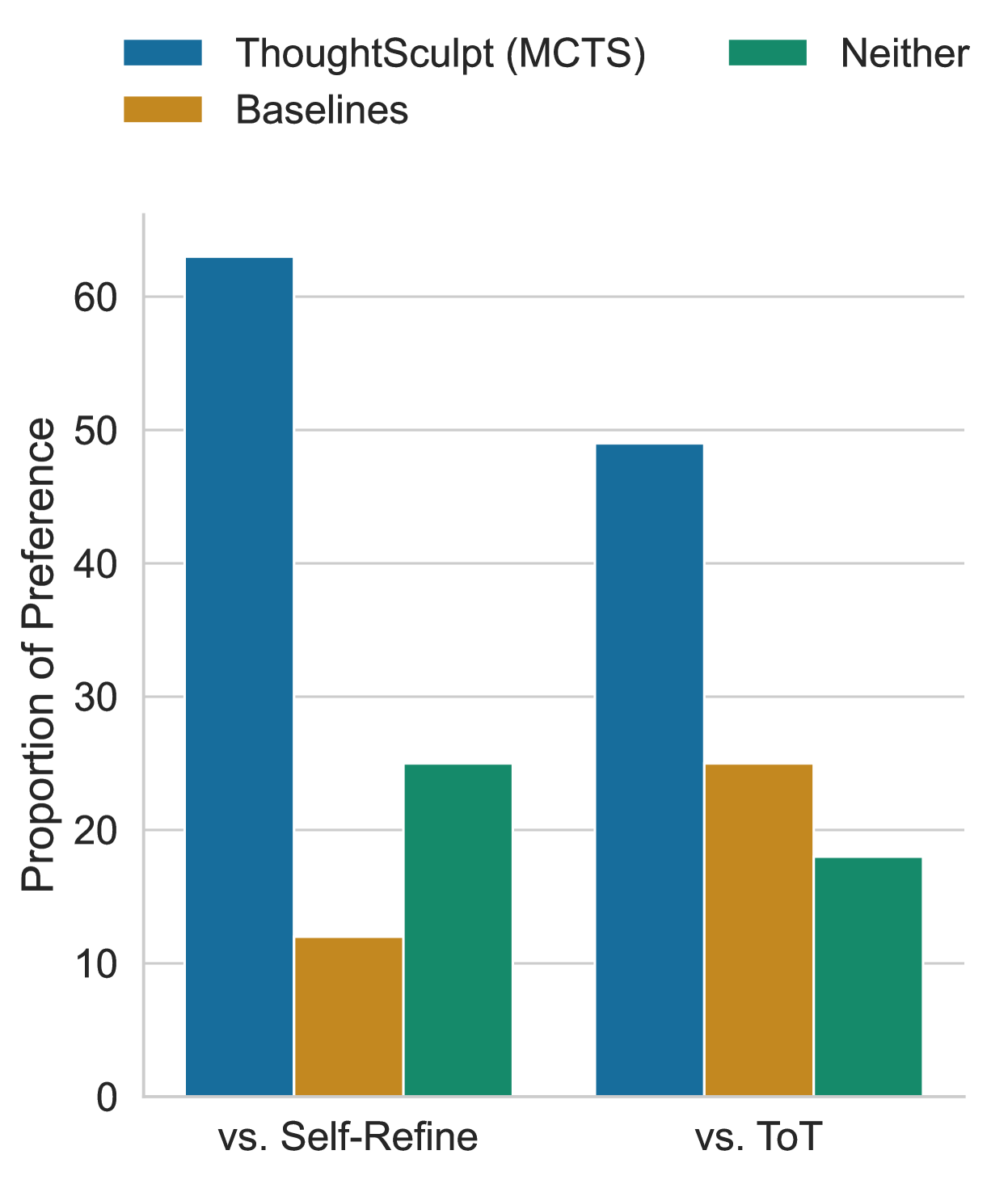
The image is a grouped bar chart comparing the "Proportion of Preference" for three categories across two different comparison scenarios. The chart visually demonstrates user or evaluator preference for a method called "ThoughtSculpt (MCTS)" against two other options: "Baselines" and a neutral "Neither" option. The data is presented in two distinct groups on the x-axis.
### Components/Axes
* **Chart Type:** Grouped vertical bar chart.
* **Y-Axis:**
* **Label:** "Proportion of Preference"
* **Scale:** Linear scale from 0 to 60, with major gridlines at intervals of 10 (0, 10, 20, 30, 40, 50, 60).
* **X-Axis:**
* **Categories (Groups):** Two primary comparison groups.
1. "vs. Self-Refine" (left group)
2. "vs. ToT" (right group)
* **Legend:** Located at the top of the chart, centered horizontally.
* **Blue Square:** "ThoughtSculpt (MCTS)"
* **Gold Square:** "Baselines"
* **Green Square:** "Neither"
* **Data Series:** Three colored bars per x-axis group, corresponding to the legend.
### Detailed Analysis
**Group 1: "vs. Self-Refine" (Left Cluster)**
* **ThoughtSculpt (MCTS) [Blue Bar]:** This is the tallest bar in the entire chart. Its top aligns just above the 60 gridline. **Approximate Value: 63** (±1).
* **Baselines [Gold Bar]:** This is the shortest bar in this group. Its top is slightly above the 10 gridline. **Approximate Value: 12** (±1).
* **Neither [Green Bar]:** This bar's height is midway between the 20 and 30 gridlines. **Approximate Value: 25** (±1).
**Group 2: "vs. ToT" (Right Cluster)**
* **ThoughtSculpt (MCTS) [Blue Bar]:** This bar is shorter than its counterpart in the first group. Its top is just below the 50 gridline. **Approximate Value: 49** (±1).
* **Baselines [Gold Bar]:** This bar is taller than the "Baselines" bar in the first group. Its top aligns exactly with the 25 mark (midway between 20 and 30). **Approximate Value: 25** (±1).
* **Neither [Green Bar]:** This is the shortest bar in this group. Its top is slightly below the 20 gridline. **Approximate Value: 18** (±1).
**Trend Verification:**
* **ThoughtSculpt (MCTS) Trend:** The blue bar shows a clear downward slope from the "vs. Self-Refine" group to the "vs. ToT" group, indicating a decrease in preference proportion when compared to ToT versus when compared to Self-Refine.
* **Baselines Trend:** The gold bar shows a clear upward slope from the "vs. Self-Refine" group to the "vs. ToT" group, indicating an increase in preference proportion when compared to ToT versus when compared to Self-Refine.
* **Neither Trend:** The green bar shows a slight downward slope from the "vs. Self-Refine" group to the "vs. ToT" group.
### Key Observations
1. **Dominant Preference:** "ThoughtSculpt (MCTS)" is the most preferred option in both comparison scenarios, with proportions significantly higher than both "Baselines" and "Neither."
2. **Strongest Lead:** ThoughtSculpt's lead is most pronounced in the "vs. Self-Refine" comparison (63 vs. 12 and 25).
3. **Baseline Performance Shift:** The "Baselines" category performs notably better in the "vs. ToT" comparison (25) than in the "vs. Self-Refine" comparison (12).
4. **Neutral Response:** The "Neither" option captures a moderate proportion of responses in both groups, suggesting a non-trivial number of evaluators found no clear preference.
### Interpretation
This chart presents results from a preference-based evaluation, likely from a human study or an automated judge comparing AI reasoning methods. The data strongly suggests that the **ThoughtSculpt (MCTS)** method is perceived as superior to both the **Self-Refine** baseline and the **ToT (Tree of Thoughts)** baseline.
The significant drop in ThoughtSculpt's preference score from ~63 against Self-Refine to ~49 against ToT indicates that **ToT is a more competitive baseline than Self-Refine**. Conversely, the rise in the "Baselines" score from 12 to 25 when moving from the Self-Refine to the ToT group confirms that evaluators found the ToT baseline more preferable than the Self-Refine baseline.
The "Neither" category's presence (18-25%) is important. It acts as a control, showing that the evaluations were not forced choices and that in a meaningful subset of cases, the methods were either indistinguishable or equally flawed. The slight decrease in "Neither" responses for the ToT comparison might imply that the distinction between ThoughtSculpt and ToT was slightly clearer to evaluators than the distinction between ThoughtSculpt and Self-Refine.
**In summary, the chart communicates that ThoughtSculpt (MCTS) is the preferred method, but its advantage is context-dependent, being more substantial against the Self-Refine baseline than against the stronger ToT baseline.**