## System Diagram: Test Case Generation Workflow
### Overview
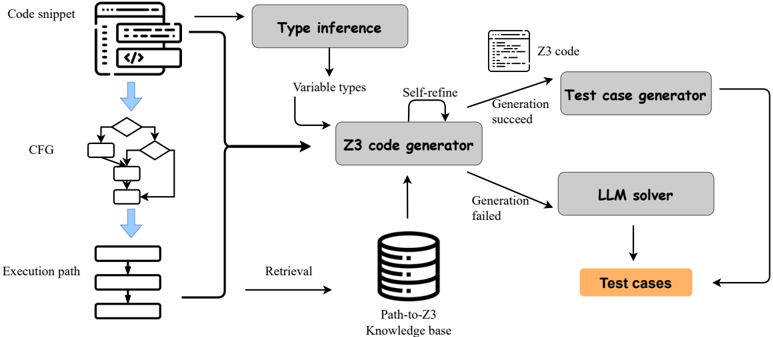
The image is a system diagram illustrating a workflow for test case generation. It depicts the flow of information and processes involved, starting from a code snippet and culminating in the generation of test cases. The diagram includes components like type inference, Z3 code generation, and an LLM solver, showing how they interact to achieve the final output.
### Components/Axes
* **Code snippet:** Represents the input code that needs to be tested.
* **CFG (Control Flow Graph):** A graphical representation of the code's execution paths.
* **Execution path:** The actual sequence of steps executed by the code.
* **Type inference:** A process to determine the data types of variables in the code.
* **Z3 code generator:** A component that generates code for the Z3 theorem prover.
* **Test case generator:** A module responsible for creating test cases based on the generated Z3 code.
* **LLM solver:** A Large Language Model used to solve constraints and generate test cases.
* **Path-to-Z3 Knowledge base:** A database storing information for generating Z3 code.
* **Test cases:** The final output, representing the generated test cases.
### Detailed Analysis or Content Details
1. **Code Snippet to CFG:** The process begins with a "Code snippet" which is then converted into a "CFG" (Control Flow Graph). A downward-pointing blue arrow indicates the flow.
2. **CFG to Execution Path:** The CFG is further processed into an "Execution path," again indicated by a downward-pointing blue arrow.
3. **Code Snippet to Type Inference:** The "Code snippet" also feeds into "Type inference," which determines "Variable types."
4. **Type Inference and CFG to Z3 Code Generator:** Both "Type inference" (specifically "Variable types") and the "CFG" are inputs to the "Z3 code generator."
5. **Z3 Code Generator Self-Refinement:** The "Z3 code generator" has a "Self-refine" loop, indicating an iterative process.
6. **Z3 Code Generator to Test Case Generator:** If "Generation succeed," the "Z3 code generator" feeds into the "Test case generator." The input is labeled "Z3 code".
7. **Test Case Generator to Test Cases:** The "Test case generator" produces "Test cases."
8. **Z3 Code Generator to LLM Solver:** If "Generation failed," the "Z3 code generator" feeds into the "LLM solver."
9. **LLM Solver to Test Cases:** The "LLM solver" also produces "Test cases."
10. **Path-to-Z3 Knowledge Base to Z3 Code Generator:** The "Path-to-Z3 Knowledge base" provides input to the "Z3 code generator" via "Retrieval."
11. **Test Case Generator to Test Case:** The "Test case generator" output loops back to the "Test cases" box.
### Key Observations
* The diagram illustrates a multi-faceted approach to test case generation, utilizing both Z3 code generation and an LLM solver.
* The Z3 code generator has a self-refinement loop, suggesting an iterative process to improve code generation.
* The system uses a knowledge base to aid in Z3 code generation.
* The LLM solver is used when Z3 code generation fails, providing an alternative approach.
### Interpretation
The diagram outlines a sophisticated system for automated test case generation. It leverages static analysis (CFG, Type Inference), symbolic execution (Z3 code generator), and machine learning (LLM solver) to create test cases. The system attempts to generate test cases using the Z3 code generator first. If this fails, it falls back to an LLM solver, indicating a robustness strategy. The Path-to-Z3 Knowledge base suggests that the system learns from previous attempts to improve future test case generation. The self-refinement loop in the Z3 code generator indicates an optimization process to enhance the quality of the generated code.