\n
## Diagram: Z3 Code Generation and Testing Pipeline
### Overview
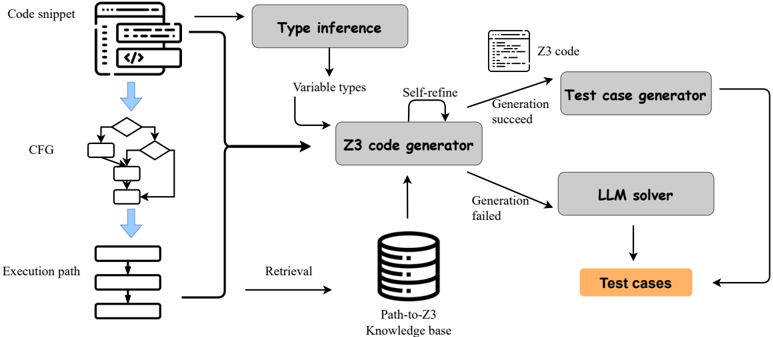
This diagram illustrates a pipeline for generating Z3 code from a code snippet, inferring variable types, and generating test cases using an LLM solver. The process involves several stages, including type inference, Z3 code generation, and test case generation, with feedback loops for refinement and failure handling.
### Components/Axes
The diagram consists of several rectangular blocks representing different components or stages in the pipeline. Arrows indicate the flow of data or control between these components. Key components include:
* **Code snippet:** Input to the pipeline, represented by a block with a code icon.
* **Type inference:** A block that infers variable types from the code snippet.
* **Variable types:** Output of the type inference stage, feeding into the Z3 code generator.
* **Z3 code generator:** The central component, responsible for generating Z3 code.
* **Z3 code:** Output of the Z3 code generator.
* **Test case generator:** Generates test cases from the Z3 code.
* **LLM solver:** Solves the Z3 code to generate test cases.
* **Test cases:** The final output of the pipeline.
* **CFG:** Control Flow Graph, generated from the code snippet.
* **Execution path:** Represents the execution path of the code.
* **Path-to-Z3 Knowledge base:** A database used for retrieval by the Z3 code generator.
The diagram also includes labels indicating the flow of control:
* "Self-refine" (from Variable types to Z3 code generator)
* "Generation succeed" (from Z3 code generator to Test case generator)
* "Generation failed" (from Z3 code generator to LLM solver)
* "Retrieval" (from Path-to-Z3 Knowledge base to Z3 code generator)
### Detailed Analysis or Content Details
The pipeline begins with a "Code snippet" which is processed to generate a "CFG" (Control Flow Graph) and an "Execution path". The "Code snippet" also feeds into a "Type inference" block, which outputs "Variable types". These "Variable types" are then fed into the "Z3 code generator" along with a "Retrieval" signal from the "Path-to-Z3 Knowledge base".
The "Z3 code generator" produces "Z3 code". If the "Generation succeed" signal is triggered, the "Z3 code" is passed to the "Test case generator". The "Test case generator" then uses an "LLM solver" to produce "Test cases".
If the "Generation failed" signal is triggered, the "Z3 code generator" sends the "Z3 code" to the "LLM solver" directly, which then generates "Test cases". The "Z3 code generator" also receives a "Self-refine" signal from the "Variable types", indicating a feedback loop for improving the Z3 code generation process.
### Key Observations
The diagram highlights a closed-loop system where the Z3 code generation process can be refined based on variable types. It also shows two paths for generating test cases: one through the test case generator and another directly through the LLM solver when Z3 code generation fails. The inclusion of a knowledge base suggests that the Z3 code generation process leverages existing knowledge to improve its accuracy and efficiency.
### Interpretation
This diagram represents a sophisticated approach to automated testing. By leveraging Z3 code generation and an LLM solver, the pipeline aims to automatically generate test cases from code snippets. The feedback loop and failure handling mechanisms suggest a robust system that can adapt to different code structures and complexities. The use of a knowledge base indicates an attempt to improve the quality of the generated Z3 code by leveraging existing knowledge about program behavior. The diagram suggests a system designed for formal verification or automated bug finding, where the generated test cases are intended to thoroughly exercise the code and identify potential errors. The two paths to test case generation suggest a fallback mechanism to ensure test cases are always generated, even if the primary Z3 code generation process fails. This is a system that attempts to automate the process of creating formal tests.