## Flowchart: Automated Test Case Generation System
### Overview
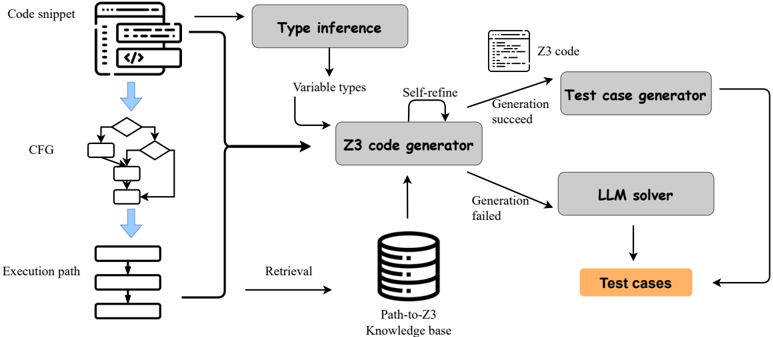
The diagram illustrates a multi-stage automated system for generating test cases from code snippets. It integrates type inference, symbolic execution (Z3), and large language model (LLM) components in a feedback loop. The process begins with a code snippet and execution path, progressing through type analysis, code generation, and iterative refinement until valid test cases are produced.
### Components/Axes
1. **Input/Output Elements**:
- **Code Snippet**: Starting point (top-left)
- **Test Cases**: Final output (bottom-right, orange box)
- **Path-to-Z3 Knowledge Base**: Central knowledge repository (bottom-center)
2. **Process Components**:
- **CFG (Control Flow Graph)**: Represents code structure (left-center)
- **Execution Path**: Derived from CFG (below CFG)
- **Type Inference**: Analyzes variable types (top-center)
- **Z3 Code Generator**: Symbolic execution engine (center)
- **Test Case Generator**: Creates test inputs (right-center)
- **LLM Solver**: Handles generation failures (bottom-right)
3. **Flow Arrows**:
- Blue arrows: Data flow between components
- Black arrows: Control flow/decision paths
- Dashed arrows: Self-refinement loops
### Detailed Analysis
1. **Code Processing Path**:
- Code snippet → CFG → Execution Path
- Execution Path → Type Inference → Variable Types
- Variable Types → Z3 Code Generator
2. **Z3 Code Generator Logic**:
- Success Path: Z3 Code → Test Case Generator
- Failure Path: Z3 Code → LLM Solver
- Both paths feed into Path-to-Z3 Knowledge Base
3. **Feedback Mechanisms**:
- Test Case Generator → Self-refine (Z3 Code Generator)
- Test Cases → Test Case Generator (loop)
- LLM Solver → Test Cases (loop)
### Key Observations
1. **Iterative Refinement**: The system employs two feedback loops:
- Self-refinement of Z3 code generation
- Test case validation and regeneration
2. **Failure Handling**: LLM Solver acts as a fallback when Z3 code generation fails, suggesting hybrid symbolic/statistical approaches.
3. **Knowledge Accumulation**: Path-to-Z3 Knowledge Base serves as persistent memory for learned execution paths.
### Interpretation
This system demonstrates a sophisticated approach to test case generation that combines:
1. **Static Analysis** (CFG/Execution Path)
2. **Formal Verification** (Z3 type inference)
3. **Machine Learning** (LLM fallback)
4. **Knowledge Engineering** (Path repository)
The architecture suggests an emphasis on:
- **Reliability**: Through formal verification (Z3)
- **Adaptability**: Via LLM fallback for edge cases
- **Efficiency**: Through knowledge reuse from Path-to-Z3
- **Completeness**: By combining multiple verification paradigms
The orange test case output indicates this is the primary success metric, while the gray components represent intermediate processing stages. The lack of quantitative metrics suggests this is a conceptual architecture rather than performance data.