## Line Chart: R1-Qwen | GPQA-D Accuracy vs. Ratio
### Overview
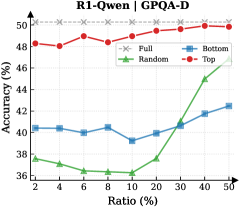
This line chart displays the accuracy of different strategies (Full, Random, Bottom, Top) for a model (R1-Qwen) on a dataset (GPQA-D) as a function of the ratio, presumably of training data or a similar parameter. The chart shows how accuracy changes as the ratio increases from 2% to 50%.
### Components/Axes
* **Title:** R1-Qwen | GPQA-D
* **X-axis:** Ratio (%) - Scale ranges from 2 to 50, with markers at 2, 4, 6, 8, 10, 20, 30, 40, and 50.
* **Y-axis:** Accuracy (%) - Scale ranges from 36 to 50, with markers at 36, 38, 40, 42, 44, 46, 48, and 50.
* **Legend:** Located in the top-center of the chart.
* Full (Grey 'x' markers)
* Random (Green triangle markers)
* Bottom (Blue square markers)
* Top (Red circle markers)
### Detailed Analysis
* **Full (Grey):** The line representing "Full" is nearly horizontal, indicating a relatively constant accuracy across all ratios. It starts at approximately 48.2% at a ratio of 2% and increases slightly to approximately 50.2% at a ratio of 50%.
* **Random (Green):** The "Random" line shows a decreasing trend from 2% to 6% ratio, then a sharp increase from 20% to 40% ratio.
* At 2% Ratio: Approximately 38.5% accuracy.
* At 4% Ratio: Approximately 37.5% accuracy.
* At 6% Ratio: Approximately 36.5% accuracy.
* At 8% Ratio: Approximately 36.5% accuracy.
* At 10% Ratio: Approximately 37% accuracy.
* At 20% Ratio: Approximately 38.5% accuracy.
* At 30% Ratio: Approximately 42% accuracy.
* At 40% Ratio: Approximately 45.5% accuracy.
* At 50% Ratio: Approximately 46.5% accuracy.
* **Bottom (Blue):** The "Bottom" line fluctuates with a slight upward trend.
* At 2% Ratio: Approximately 40.5% accuracy.
* At 4% Ratio: Approximately 40.5% accuracy.
* At 6% Ratio: Approximately 41% accuracy.
* At 8% Ratio: Approximately 40% accuracy.
* At 10% Ratio: Approximately 39.5% accuracy.
* At 20% Ratio: Approximately 40% accuracy.
* At 30% Ratio: Approximately 41% accuracy.
* At 40% Ratio: Approximately 42% accuracy.
* At 50% Ratio: Approximately 42.5% accuracy.
* **Top (Red):** The "Top" line shows a slight increase, then a decrease, and then a slight increase again.
* At 2% Ratio: Approximately 48% accuracy.
* At 4% Ratio: Approximately 48.5% accuracy.
* At 6% Ratio: Approximately 49% accuracy.
* At 8% Ratio: Approximately 48.5% accuracy.
* At 10% Ratio: Approximately 48.5% accuracy.
* At 20% Ratio: Approximately 49% accuracy.
* At 30% Ratio: Approximately 49.5% accuracy.
* At 40% Ratio: Approximately 49% accuracy.
* At 50% Ratio: Approximately 49.5% accuracy.
### Key Observations
* The "Full" strategy maintains a consistently high accuracy, significantly higher than the other strategies at lower ratios.
* The "Random" strategy performs poorly at low ratios but shows a substantial improvement as the ratio increases, suggesting it benefits from more data.
* The "Bottom" strategy exhibits moderate and relatively stable accuracy.
* The "Top" strategy shows a slight initial increase in accuracy, followed by a dip, and then a slight recovery.
### Interpretation
The data suggests that the "Full" strategy is the most robust and reliable, providing consistently high accuracy regardless of the ratio. The "Random" strategy, while initially less accurate, demonstrates the potential to improve with increased data. This could indicate that the random selection process benefits from a larger sample size. The "Bottom" and "Top" strategies offer moderate performance, potentially representing the impact of selecting data from specific portions of the dataset. The differences in performance between these strategies highlight the importance of data selection and the potential benefits of utilizing the entire dataset ("Full" strategy) for optimal accuracy. The ratio likely represents the proportion of the dataset used for training, and the results suggest that increasing the training data generally improves performance, particularly for the "Random" strategy. The "Full" strategy's consistent performance suggests it is less sensitive to the amount of training data used.