## Bar Chart: Attack Types vs. RtA
### Overview
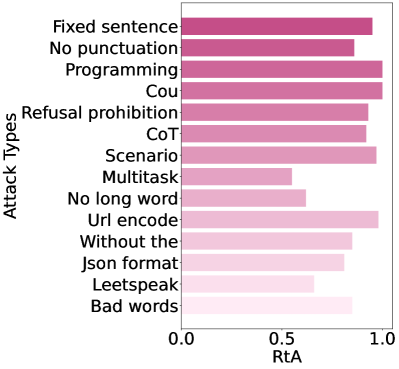
This image is a horizontal bar chart displaying the "RtA" (likely representing "Rate of Attack" success or "Response to Attack" efficacy) across 14 distinct "Attack Types." The chart uses a color gradient that transitions from dark pink at the top to light pink at the bottom, which appears to be a stylistic choice rather than a data-driven heatmap.
### Components/Axes
* **Y-Axis (Left):** Labeled "Attack Types." It lists 14 categorical attack methods.
* **X-Axis (Bottom):** Labeled "RtA." The scale ranges from 0.0 to 1.0, representing a normalized value (likely a percentage or probability).
* **Data Series:** 14 horizontal bars, each corresponding to an attack type.
* **Visual Gradient:** The bars are colored with a vertical gradient, where the top bars are a deep magenta/pink and the bottom bars are a very pale, almost white-pink.
### Detailed Analysis
The following values are estimated based on the X-axis scale (0.0 to 1.0). Uncertainty is approximately ±0.02.
| Attack Type | Estimated RtA Value |
| :--- | :--- |
| **Fixed sentence** | ~0.95 |
| **No punctuation** | ~0.85 |
| **Programming** | ~1.00 |
| **Cou** (Likely truncated) | ~1.00 |
| **Refusal prohibition** | ~0.93 |
| **CoT** | ~0.92 |
| **Scenario** | ~0.97 |
| **Multitask** | ~0.55 |
| **No long word** | ~0.62 |
| **Url encode** | ~0.98 |
| **Without the** (Likely truncated) | ~0.85 |
| **Json format** | ~0.80 |
| **Leetspeak** | ~0.65 |
| **Bad words** | ~0.85 |
### Key Observations
* **High Efficacy Attacks:** "Programming," "Cou," and "Url encode" show the highest RtA values, approaching or reaching 1.0. This suggests these methods are highly effective at bypassing whatever defense mechanism is being tested.
* **Low Efficacy Attacks:** "Multitask" (~0.55) and "No long word" (~0.62) are the least effective attack types in this dataset.
* **Gradient Disconnect:** The color gradient is purely positional (top-to-bottom) and does not correlate with the RtA values. For example, "Programming" (top, dark pink) has a high value, but "Bad words" (bottom, light pink) also has a relatively high value (~0.85), while "Multitask" (middle, medium pink) has a low value.
* **Truncated Labels:** The labels "Cou" and "Without the" appear to be truncated, suggesting they are abbreviations or cut-off phrases from a larger dataset.
### Interpretation
This chart appears to be an evaluation of adversarial robustness for a Large Language Model (LLM) or similar AI system. "RtA" likely stands for "Rate of Attack" success, measuring how often the model fails to refuse a prompt when subjected to specific adversarial techniques.
* **Vulnerability Profile:** The model shows high susceptibility (RtA > 0.8) to the majority of the listed attack types. This indicates that the model's safety alignment is easily bypassed by various formatting and structural constraints (e.g., "Programming," "Url encode," "Scenario").
* **Structural vs. Semantic Attacks:** The data suggests that structural attacks (like "Programming," "Url encode," "Json format") are generally more effective than semantic or constraint-based attacks (like "Multitask" or "No long word"). This implies the model's safety filters are more easily distracted or overridden by specific input formats than by complex task instructions.
* **Peircean Investigative Note:** The presence of "Cou" and "Without the" as truncated labels suggests this chart was generated from a programmatic pipeline where the labels were not fully sanitized or formatted for display. The high success rate of "Programming" and "Url encode" suggests that the model may have been trained on code-heavy datasets, making it more compliant with code-like or encoded inputs, which adversarial actors exploit to bypass safety guardrails.